

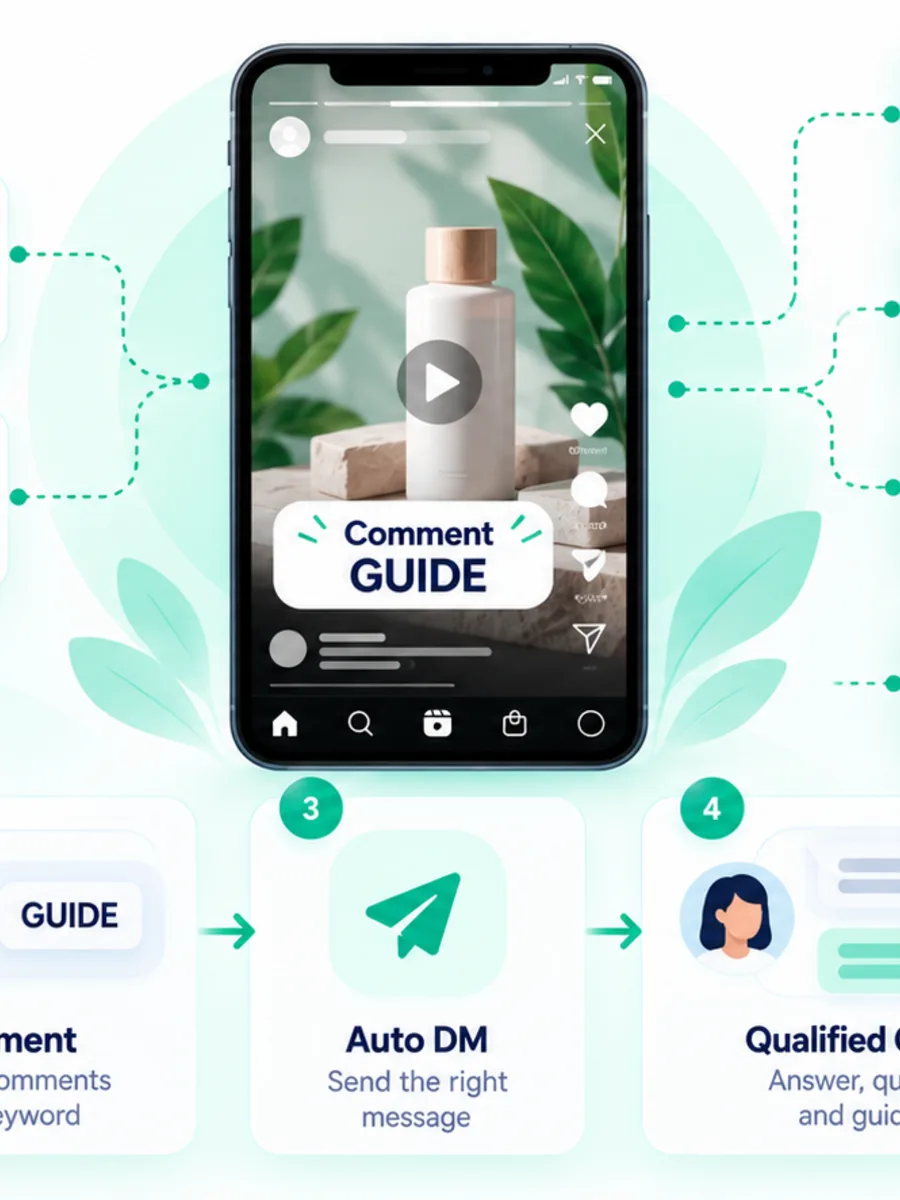
Instagram Reels comment automation turns a viewer's comment on a Reel into a structured conversation. The basic pattern is simple: publish a Reel with a clear CTA such as —Comment GUIDE—, detect the eligible comment through a supported Meta integration, send the appropriate private response, and continue the conversation only within the permissions and messaging rules that apply.
For creators, agencies and DTC brands, the important opportunity is not simply sending a link faster. A Reel can create discovery, the comment can signal intent, the DM can answer the immediate request, and a qualified conversation can then move toward a product, support or WhatsApp journey. The automation should remain permission-based and should never become an excuse for unsolicited cold DMs to followers.
Direct answer: Instagram Reels comment automation works by connecting an eligible Instagram professional account to a Meta-supported messaging workflow, detecting configured Reel comment conditions such as a keyword, and starting an appropriate private conversation. The strongest setup combines a clear comment CTA, a useful first DM, consent-aware follow-up, human handoff and measurable downstream outcomes. For ecommerce, the journey can optionally continue into WhatsApp or a broader team inbox when that is the customer's preferred next step.

Why Reels Beat Feed Posts for Comment-to-DM Lead Capture
Reels are built around discovery. A viewer may encounter a Reel without already following the account, watch the content, recognise a problem or product need, and then decide to comment. That makes the Reel particularly useful as the awareness and intent-capture layer of a conversational funnel.
A conventional post can also generate comments, but a Reels-first workflow has a distinct content-to-conversation path: the short-form video demonstrates an idea, product or result; the CTA asks for a specific comment; and the comment becomes a signal that the viewer wants something related to the content.
For example, a Shopify brand selling skincare could publish a Reel explaining a three-step routine and ask viewers to comment ROUTINE for the product list. A creator could ask for GUIDE to receive a checklist. A service business could ask for BOOK to begin a consultation conversation.
The goal is not to make every viewer enter automation. The goal is to give interested viewers a clear, voluntary next action. This distinction matters because reach and engagement are not the same as permission for unrelated marketing.
Reels also provide a useful content-testing loop. If several Reels discuss different customer problems, each can use a different keyword. The resulting conversations can reveal which topics produce questions, qualified enquiries or downstream actions.
Reels-first does not mean Reels-only
A mature Instagram strategy can combine Reels, feed posts, Stories and incoming DMs. The trigger should match the surface where the customer is already expressing intent. A Reel comment is particularly useful when the content itself naturally leads to a resource, product explanation or next step.
How Reels Comment Automation Works on Meta—s Messaging Rules
The technical workflow begins with an eligible Instagram professional account and a supported Meta integration. Meta's Instagram platform documentation describes APIs for professional accounts and messaging capabilities that allow approved applications to work with Instagram conversations. Before building a campaign, verify the current permissions and capabilities in Meta's official documentation rather than relying on an old automation tutorial.
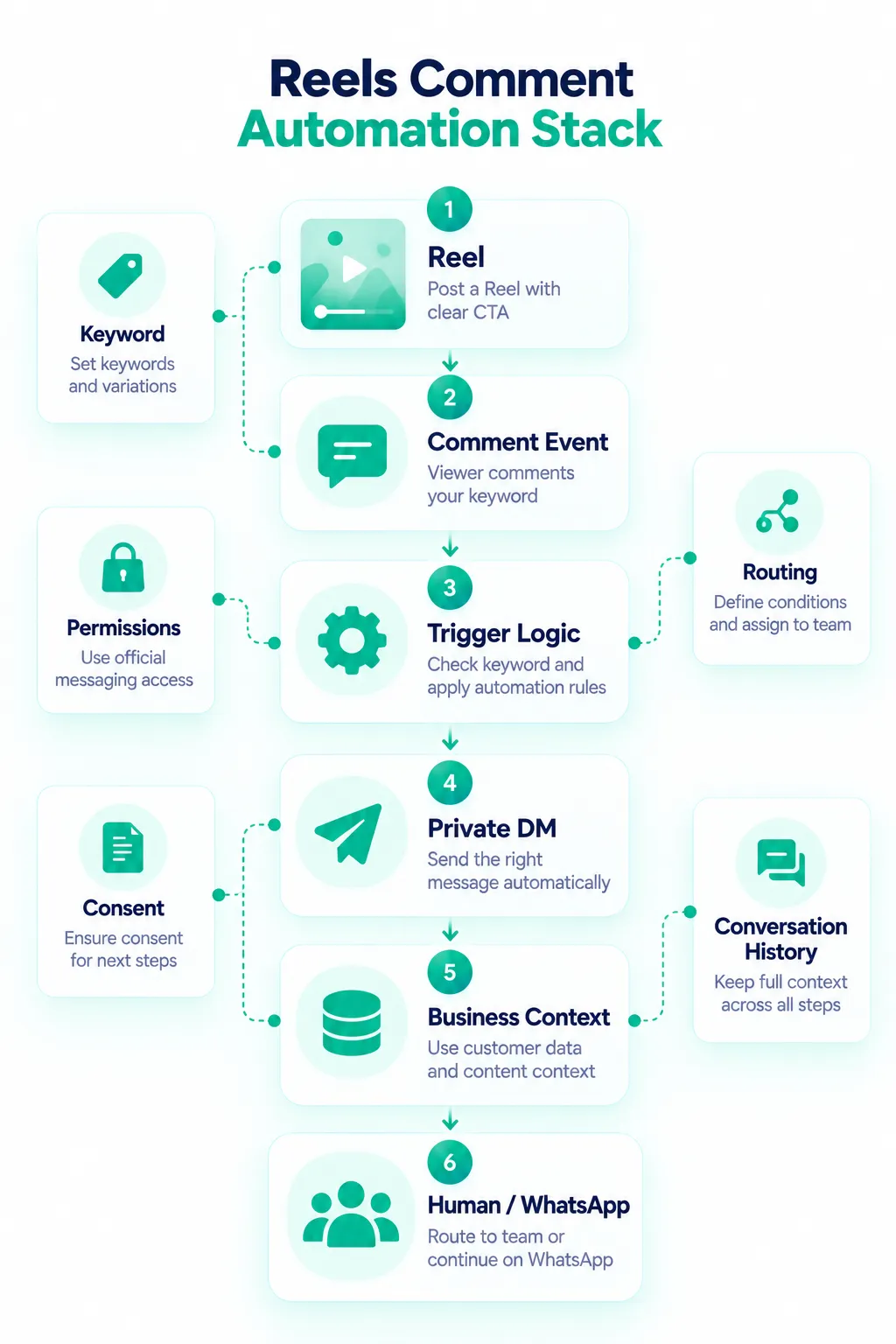
A practical architecture looks like this:
- Reel: the content presents a problem, offer, education point or product.
- Comment CTA: the viewer is invited to comment a specific word or phrase.
- Comment event: the connected system receives the eligible event.
- Trigger logic: the automation checks the configured Reel and comment condition.
- Private response: the workflow sends the relevant DM where supported.
- Conversation: the customer receives the promised resource or next step.
- Handoff: a person or another channel takes over when the conversation needs more context.
Meta capabilities, permissions and messaging behaviour can change. Do not invent or assume a universal rate limit, quota or guaranteed delivery window. Instead, check the current official Meta documentation for the account and API configuration being used.
For current platform references, use Meta's official Instagram API documentation and the relevant Instagram messaging documentation.
Keyword Strategy for Reels Captions (What to Ask Viewers to Comment)
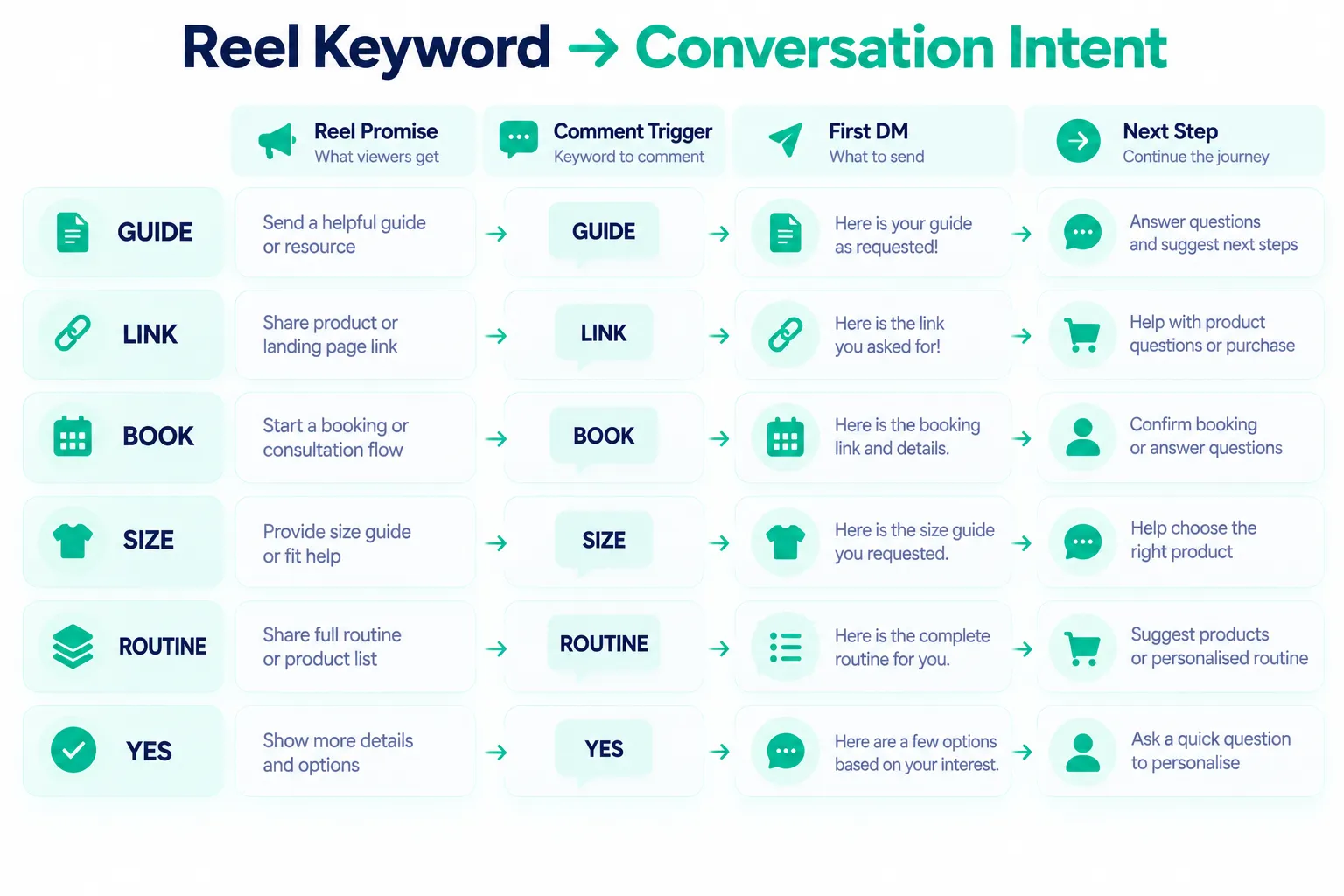
The best keyword is easy to remember, closely related to the Reel and unambiguous enough for the automation to recognise.
| Reel intent | Example CTA | Useful trigger | First DM purpose |
|---|---|---|---|
| Educational resource | Comment GUIDE | GUIDE | Deliver the promised guide |
| Product discovery | Comment LINK | LINK | Share the relevant product destination |
| Product selection | Comment SIZE | SIZE | Provide size information |
| Consultation | Comment BOOK | BOOK | Start the booking path |
| Interest signal | Comment YES | YES | Ask one relevant qualifying question |
Short words are easier to communicate in a Reel caption and easier for a viewer to type. Avoid requiring a complicated phrase when a single contextual keyword will do.
Also avoid ambiguous words that naturally appear in unrelated comments. If a Reel discusses —style— and the trigger is STYLE, ordinary discussion could accidentally match the automation. A more specific trigger such as GUIDE, FIT or ROUTINE may create a cleaner intent signal depending on the content.
Match the keyword to the promise
If the CTA says —Comment GUIDE—, the first DM should provide the guide or explain how to access it. Do not use a resource CTA to disguise an unrelated sales sequence. The more closely the automation fulfils the viewer's stated action, the easier it is to create a useful customer experience.
Public Reply vs Private DM: What to Automate First
A Reel comment creates a public interaction. The private conversation is a different layer. Treat the two deliberately.
A public reply can acknowledge the comment, answer a simple question or indicate that the requested information is being sent privately. It can also make the automation behaviour understandable to other viewers without exposing private customer information.
The private DM should contain the actual promised resource, link or next step when the platform and workflow support it. This is where the automation can become more useful because the conversation can move beyond a single public comment.
For example, a public response could be concise: —Sent you the guide in DM.— The private message could then say: —Here is the guide you requested: [link]. If you want help choosing a product, tell us what you're looking for.—
Do not make the public reply unnecessarily promotional. A public comment thread is visible to the wider audience, so keep it relevant to the original Reel and avoid exposing customer-specific information.
From Reel Comment to Qualified Lead (Without Spamming Non-Followers)
A comment is a useful intent signal, but it is not a reason to overwhelm the person with messages. A good Reel-to-DM journey starts with the exact thing the viewer asked for.
Consider a Reel demonstrating a Shopify product. The CTA says —Comment DEMO for the product walkthrough.— The customer comments DEMO. The automation can deliver the walkthrough and then ask a focused question such as whether the customer wants help choosing the right version.
If the customer answers, the next step can become conversational qualification. If the customer does not respond, the workflow should not automatically assume that silence means permission for an endless promotional sequence.
Qualification can be lightweight. For a product, it might ask about use case, size or category. For a service, it might ask the business type or the problem they are trying to solve. The point is to collect only information that has a clear purpose.
This approach also separates engagement from lead intent. A large number of comments can indicate strong content resonance, while a smaller number of replies, qualified conversations or purchases may represent the more meaningful business outcome.
Use the Reel as the context layer
The conversation should remember why the person commented. If the Reel was about a specific product, the opening DM should not feel like a generic chatbot greeting. Context is one of the advantages of triggering the conversation from the content itself.
Compliance Guardrails: No Unsolicited Auto-DM to New Followers
The safest principle is simple: do not treat a new follower as an invitation to send an unsolicited automated DM. A person following an account is not the same interaction as a person commenting with an explicit request for a resource.
Comment-to-DM automation should be designed around the customer's actual action and the messaging capabilities supported by Meta. Do not build a workflow that scrapes followers, collects passwords, simulates browser activity or mass-sends unsolicited messages.
Consent also needs to be understood in context. If someone comments GUIDE and receives the guide they requested, that is a different interaction from silently enrolling the person into unrelated recurring marketing. If the business wants a separate subscription or marketing permission, use the appropriate disclosure and consent process.
For global audiences, additional privacy and marketing requirements can apply depending on jurisdiction and the information being collected. The automation should therefore be designed so that customer data, consent and follow-up behaviour can be controlled rather than hard-coded into an aggressive sequence.
Official API access matters for another reason: the platform rules can evolve. Building on unsupported scraping techniques creates an unnecessary dependency on behaviour that may break or create account-security risks.

When to Hand Off from Instagram DM to WhatsApp
Instagram is often an excellent discovery and conversation-starting channel. WhatsApp can become useful when the customer wants a more persistent support or sales conversation and the business already operates a WhatsApp workflow.
The handoff should have a reason. Examples include:
- The customer asks for a more detailed product conversation.
- A sales representative needs to take over.
- The customer prefers WhatsApp for ongoing support.
- The journey involves order or post-purchase communication handled on WhatsApp.
- The Instagram conversation needs to connect with an existing WhatsApp customer journey.
A good handoff explains what happens next instead of abruptly pushing a phone number or WhatsApp link. For example: —If you'd prefer to continue with our team on WhatsApp, you can move the conversation here.—
For more detail on this architecture, Mark360's related guide Instagram Comment-to-DM to WhatsApp: The Complete Funnel covers the broader Instagram-to-WhatsApp journey.
The important distinction is that WhatsApp should be an intentional next step, not an automatic destination for every comment.
Shopify Brands: Mapping Reel Intent to Product / Cart Conversations
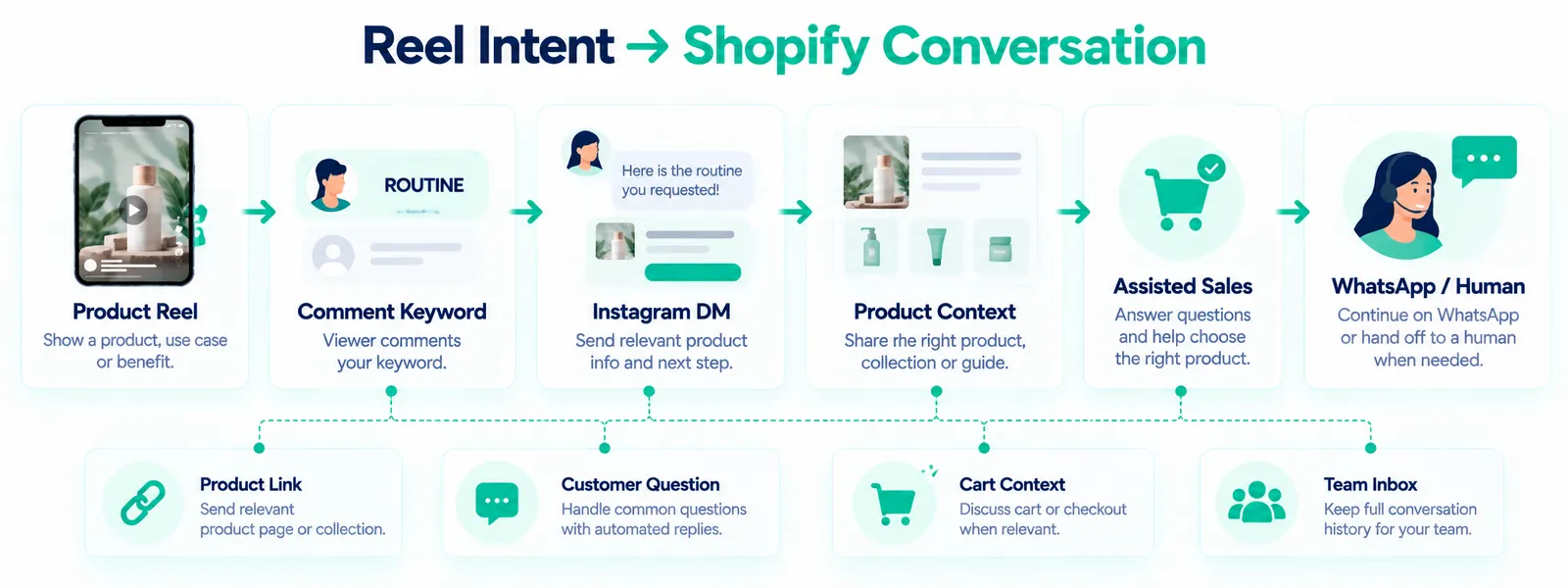
For Shopify brands, the value of Reel comment automation increases when the content and commerce context are connected. A Reel can introduce a product problem or use case, while the DM provides the relevant product destination and the next conversation step.
Imagine a Reel showing three ways to use a product. The CTA is —Comment ROUTINE for the full routine.— The first DM can provide the relevant product collection or guide. If the customer replies with a product question, the conversation can move toward assistance.
The architecture should avoid inventing dynamic ecommerce information. Product availability, price, shipping, discount eligibility and order state can change. If the automation does not have a reliable current data source, do not present those values as live facts.
For brands already operating Shopify, a useful conceptual funnel is:
- Reel introduces the customer problem.
- Comment keyword identifies intent.
- Instagram DM delivers relevant information.
- Product conversation identifies the right item.
- Customer moves toward product page, checkout or assisted sales.
- WhatsApp or human support can take over where appropriate.
Mark360's related ecommerce Instagram DM automation content can be used alongside this Reels-first approach when the goal extends beyond a single campaign.
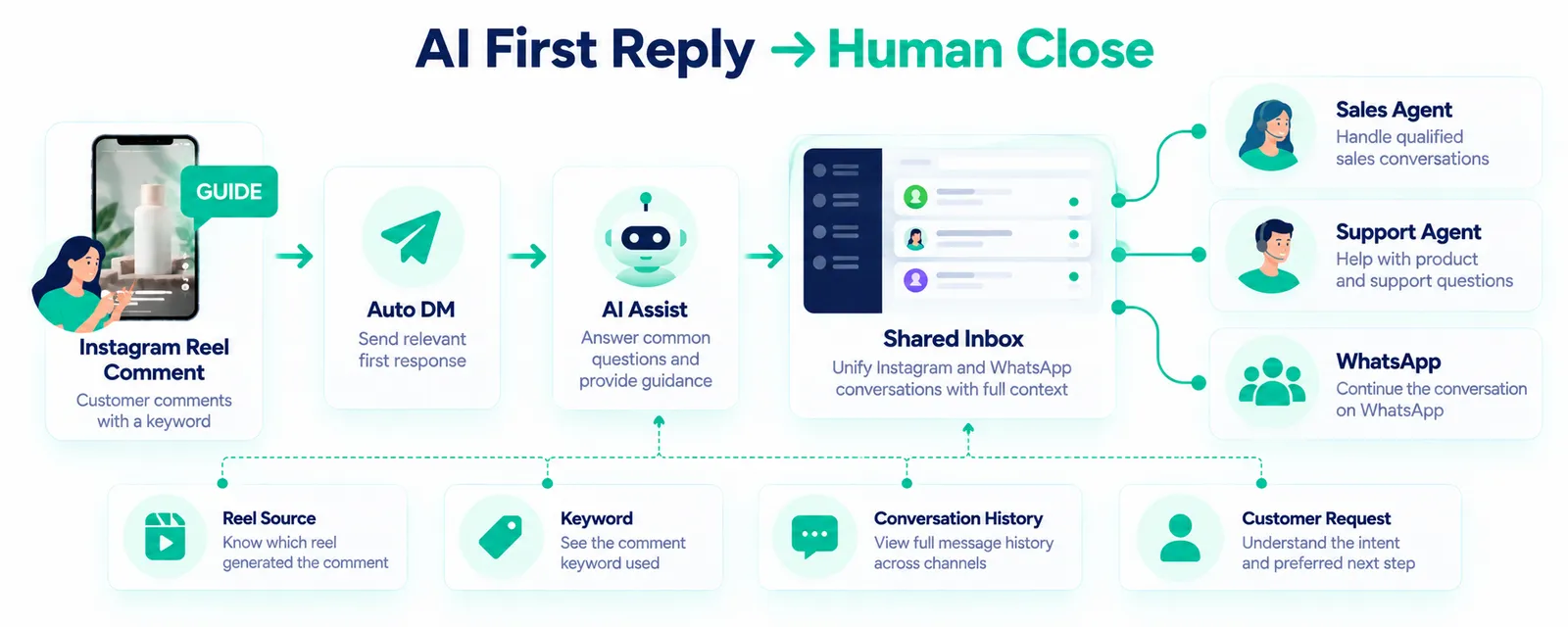
Shared Inbox: AI Agent First Reply, Human Close
Automation becomes more operationally useful when conversations do not disappear into separate channel dashboards.
A shared inbox can give the team a common view of incoming Instagram and WhatsApp conversations. The automation can handle predictable first replies, while an AI agent can assist with known questions and a human can take ownership when the conversation needs judgement.
The handoff should preserve context. An agent should ideally know which Reel generated the conversation, which keyword the customer used, what the automated response contained and what the customer asked afterwards.
This is particularly important for agencies and ecommerce teams. A Reel may generate conversations outside normal working hours, while sales staff need to process the higher-intent conversations later. Routing and assignment make the workflow operational rather than simply automated.
Mark360's product angle is therefore broader than being an Instagram-only DM tool. Mark360 can fit where the business needs Instagram comment-to-DM, incoming DM automation, a unified Instagram and WhatsApp shared inbox, AI-assisted responses, human assignment and Shopify-oriented commerce workflows. The exact integration depth should always be verified against the current Mark360 product capabilities rather than assumed.
For readers comparing broader architectures, the related Instagram DM Automation + IG/WA Shared Inbox guide explores the shared-inbox model.
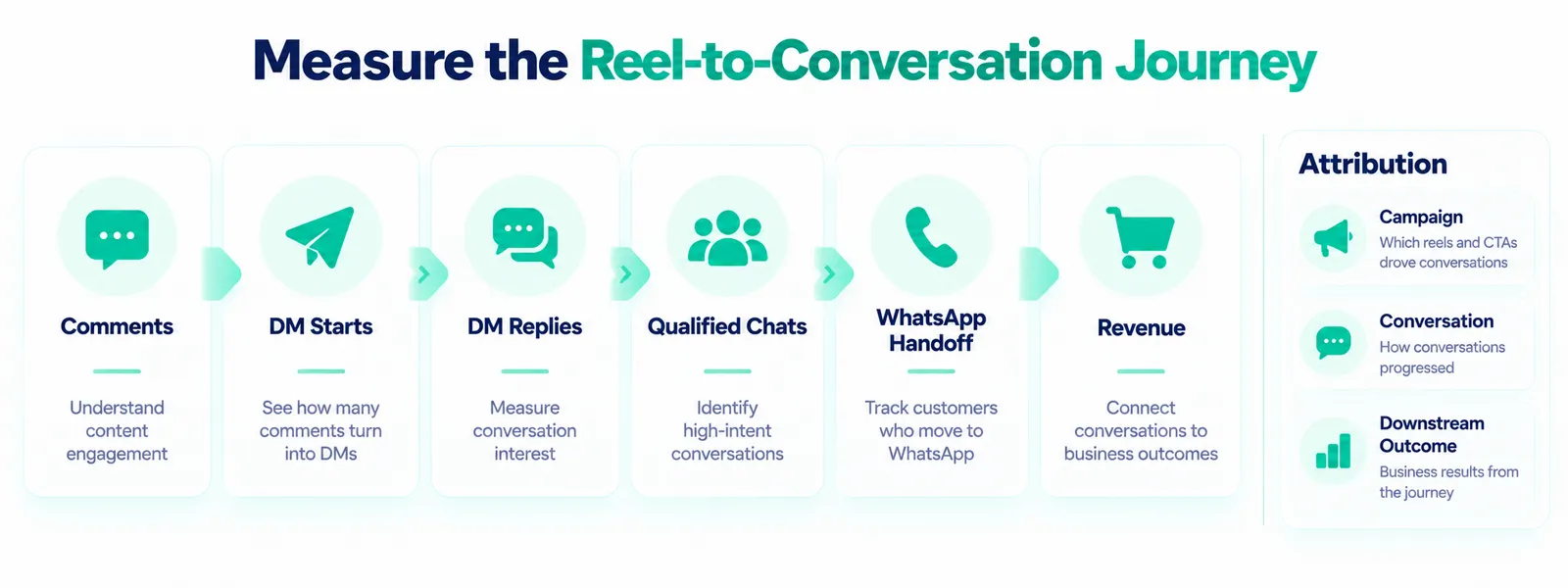
Metrics That Matter (Comment→DM Rate, Reply Rate, WA Handoff, Revenue)
The right metrics depend on the purpose of the Reel. A lead-generation Reel should not be judged only by views or comments if the business ultimately needs qualified conversations or revenue.
| Metric | What it tells you | How to use it |
|---|---|---|
| Comment volume | How much visible interaction the Reel generated | Compare against the CTA and content topic |
| Comment-to-DM rate | How often eligible comments become private conversations | Check trigger and delivery performance |
| DM reply rate | How often people continue after the first DM | Evaluate relevance of the opening response |
| Qualified conversation rate | How often conversations meet your lead criteria | Evaluate content and qualification logic |
| WhatsApp handoff | How often customers intentionally move to WhatsApp | Evaluate whether the handoff is useful rather than forced |
| Revenue | Downstream commercial outcome where attribution is reliable | Connect campaigns to actual business outcomes |
Do not assume that a higher number is always better. A Reel with many comments but poor conversation quality may need a clearer CTA or better audience targeting. A smaller campaign with highly relevant product conversations may be more useful to a sales team.
Attribution also needs caution. A purchase may have multiple touchpoints, and the Reel may be only one part of the customer journey. Use consistent campaign naming and available platform or business analytics rather than claiming that every downstream purchase came directly from a single automated DM.
Reels vs Stories vs Feed Automations: Which Trigger When
Different Instagram surfaces create different conversational contexts. The right trigger depends on what the customer is doing at the moment they engage.
| Surface | Typical intent | Useful automation role |
|---|---|---|
| Reel | Discovery and content-driven interest | Comment keyword → relevant DM |
| Feed post | Deeper content or product discussion | Comment response and supported private conversation |
| Story | Short-lived, contextual engagement | Story reply or supported interaction workflow |
| Incoming DM | Direct customer intent | Auto-reply, qualification and human handoff |
A Reel can therefore be the top-of-funnel conversation trigger, while Stories can support active audience engagement and direct DMs can become the support or sales layer.
Mark360's related Instagram Auto Reply & Story Reply Automation article explains the Story-specific model in more detail.
If your strategy also includes follow-based workflows, keep that separate from comment-driven intent. The related Instagram Follow Gate & Follow-to-DM article covers that distinct pattern and its consent considerations.
Common Mistakes That Kill Reel Automations
Using a vague CTA
—Comment below— does not tell the automation or the viewer what the conversation is supposed to accomplish. Use a clear action such as GUIDE, LINK, BOOK or another contextual keyword.
Sending an unrelated first DM
If the customer asks for a guide and receives a generic sales pitch, the automation has failed the expectation it created. Deliver the promised item first.
Automating new followers without an initiating action
A follow is not a substitute for a customer-initiated conversation. Do not turn a Reel campaign into unsolicited follower outreach.
Using unofficial scraping tools
Tools that require passwords, scrape Instagram pages or simulate browser actions can introduce security and platform-compliance risks. Prefer official Meta-supported integrations.
Ignoring human handoff
Customers eventually ask questions that do not fit a fixed rule. Build an explicit route to a human rather than trapping people inside the automation.
Hard-coding changing commerce information
Prices, inventory, delivery expectations and promotions can change. Use reliable current data or keep the automated response general.
Measuring only views
Views can indicate reach, but the business objective may be qualified conversations, product discovery, WhatsApp handoff or revenue. Measure the full journey where attribution is meaningful.
For brands building an Instagram automation stack, the practical decision is not simply —Which tool sends a DM fastest?— It is —Which architecture turns customer-initiated Reel intent into a useful conversation while respecting Meta's rules and supporting the next business step?—
That is where Mark360 can be considered when the workflow needs more than an Instagram-only automation layer: Instagram comment-to-DM, incoming DM automation, Instagram and WhatsApp shared inbox operations, AI-assisted first replies, human assignment and Shopify-oriented customer journeys. It should be evaluated against the exact capabilities your team needs today, with no assumption that every possible Instagram feature is already shipped.
For additional context on alternatives and broader Instagram automation architecture, see Best ManyChat Alternatives for Instagram Comment-to-DM. The goal is not to automate more messages; it is to create more relevant conversations from genuine customer intent.