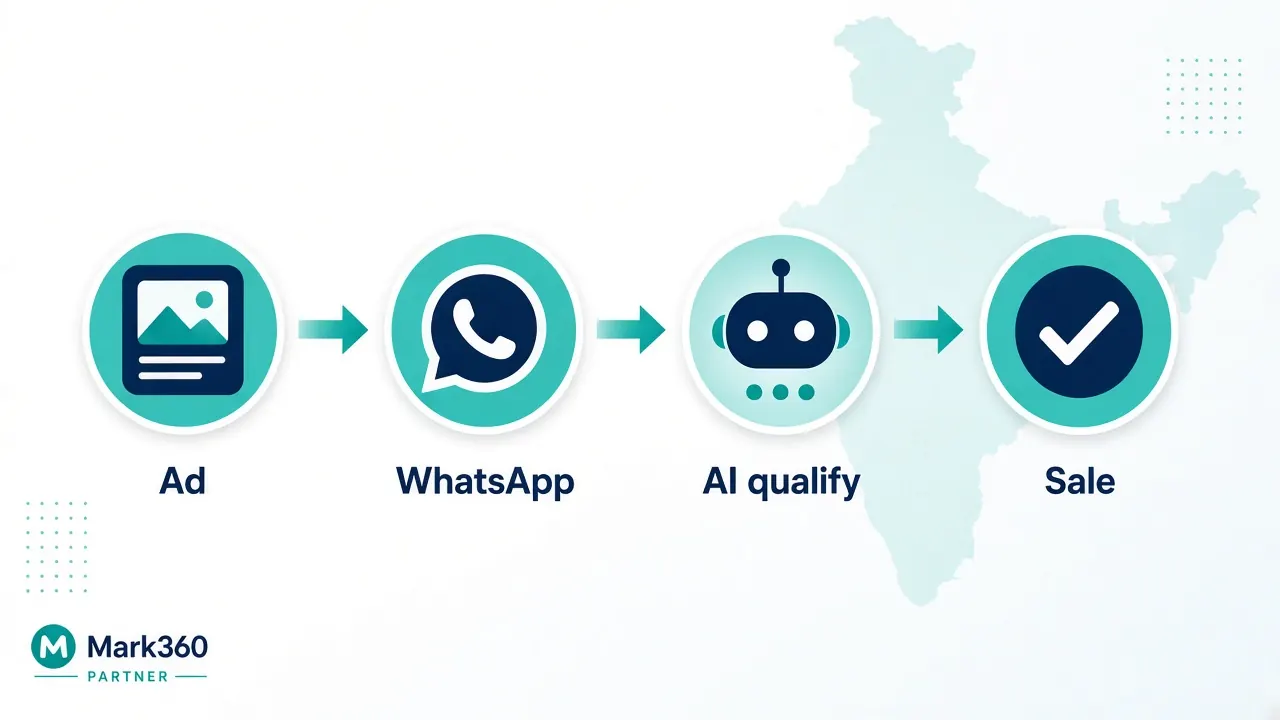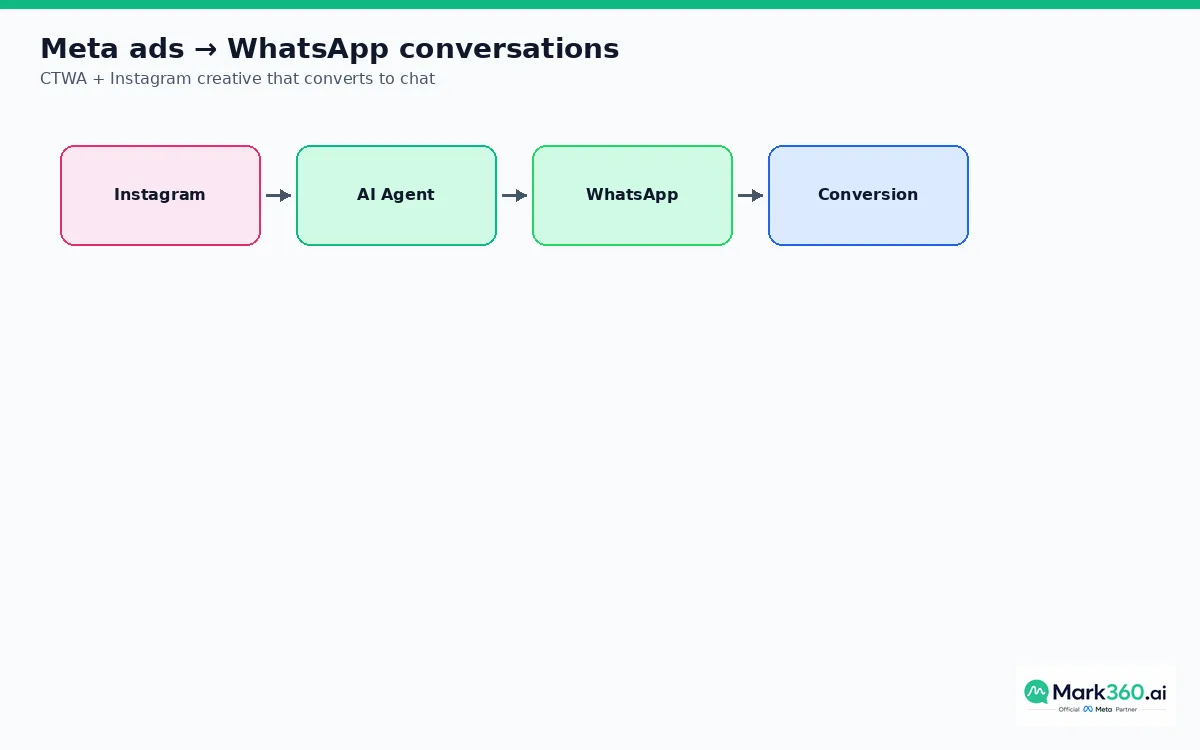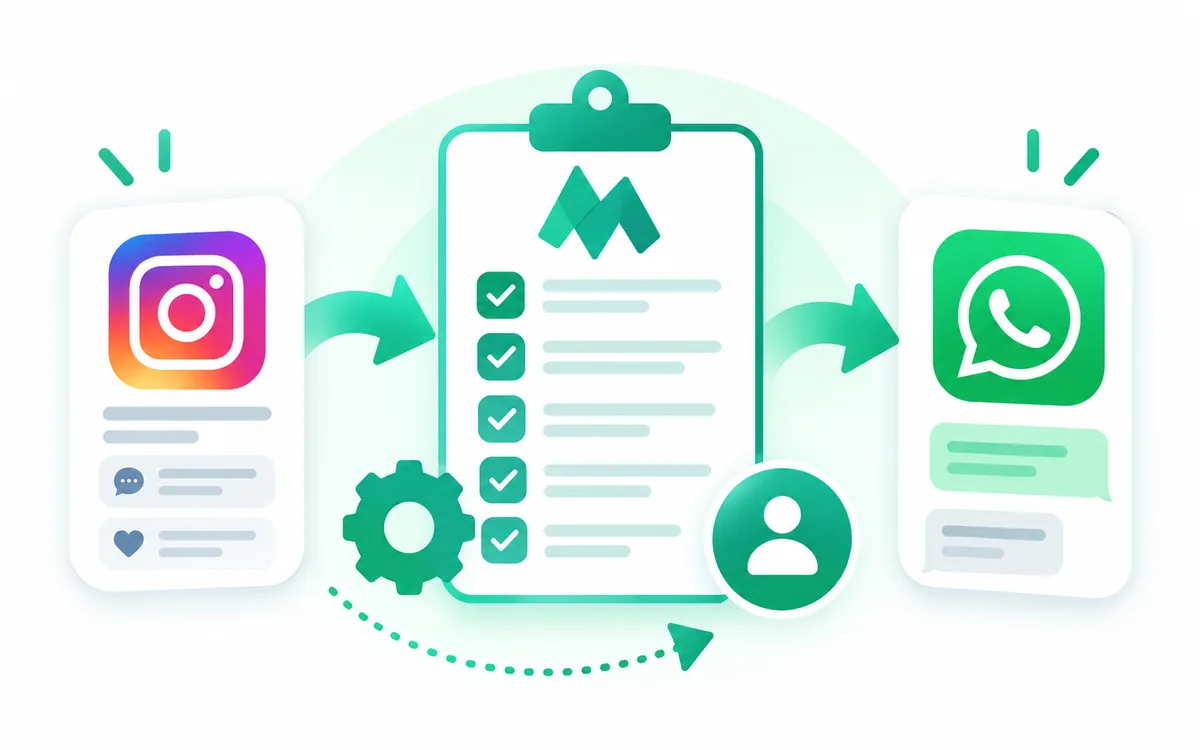

Direct answer: Ecommerce Instagram DM automation uses Instagram Messaging (DMs, comment replies, and Story replies) to answer catalog questions, capture purchase intent, recover carts, and hand high-intent shoppers to WhatsApp Business API for payment and order confirmation — ideally with AI agents that understand products, not just keyword menus.
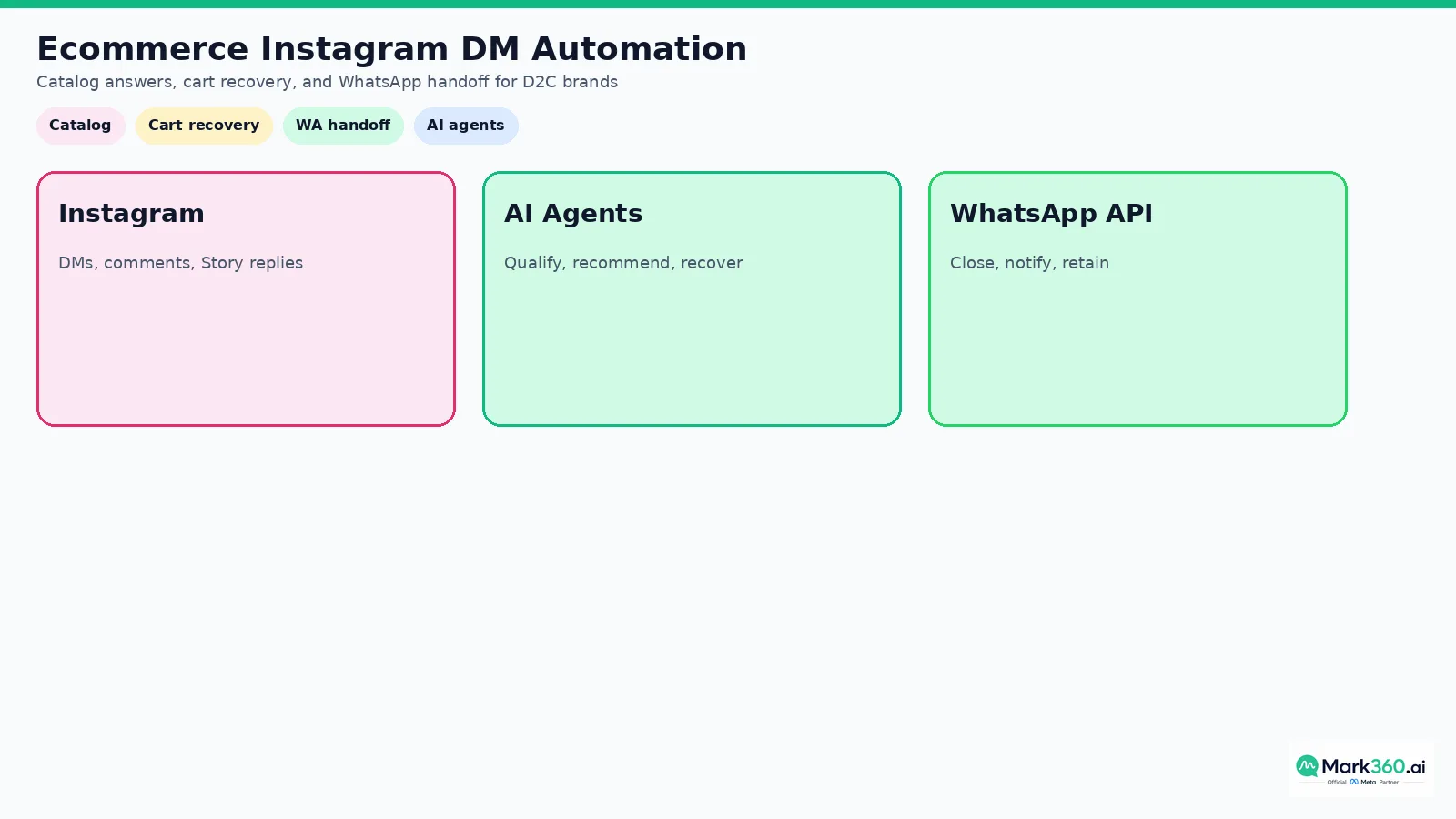
What is ecommerce Instagram DM automation?
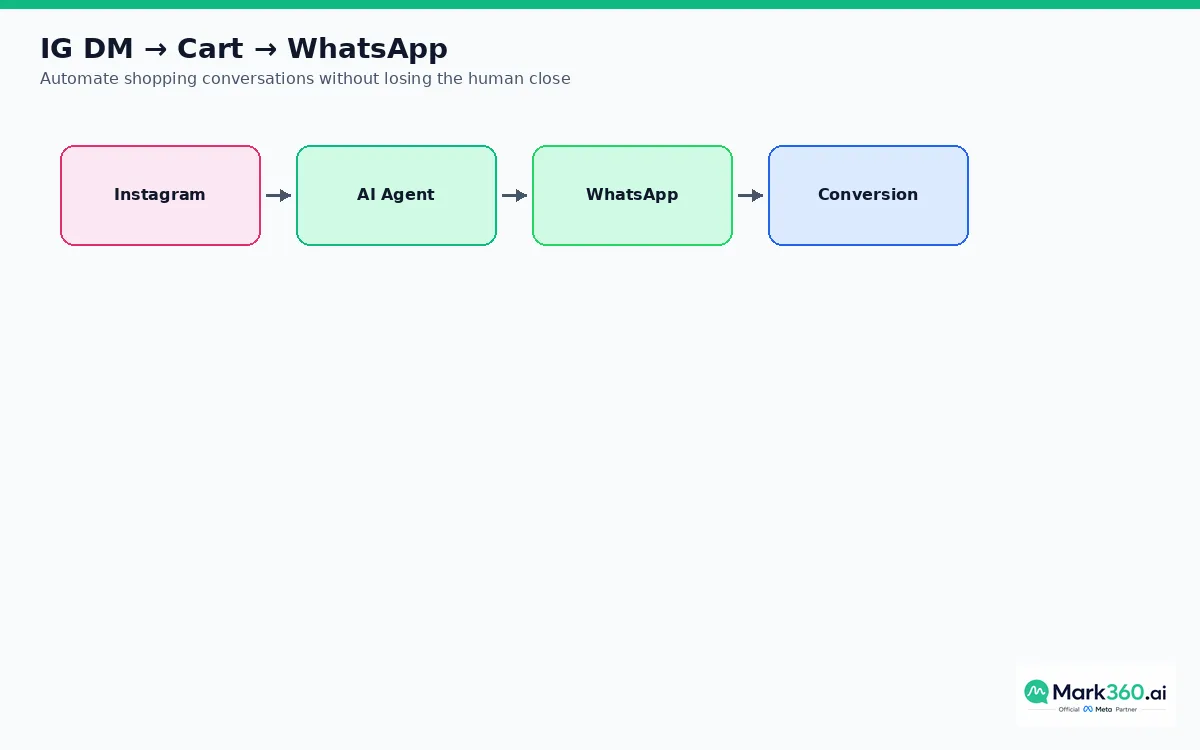
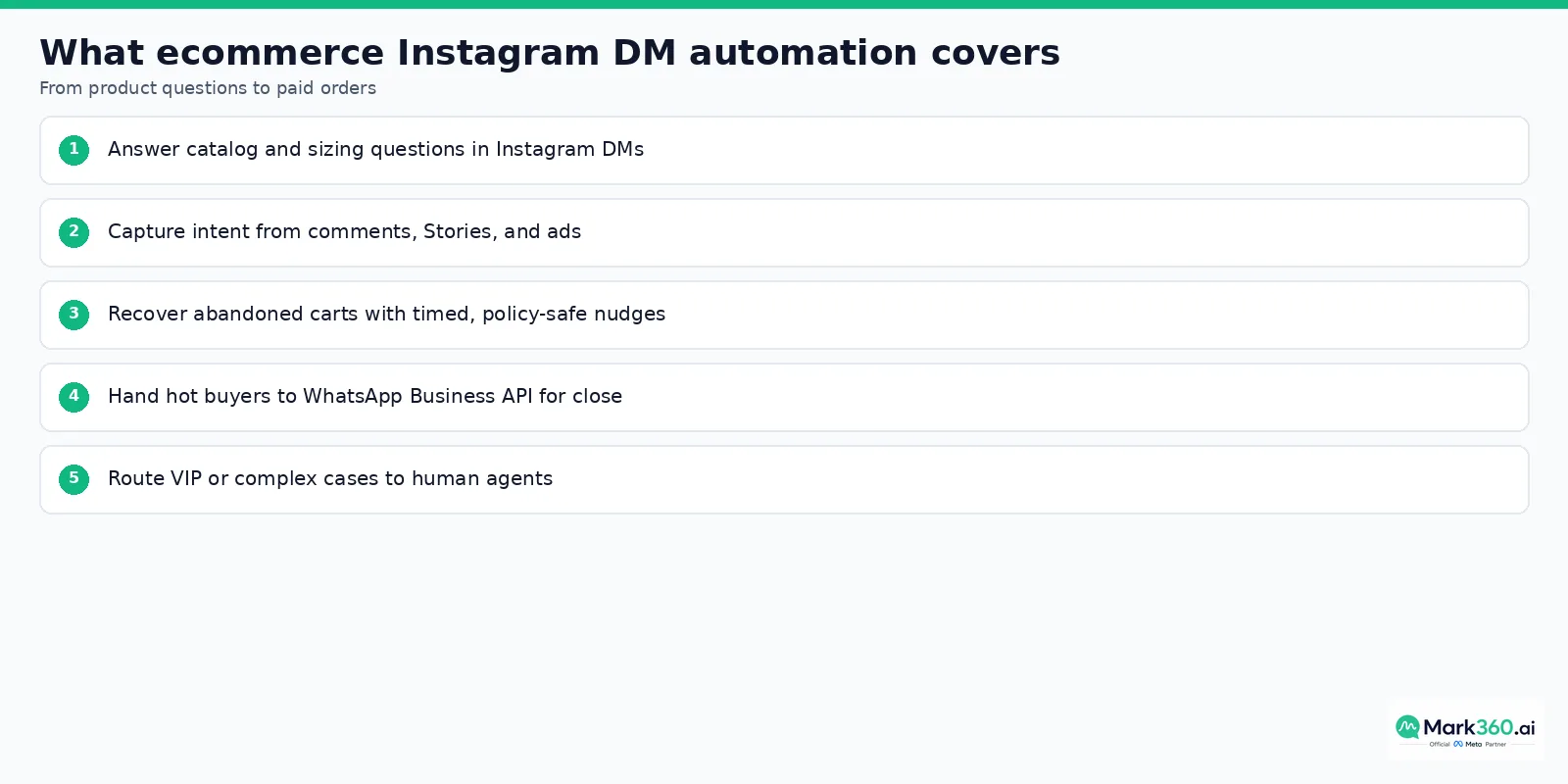
Ecommerce Instagram DM automation is the practice of turning Instagram conversations into revenue. Shoppers ask about sizes, colors, stock, shipping, and payment inside DMs. Without automation, those messages pile up. With the right stack, an AI agent answers product questions, shares the right SKU or checkout link, and moves the buyer to WhatsApp when a human close or transactional message is needed.
This is different from broadcasting. Instagram Messaging is built for two-way conversations under Meta’s messaging rules. Brands that treat DMs like email blasts risk policy violations and blocked messaging. Brands that treat DMs like a sales floor — with clear handoffs — convert more of the traffic they already pay for on Meta ads and organic Reels.
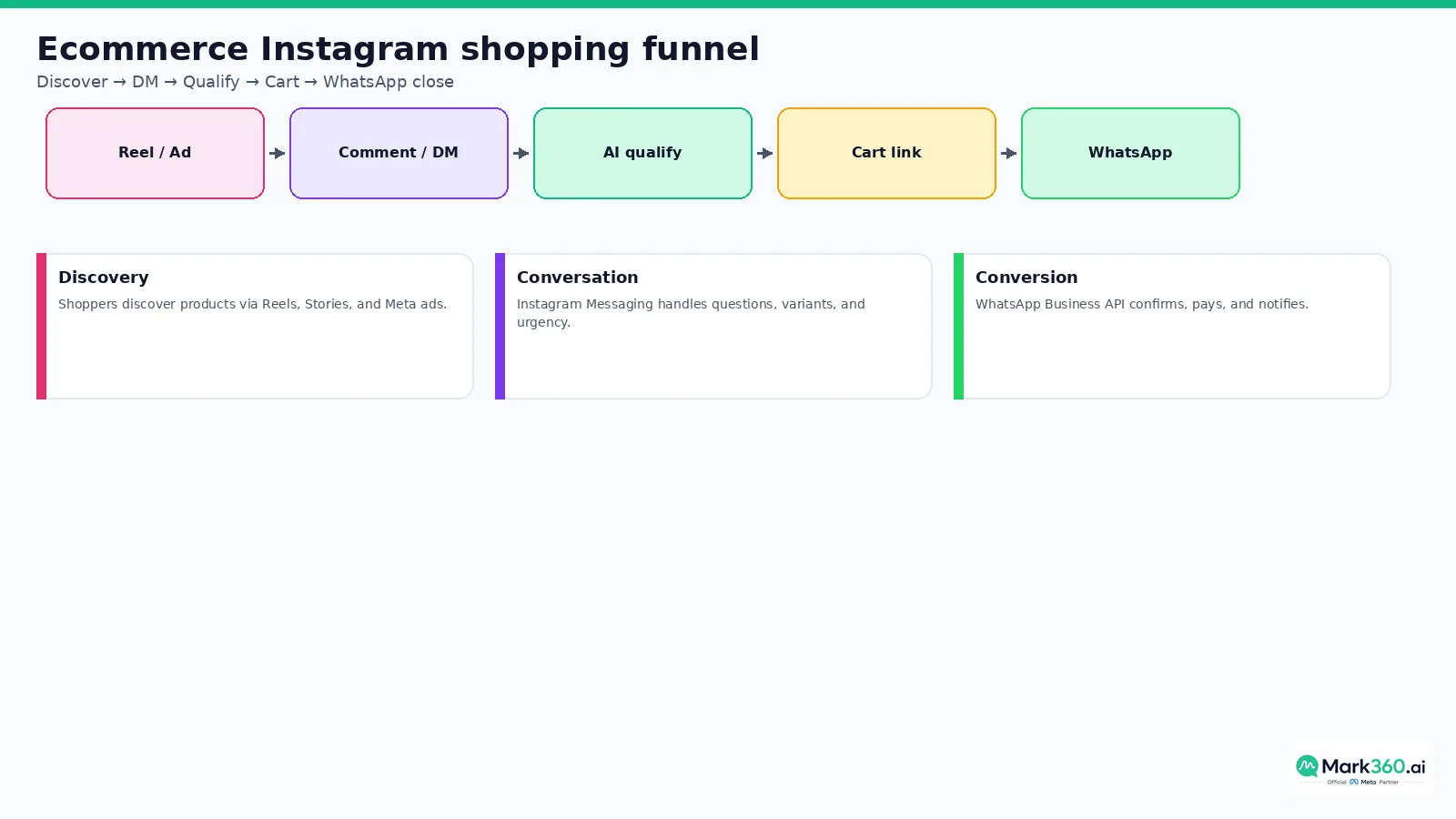
Why Instagram DMs matter for ecommerce in 2026
Instagram is where discovery happens: Reels, Shop tags, influencer content, and Meta ads. The purchase decision often continues in a private chat. Buyers want fast answers on fit, authenticity, delivery time, and returns before they trust a checkout page.
Three shifts make automation non-negotiable for growth teams:
- Volume: Successful Reels and ads create message spikes that no small team can answer manually in minutes.
- Expectation: Shoppers expect near-instant replies during peak hours and weekends.
- Channel split: Instagram is excellent for discovery and light Q&A; WhatsApp Business API is stronger for templates, receipts, and high-trust closes in many markets.
Mark360 positions this as a dual-channel system: Instagram AI agents for capture and qualification, plus WhatsApp Business API as a Meta Partner stack for conversion and retention — not a replacement for Meta’s official policies.
Core use cases: catalog, cart, and handoff
1. Catalog and product Q&A
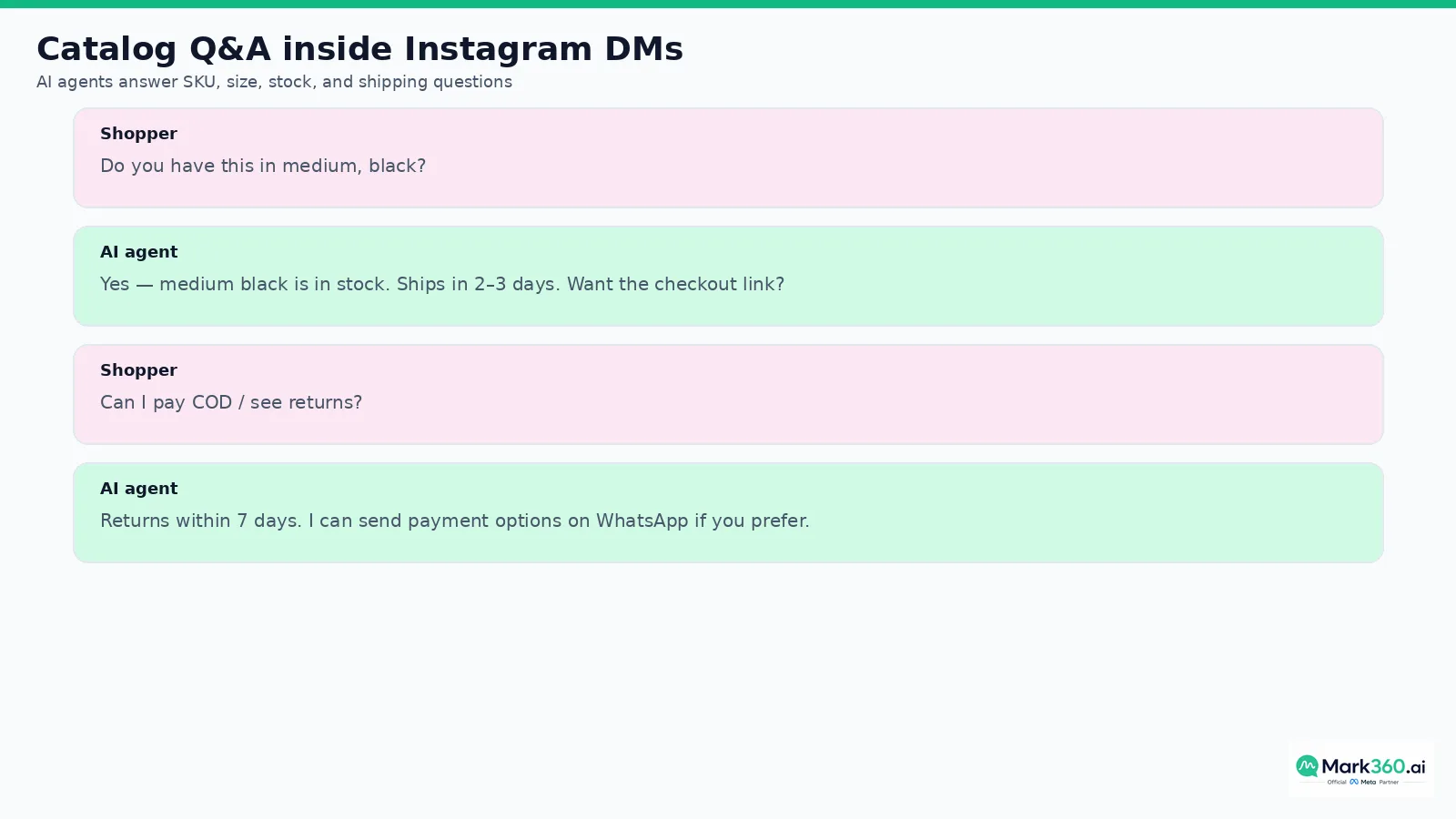
Most ecommerce DMs are variations of the same questions: Is this in stock? What size am I? Does it ship internationally? Is this authentic? Can I see more photos?
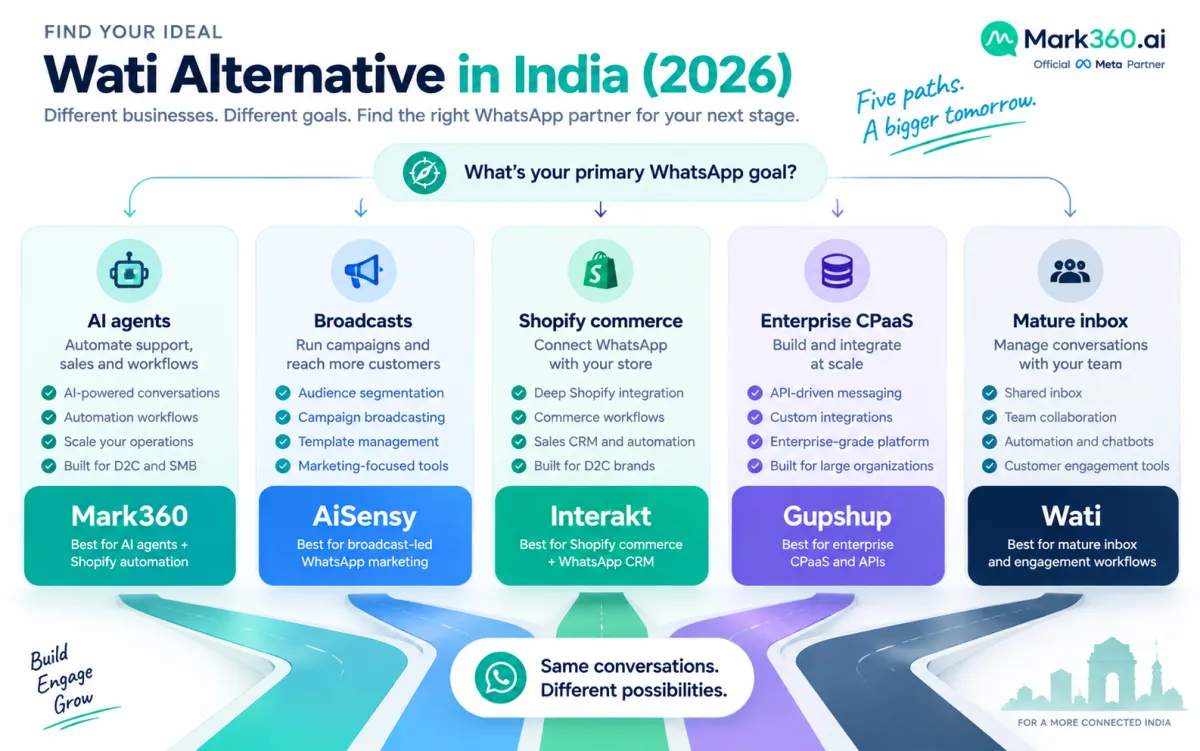
Keyword-based flows (including tools like Manychat) can cover common paths with buttons and quick replies. They struggle when shoppers ask messy, multi-part questions or when catalog data changes daily. AI agents connected to product context can interpret natural language, ask clarifying questions, and return the right variant.
2. Comment-to-DM and Story capture
Comments on Reels and posts are public intent signals. A compliant automation replies in-thread or invites the shopper into DMs with a relevant prompt (for example, “Comment SIZE for fit guide”). Story replies and sticker responses are another high-intent entry. The goal is not to spam every commenter — it is to open a useful conversation and qualify interest.
3. Cart creation and link sharing
Once intent is clear, automation should reduce friction: send a deep link to the exact SKU, a shoppable cart, or a checkout URL. For brands with Instagram Shopping or a connected catalog, keep SKU IDs consistent across Instagram, your storefront, and WhatsApp so the agent never sends the wrong product.
4. Cart recovery (policy-aware)
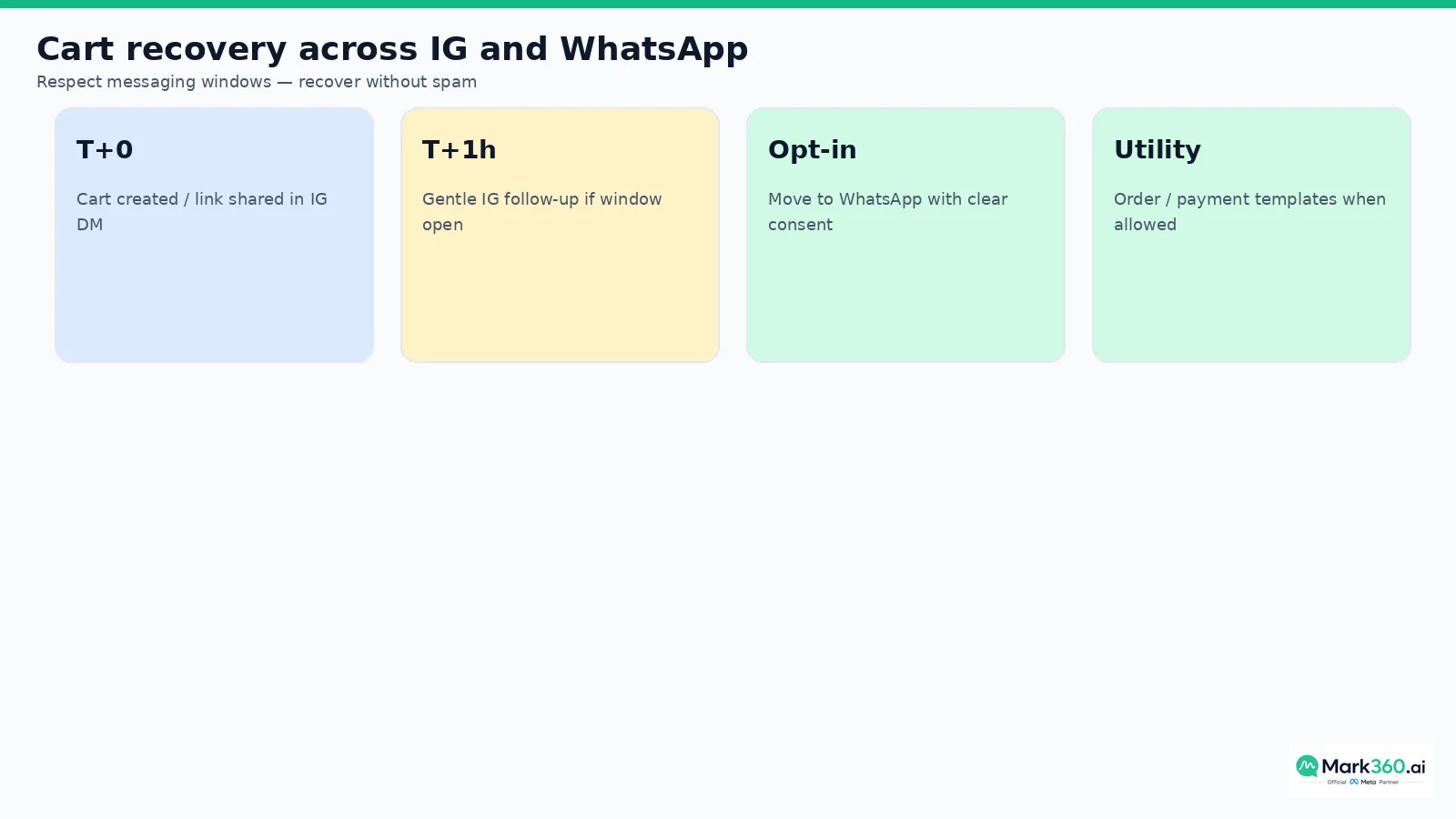
Abandoned carts are not an excuse to message endlessly. Instagram Messaging and WhatsApp each have windows and template rules. A practical pattern:
- Share the cart or checkout link while the Instagram messaging window is open.
- If the shopper goes quiet, send one helpful reminder inside the allowed window.
- With clear consent, continue on WhatsApp Business API using the correct message category (often marketing for promos; utility for order/payment updates when those apply).
Always follow Meta’s current Instagram messaging documentation and WhatsApp Business Platform pricing guidance for categories and delivery charges. Pricing is set by Meta by category and recipient market; platforms may show their own totals separately.
5. WhatsApp handoff for close and retention
When a shopper is ready to pay, needs COD confirmation, wants order tracking, or prefers WhatsApp as their primary inbox, hand off with context: product, size, objections already answered, and cart URL. That is where WhatsApp Business API shines — approved templates, utility notifications, and a channel many buyers already trust for transactional chat.
Flows vs AI agents for shopping DMs
Manychat-style flows are excellent for campaigns: “Comment YES,” deliver a lead magnet, tag the contact. Ecommerce shopping conversations are messier. Fit questions, bundle advice, and objection handling rarely fit a tidy tree.
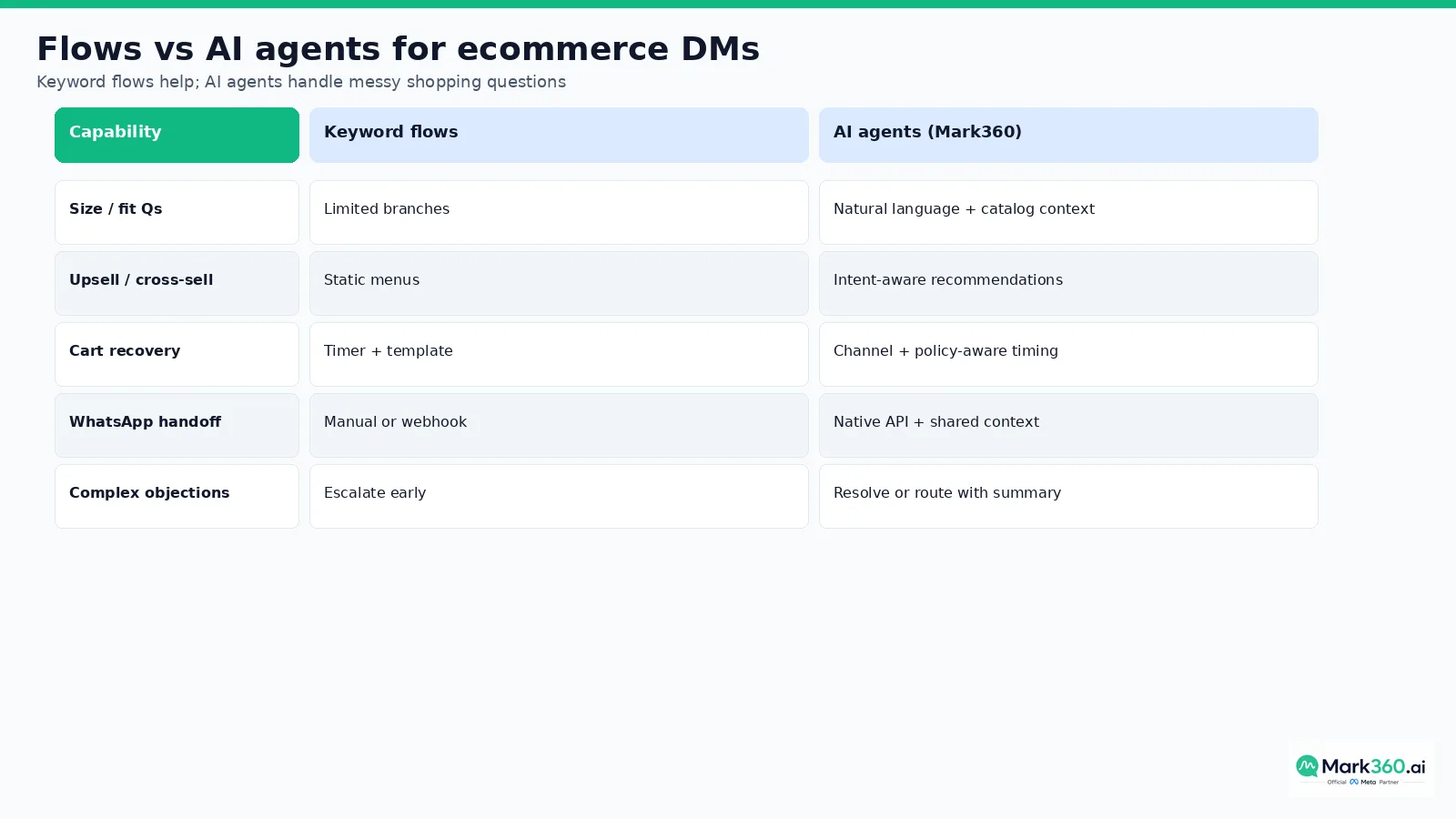
| Need | Keyword / visual flows | AI agents |
|---|---|---|
| Campaign opt-ins | Strong | Useful, but flows often win on simplicity |
| Open-ended product questions | Weak without huge trees | Strong with catalog context |
| Upsell based on intent | Static menus | Dynamic recommendations |
| WhatsApp + IG continuity | Often bolt-on | Designed as shared journey |
| Human escalation | Basic transfer | Summary + full transcript |
Fair framing: Manychat and similar tools remain popular for growth campaigns. Mark360’s angle is Instagram AI agents plus WhatsApp Business API for brands that need shopping-grade conversations and official API messaging — not “flows are useless.”
Architecture of a modern ecommerce messaging stack
- Entry points: Organic posts, Reels, Stories, Instagram ads, comment triggers.
- Instagram Messaging layer: AI agent with product, shipping, and FAQ knowledge.
- Qualification: Budget, size, urgency, location, payment preference.
- Commerce actions: Cart links, discount eligibility, inventory checks.
- WhatsApp Business API: Consent-based handoff, templates, order updates.
- Shared inbox: Humans take over with full history on either channel.
- Analytics: Reply time, DM-to-cart rate, cart-to-paid, WA conversion, CSAT.
Compliance basics (do not skip)
- Respect Instagram Messaging windows and human-agent tags where required.
- Do not treat Instagram as a bulk broadcast channel for cold outreach.
- On WhatsApp, use the correct template category; see Meta’s pricing docs for how marketing, utility, authentication, and service are billed.
- Collect consent before moving a conversation to WhatsApp for marketing follow-ups.
- Provide an easy path to a human agent for complaints, refunds, and sensitive issues.
Meta publishes Instagram Messaging guidance in the Messenger Platform docs and WhatsApp rules in Business Platform documentation. Policies evolve — verify against official sources before launching high-volume journeys.
KPIs that matter for ecommerce DM automation
- Median first response time on Instagram (target: under a few minutes during peak).
- Qualified conversation rate (DMs that reach product + intent clarity).
- DM-to-cart rate and cart-to-paid rate.
- Handoff acceptance (shoppers who continue on WhatsApp).
- Human takeover rate and resolution time after escalation.
- Revenue attributed to messaging-assisted orders (UTM or order tags).
Implementation checklist for D2C teams
- Connect Instagram professional account messaging and define agent hours.
- Sync catalog fields the agent must know (SKU, size chart, stock, ship ETA).
- Write escalation rules for refunds, damaged items, and VIP buyers.
- Design cart-link templates that always include the exact variant.
- Enable WhatsApp Business API via a Meta Partner stack (such as Mark360) for templates and utilities.
- Test comment-to-DM and ad-to-DM entry points with real creative.
- Train the team on the shared inbox so humans never ask buyers to “start over.”
- Review Meta messaging and pricing docs quarterly.
How Mark360 approaches ecommerce Instagram + WhatsApp

Mark360 combines Instagram AI agents, WhatsApp Business API, and Meta Partner alignment so ecommerce brands can capture demand on Instagram and close on the channel buyers prefer. Soft next step: explore automation options on mark360.ai and related guides such as Click to WhatsApp ads and WhatsApp service message pricing when you model messaging costs.
Related series topics: Instagram messaging API rules, shared IG + WhatsApp inboxes, WhatsApp API on-ramps for Instagram brands, and the full Meta Click-to-WhatsApp + Instagram ads funnel.
Playbook: from first DM to paid order
Here is a practical sequence growth and CX teams can implement in one to two weeks without rebuilding the whole stack.
Step 1 — Map your top 20 DM intents
Export or sample a week of Instagram inbox messages. Cluster them into intents such as size/fit, stock, shipping ETA, authenticity, discount requests, influencer code questions, order status, and returns. Those clusters become your AI agent topics and escalation rules. If an intent appears fewer than a few times per week, a short FAQ snippet is enough; if it appears dozens of times per day, it deserves catalog-backed automation.
Step 2 — Connect live product truth
Static PDFs go stale. Connect the agent to the fields that change: inventory count or availability flags, variant IDs, price, promotional eligibility, and shipping estimates by region. When stock flips to zero mid-campaign, the agent should say so immediately instead of sending a dead checkout link.
Step 3 — Design the “helpful, not pushy” persona
Shopping DMs fail when the bot sounds like a coupon cannon. Write tone guidelines: answer first, ask one clarifying question, offer the next best action, and stop. A good reply might confirm the variant, state ship timing, share the cart link, and ask whether the shopper prefers to continue on WhatsApp for payment help.
Step 4 — Define WhatsApp handoff triggers
Not every chat needs WhatsApp. Trigger handoff when the shopper asks about payment confirmation, COD, invoice, bulk order, or post-purchase issues — or when they explicitly prefer WhatsApp. Pass product, size, URL, and objection summary so the WhatsApp agent or human never restarts discovery.
Step 5 — Instrument revenue, not just replies
Tag orders that originated from messaging (UTM on cart links, discount codes unique to IG DM, or CRM notes). Without attribution, leadership will treat DM automation as a cost center instead of a conversion channel.
Industry patterns that convert
Fashion and beauty: Size charts, shade matching, and “how to wear” guidance dominate. Pair images or short clips with text answers. Offer WhatsApp for order confirmation during big drops.
Electronics and gadgets: Compatibility questions (“Does this work with…?”) need structured attributes. Escalate warranty and defect cases to humans quickly.
Food and specialty CPG: Delivery windows, allergen info, and subscription changes are common. Utility templates on WhatsApp help after the order is placed.
Services sold via IG: Booking links and qualification questions matter more than SKUs. Still use the same capture → qualify → WhatsApp confirm pattern.
Team operating model
Automation does not remove humans; it changes their job. Agents should monitor a shared Instagram + WhatsApp inbox, jump in on VIP and complaint tags, and continuously add missed intents to the knowledge base. Set SLAs: automated first response in seconds, human takeover within a defined number of minutes during business hours, and a clear after-hours auto-reply that sets expectations.
Weekly ops review: top unanswered questions, cart links that 404’d, handoff drop-off, and any policy warnings from Meta. That review is how AI agents get better without a giant one-time training project.
Common failure modes (and fixes)
- Endless menus: Shoppers abandon button trees. Fix with natural-language understanding plus a single clear CTA.
- Wrong variant links: Fix with SKU-level deep links and inventory checks.
- Aggressive recovery: Fix by capping reminders and requiring WhatsApp opt-in for marketing follow-ups.
- No human path: Fix with an always-visible “talk to a person” affordance.
- Channel amnesia: Fix with shared inbox context across Instagram and WhatsApp.
- Policy drift: Fix by bookmarking Meta’s Instagram messaging and WhatsApp pricing docs and re-checking before major campaigns.
Budgeting messaging costs without mythology
Instagram and WhatsApp are different products. Do not paste WhatsApp conversation-fee folklore onto Instagram DMs. For WhatsApp Business API, Meta bills by delivered message category and recipient market — see the official pricing documentation. Your BSP or platform may present customer-facing totals that include their packaging; keep those separate from Meta’s category rules when you forecast.
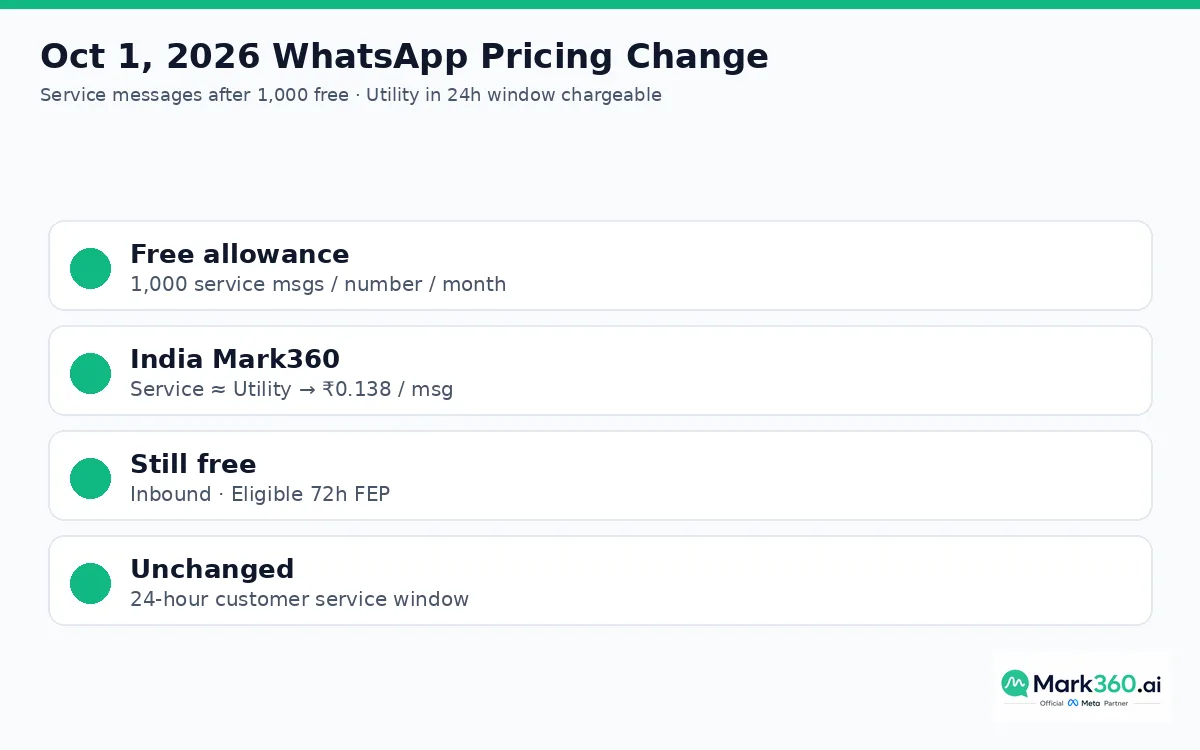
If you need an India-specific utility/marketing reference for Mark360 customer-facing examples, Marketing is ₹0.94 and Utility is ₹0.138 per delivered message on Mark360 — not a claim about Meta’s rate card, and not a “markup” narrative. Prefer modeling global campaigns by recipient market using Meta’s published category framework.
30-day rollout plan
- Days 1–7: Intent mapping, FAQ draft, catalog field list, escalation matrix.
- Days 8–14: Connect Instagram messaging, launch AI agent on top 10 intents, measure response time.
- Days 15–21: Add cart deep links, comment-to-DM on one hero Reel, WhatsApp handoff for payment intents.
- Days 22–30: Enable limited cart-recovery journey, train humans on shared inbox, publish KPI dashboard.
By day 30 you should know your DM-to-cart rate and whether WhatsApp handoff increases paid conversion. Those two numbers justify further investment more honestly than vanity reply counts.
FAQs
Can I automate Instagram DMs for an online store?
Yes. Instagram Messaging supports automated responses within Meta’s rules. Use automation for catalog Q&A and qualification, and keep a human path for disputes and complex cases.
Should cart recovery happen on Instagram or WhatsApp?
Start where the conversation began. If the shopper opts into WhatsApp, continue there with the correct template category. Do not force channel hops without consent.
Is Manychat enough for ecommerce?
Flows excel at campaign capture. Shopping Q&A and multi-channel closes often need AI agents plus WhatsApp Business API. Many brands use both styles for different jobs.
Do Instagram automated messages cost Meta conversation fees like WhatsApp?
WhatsApp Business Platform uses per-delivered-message category pricing by recipient market. Instagram Messaging has different product rules and limits — always check Meta’s current Instagram messaging docs rather than assuming WhatsApp pricing applies 1:1.
What should an AI agent know about my catalog?
At minimum: variants, size guidance, stock status, shipping ETAs, return policy, and payment options. Without that context, automation becomes a polite dead end.
How many Instagram DMs can automation handle?
Technically, automation can acknowledge high volumes quickly. Practically, quality depends on catalog sync, escalation capacity, and staying inside Meta’s messaging rules. Scale throughput only as fast as your knowledge base and human backup can support.
Can Instagram DM automation replace a helpdesk?
No. It replaces repetitive product Q&A and speeds qualification. Refunds, chargebacks, legal requests, and emotionally charged complaints still need trained humans with authority.
What is the fastest win for most D2C brands?
Automate the top five repetitive product questions, add accurate cart links, and create a clean WhatsApp handoff for payment confirmation. That trio usually moves revenue before elaborate journey builders do.
Key takeaways
- Ecommerce Instagram DM automation turns discovery conversations into carts and paid orders.
- Prioritize catalog Q&A, comment/Story capture, cart links, policy-aware recovery, and WhatsApp handoff.
- Flows win for campaigns; AI agents win for messy shopping questions.
- Respect Instagram and WhatsApp messaging rules; link Meta’s official docs in your playbooks.
- Mark360 focuses on Instagram AI agents + WhatsApp Business API as a Meta Partner stack.