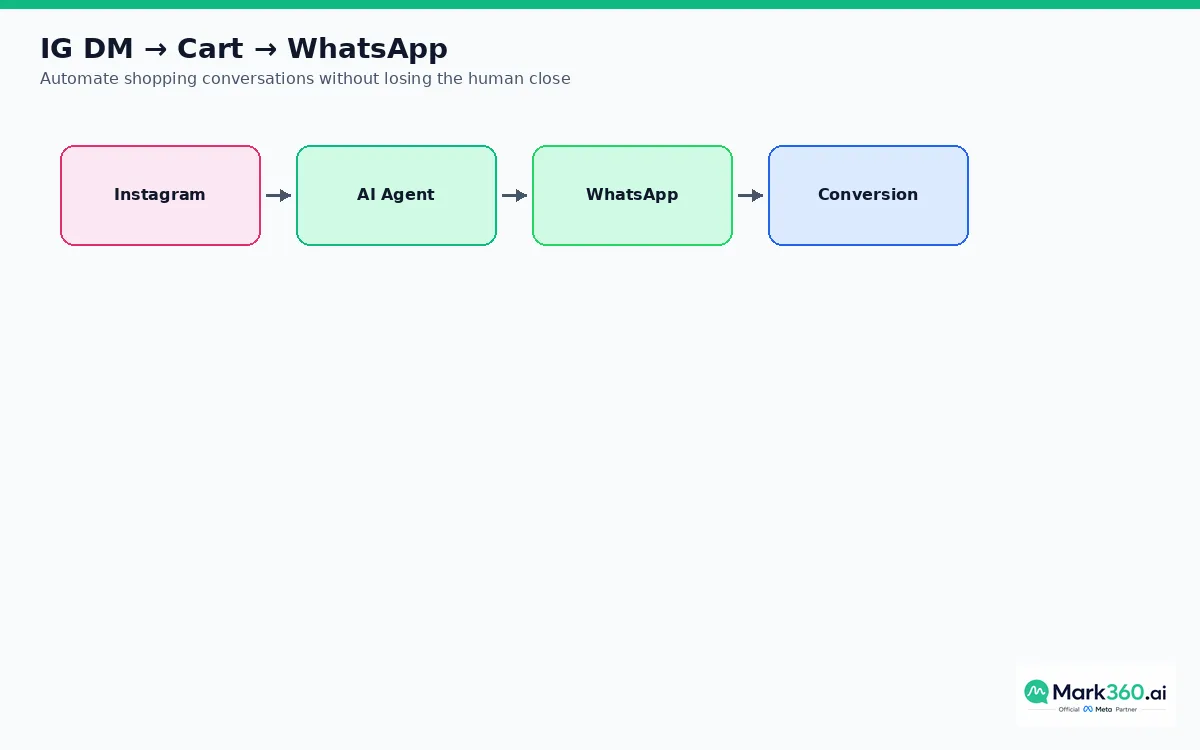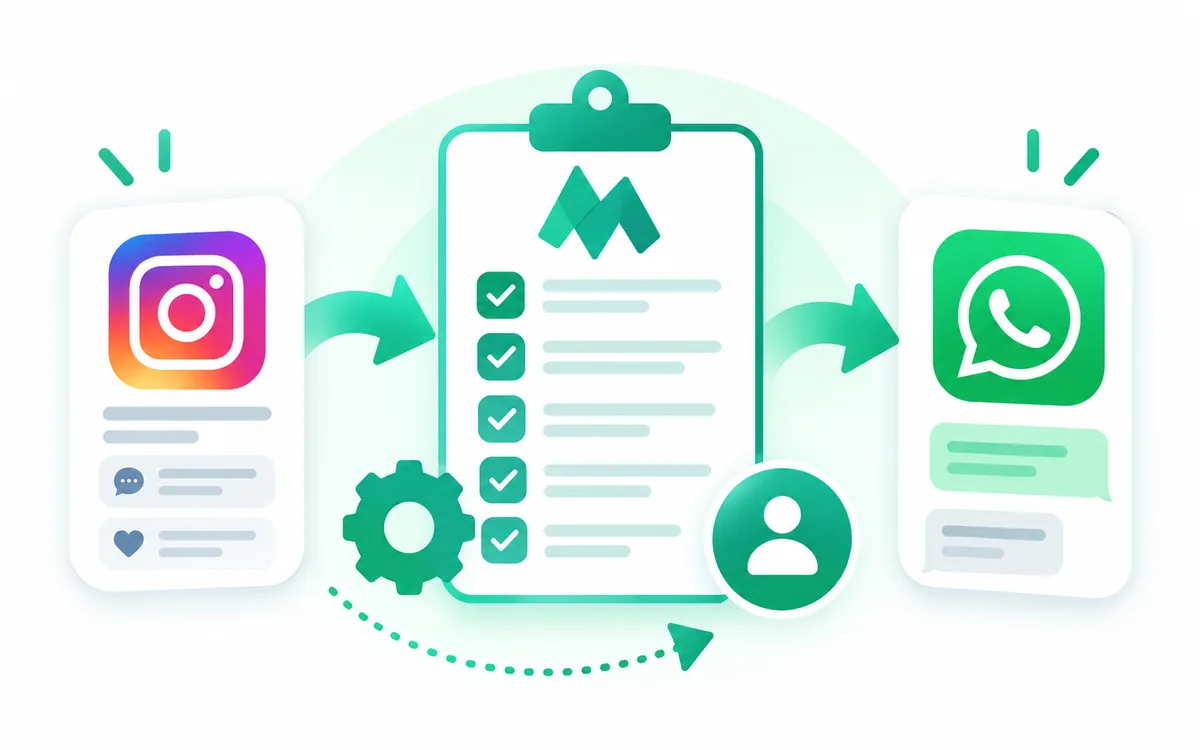

Direct answer: An Instagram and WhatsApp shared inbox with AI agents gives your team one timeline for Meta conversations — so shoppers are not forced to repeat themselves when a chat moves from Instagram DMs to WhatsApp. AI handles volume and qualification; humans take over with full context for risk, VIP, and complex closes.
Why channel silos kill conversion
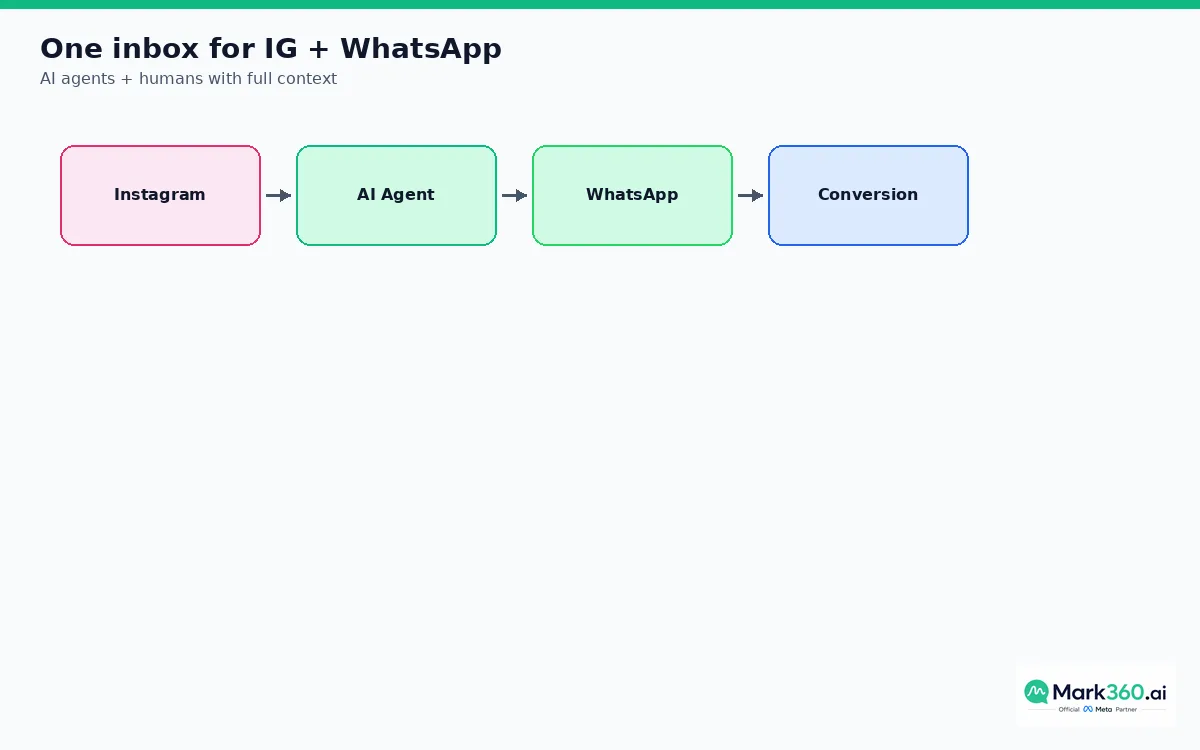
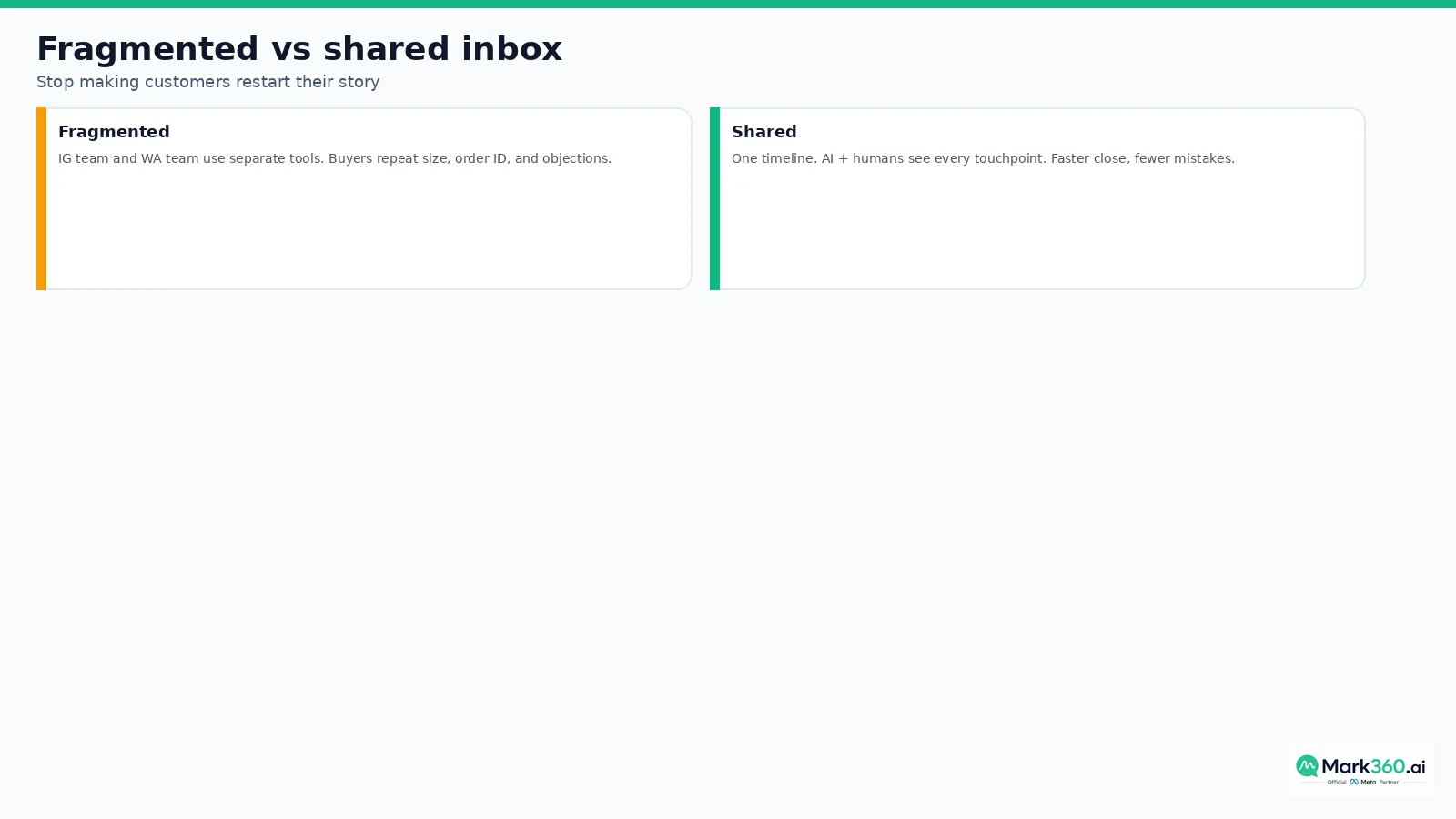
Many brands still run Instagram in one tool and WhatsApp in another. A shopper asks about sizing on Instagram, then continues on WhatsApp to pay — and the WhatsApp agent asks for the size again. That friction feels small to operators and enormous to buyers.
Shared inboxes fix the continuity problem. Every message, attachment, cart link, and AI summary lives on one customer timeline. That is the difference between “omnichannel” as a slide and omnichannel as an operating system.
What “shared inbox + AI agents” actually means
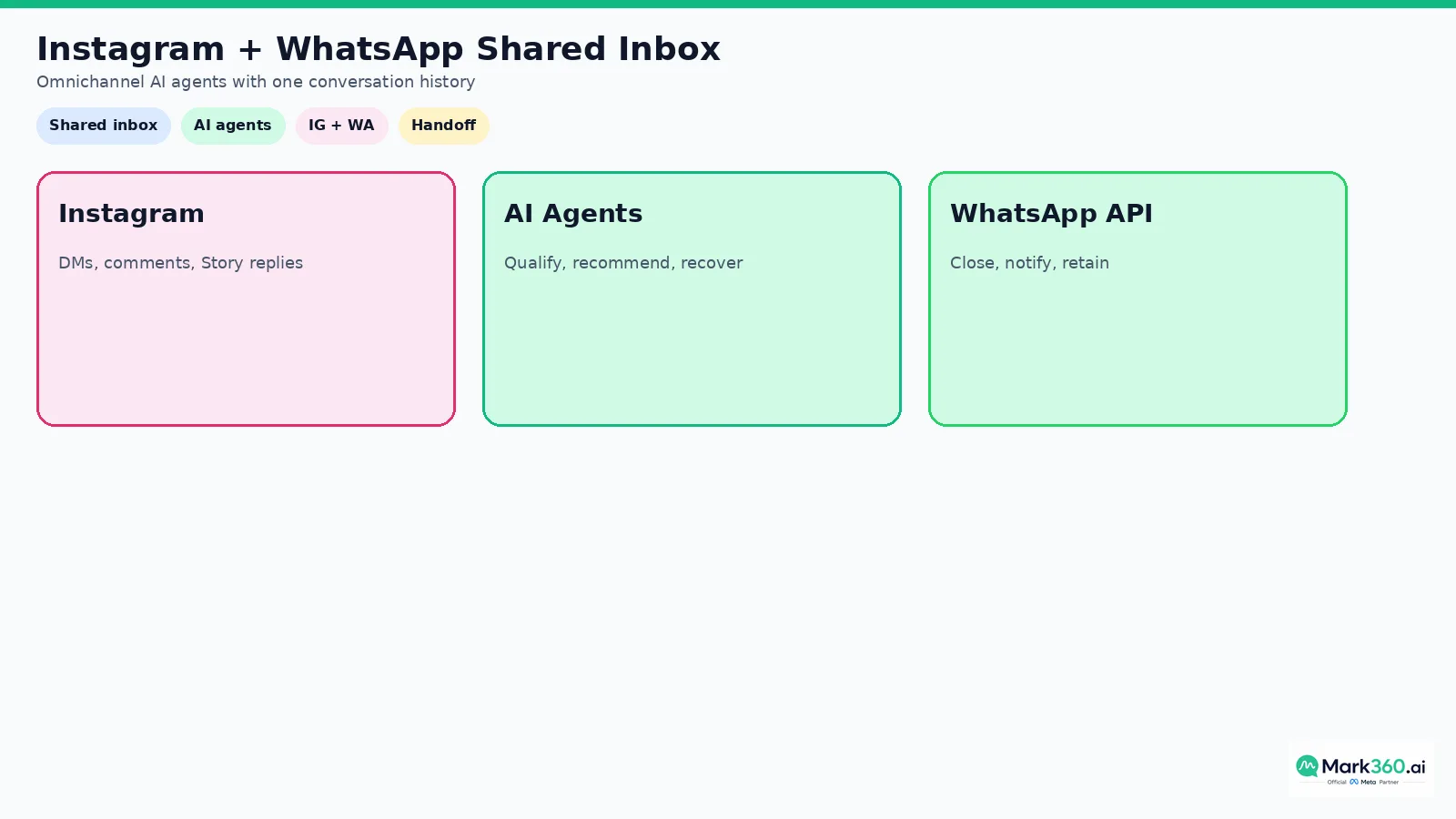
A modern Meta messaging stack has three layers:
- Channels: Instagram Messaging and WhatsApp Business API (official).
- Automation: AI agents that answer product and FAQ questions inside messaging windows.
- Collaboration: Humans who can claim a thread, see history across channels, and resolve edge cases.
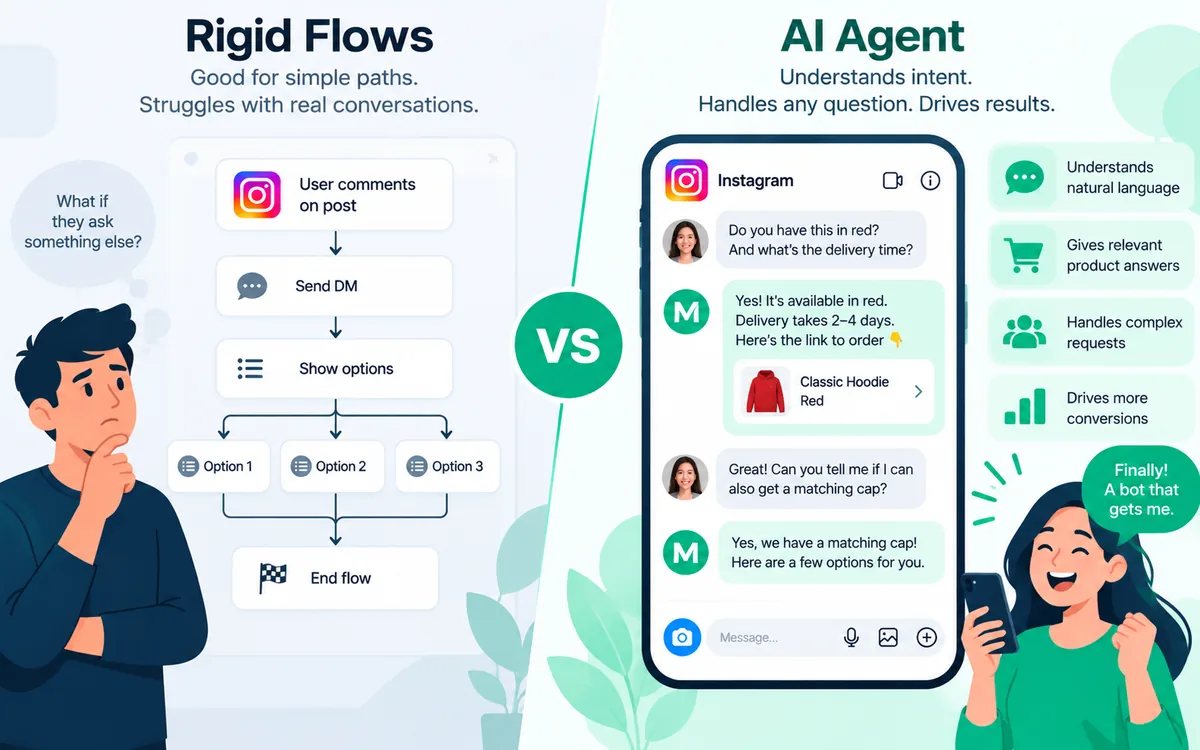
Flow builders can still power campaign opt-ins. They are not a substitute for a shared inbox when sales and support span Instagram and WhatsApp in the same customer journey.

Routing that should not be channel-first

Route on intent, risk, and value — then prefer the buyer’s active channel when safe.
- Intent: Purchase help, order support, partnership, spam.
- Risk: Refunds, chargebacks, harassment, legal — escalate immediately.
- Value: VIP tiers and high cart values get priority queues.
- Channel preference: Continue on WhatsApp when the shopper opted in; stay on Instagram when the conversation is still discovery-heavy.
Operating model for CX and growth teams
Shared inboxes fail when ownership is unclear. Define:
- Who owns first response during peak hours.
- When AI must escalate (keywords, sentiment, payment disputes).
- How WhatsApp template categories are chosen after handoff.
- How agents document outcomes for analytics.
Train humans to read the AI summary first, then the last five messages — not to restart with “How can I help you?”
KPIs for omnichannel messaging

- Combined first response time across Instagram and WhatsApp.
- Repeat-ask rate (customer restating facts already given).
- IG → WhatsApp handoff acceptance.
- CSAT after human takeover.
- Revenue influenced by multi-channel threads.
- Policy warnings / blocked sends.
Fair comparison: single-channel tools vs shared Meta inbox
| Capability | IG-only flow tool | WA-only inbox | Shared IG + WA + AI |
|---|---|---|---|
| Campaign capture | Strong | Medium | Strong |
| Cross-channel history | Weak | Weak | Strong |
| Shopping Q&A | Mixed | Mixed | Strong with AI + catalog |
| Templates / utility | N/A | Strong | Strong |
| Human escalation quality | Varies | Varies | Designed for continuity |
Manychat-style tools remain excellent for Instagram campaign menus. WhatsApp-only helpdesks are fine if you never start on Instagram. Brands that sell through both need continuity by design.
Compliance notes
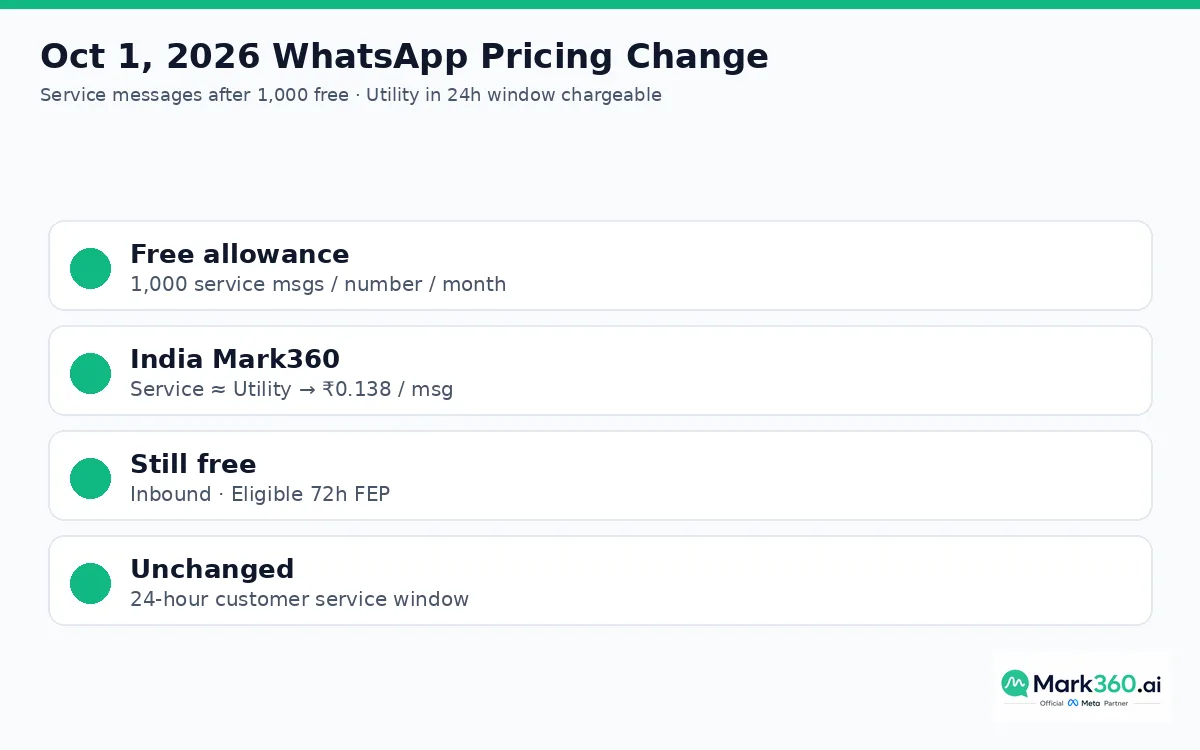
Shared inboxes do not relax Meta rules. Instagram Messaging still has windows and allowed message types — see Meta’s Instagram Messaging docs. WhatsApp still requires correct template categories and opt-in for marketing — see WhatsApp pricing and messaging policies. Consent is required before you move a promotional journey from Instagram to WhatsApp.
Implementation checklist
- Connect Instagram professional messaging and WhatsApp Business API to one inbox.
- Unify customer identity (phone + IG scoped ID mapping where available).
- Deploy AI agents on top intents with escalation rules.
- Write handoff macros that include product, objection, and next step.
- Instrument combined response time and repeat-ask rate.
- Run a weekly review of missed intents and policy events.
How Mark360 approaches shared Meta messaging
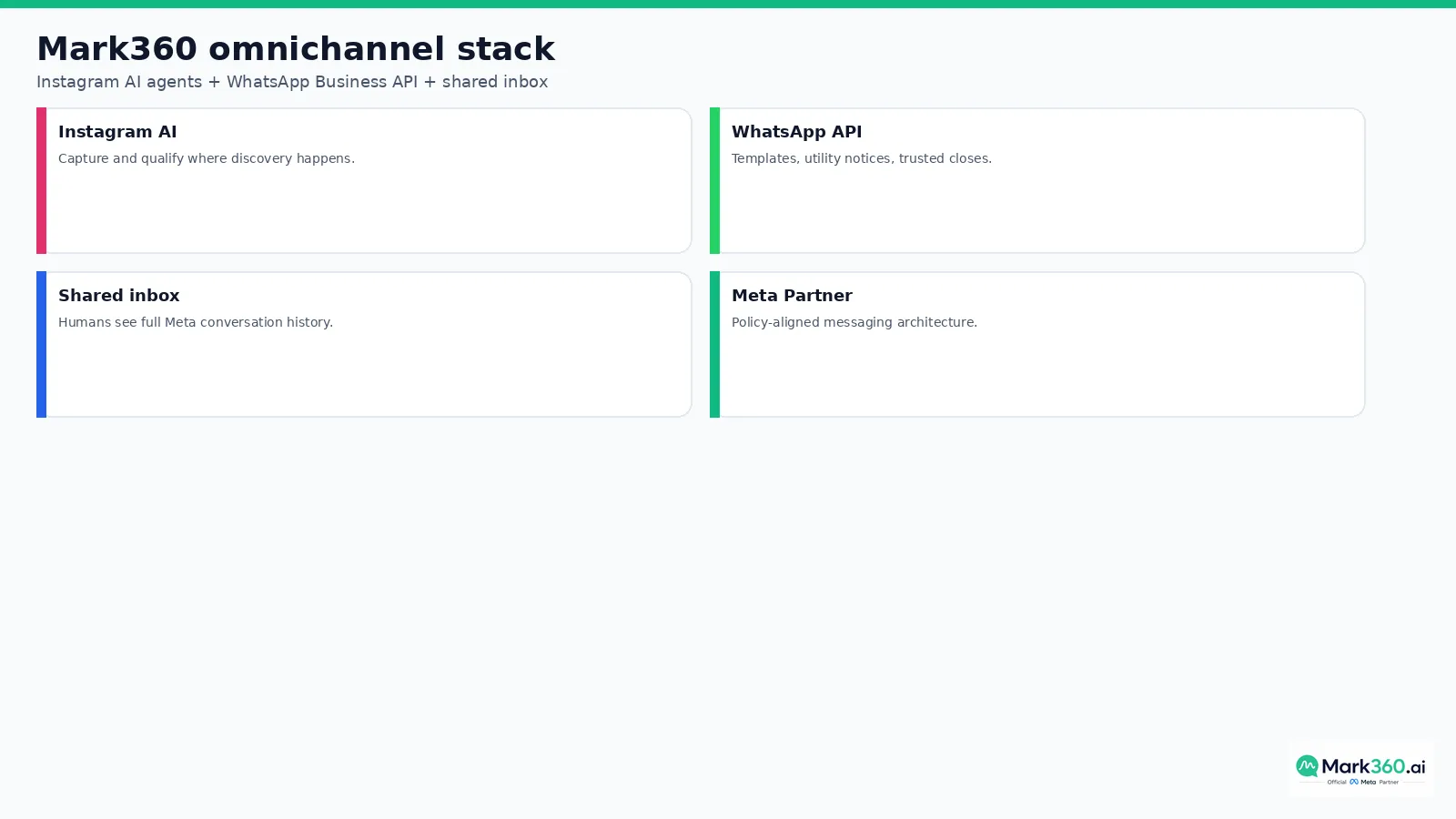
Mark360 combines Instagram AI agents, WhatsApp Business API, and a shared inbox so teams work from one conversation history. Soft CTA: explore options on mark360.ai. Related reading: ecommerce Instagram DM automation and Instagram Messaging API rules.
Deep dive: identity resolution across Instagram and WhatsApp
The hardest engineering problem in shared inboxes is not UI — it is knowing that “@shopper on Instagram” and “+91… on WhatsApp” are the same person. Practical approaches include explicit linking (“Text this code on WhatsApp”), click-to-chat deep links that carry a session ID, and CRM merges after purchase. Perfect automatic matching is rare; design for graceful linking prompts instead of silent wrong merges.
Wrong merges are worse than no merges. If two customers get combined, agents see private data they should not. Prefer confirmed links and keep an easy “unlink / this is someone else” control for humans.
Staffing model for peak Meta moments
Reels, drops, and ad spikes do not respect business hours. A shared inbox lets you flex staffing across channels: when Instagram spikes, agents who usually work WhatsApp can help because the UI and history model are the same. Document surge rules: which intents AI must keep, which require humans, and when to pause non-urgent marketing templates so service quality stays high.
Also define “quiet hours” messaging policy. Automation can acknowledge; humans may defer. Buyers tolerate overnight AI more than overnight silence — if the AI is accurate and the human promise is clear.
Change management when merging tools
Merging Instagram and WhatsApp operations is a change-management project. Announce the new inbox, retire parallel reply habits, and run a two-week shadow period where leads spot-check AI escalations. Celebrate reductions in repeat-ask rate publicly so the team sees why the new workflow exists.
Do not flip every automation on day one. Start with after-hours acknowledgment and top five FAQs. Expand only when escalation quality is stable. Tool sprawl returns quickly if AI creates more cleanup work for humans than it removes.
Playbook: first 14 days on a shared inbox
Day 1–2: connect Instagram Messaging and WhatsApp Business API, map agent seats, and disable personal-phone forwarding. Day 3–4: import or rewrite the top twenty FAQs into the AI knowledge base with catalog fields. Day 5–6: define escalation tags for refund, VIP, influencer, and abuse. Day 7: soft launch after-hours AI only.
Day 8–10: enable daytime AI for the safest intents while humans watch a live feed of escalations. Day 11–12: turn on Instagram-to-WhatsApp consent prompts for payment-ready shoppers. Day 13–14: publish the KPI dashboard and hold a retro on repeat-ask incidents. This cadence prevents a big-bang cutover that overwhelms CX.
Throughout the two weeks, keep a “parking lot” doc for edge cases the AI mishandles. Each parking-lot item becomes either a knowledge update, an escalation rule, or a human-only topic. That loop is how shared-inbox AI gets better without endless prompt tinkering.
Security and access control
Shared inboxes concentrate customer data. Enforce SSO, role-based permissions, export controls, and retention limits. Contractors should see only the brands they support. Disable unrestricted download of full transcripts unless there is a documented need. Log every human view of payment-related attachments.
Also separate production and test WhatsApp numbers. Agents practicing scripts should never accidentally message real customers from a sandbox mindset. Label test conversations clearly in the UI.
Vendor evaluation questions
When comparing shared-inbox vendors, ask: Can we see Instagram and WhatsApp on one timeline today? How are identities linked? What is the escalation UX? How are WhatsApp categories selected? Where are Meta policy updates communicated? What happens to data if we leave? Can AI answers cite catalog fields rather than hallucinate?
Flow-only Instagram tools can still sit upstream for campaign capture. Evaluate them fairly for that job — then require a real omnichannel inbox for sales and support continuity.
FAQs
Do I need WhatsApp Business API for a shared inbox?
For scalable official WhatsApp messaging (templates, multi-agent, integrations), yes. The consumer WhatsApp Business App is not the same as the Business Platform API.
Can AI agents work across both channels?
Yes — with channel-specific policy logic. Do not assume Instagram rules equal WhatsApp rules.
Is a shared inbox only for large teams?
No. Even three-person D2C teams benefit when one person covers both channels without losing context.
Will customers mind AI?
Customers mind slow or wrong answers more than AI. Provide a human path and accurate catalog context.
Extended guidance for operators
Treat this channel system like a product: roadmap, owners, SLAs, and incident response. Weekly standups should include at least one growth lead and one CX lead. Review the top failure transcripts, not only dashboards. Dashboards show symptoms; transcripts show causes.
Document the happy path and the unhappy path. Happy path: ad or organic entry, AI answer, cart, WhatsApp confirmation. Unhappy path: wrong item, delayed shipment, angry tone — human ownership within minutes. Publish both paths so agents do not invent process under pressure.
Invest in catalog truth before clever prompts. An eloquent AI that invents stock levels is worse than a short AI that says “Let me check with a teammate.” Pair knowledge updates with every product launch the same way you pair creative with every campaign.
Finally, keep Meta documentation links in your internal wiki: Instagram Messaging, WhatsApp pricing, and messaging policies. When someone proposes a “growth hack” that sounds like cold outreach, open the docs in the meeting. Culture beats a one-time training session.
Quarterly, re-certify templates, opt-in language, and escalation matrices. Platforms change. Teams change. The brands that win messaging are the ones that treat compliance as continuous operations, not a launch checkbox.
If you need a partner approach, Mark360 combines Instagram AI agents with WhatsApp Business API under Meta Partner practices — useful when you want one stack for capture, inbox, and close rather than stitching five tools manually.
Operator appendix: staffing, scripts, and weekly rituals
High-performing Meta messaging teams run a weekly ritual that looks more like a product standup than a marketing meeting. They review: median first response time, percentage of conversations resolved without a human, repeat-ask rate, template category mix, quality signals on WhatsApp, and one transcript win plus one transcript failure. The goal is not vanity automation rates — it is trustworthy speed.
Staffing models should assume spikes. A Reel that outperforms forecast can multiply inbound within an hour. Document surge staffing: who joins the shared inbox, which intents AI must keep handling, and which campaigns pause if quality rating dips. Without a surge plan, AI becomes a polite queue while angry buyers wait.
Script governance matters as much as model choice. Keep a versioned library of greetings, clarifiers, objection handlers, and escalation phrases. Tie script versions to campaign IDs when traffic comes from ads. When conversion drops, you need to know whether creative changed, audience changed, or the first bot question changed.
Catalog truth is non-negotiable. Sync stock, variants, shipping promises, and return windows into the agent knowledge layer. If those fields are wrong, every channel — Instagram and WhatsApp — will amplify the error at machine speed. Prefer “let me confirm with a teammate” over invented certainty.
Consent language should be short, explicit, and logged. When moving a shopper from Instagram to WhatsApp for marketing follow-ups, say what they will receive and how to stop. For transactional updates after an order, use the correct WhatsApp utility patterns and Meta’s category rules. Keep official documentation links in your runbook: Instagram Messaging on Meta’s Messenger Platform docs and WhatsApp Business Platform pricing docs.
Measurement should separate discovery metrics from close metrics. Instagram may generate conversations; WhatsApp may complete payment. Credit both without double-counting revenue. Use UTMs or order tags on cart links sent from chat. Leadership trusts messaging investment when attribution is boring and consistent.
Training for humans must include how to read AI summaries, how to avoid re-asking answered questions, and how to document outcomes. The shared inbox only creates leverage if humans continue mid-stream. Re-starting with “How can I help?” after a long AI thread is an expensive habit.
Finally, schedule a quarterly policy review. Meta updates messaging products. Templates expire in usefulness. Opt-in copy drifts. Assign a named owner — growth ops or CX ops — to re-read official Meta docs, re-certify templates, and update the escalation matrix. Continuous compliance is cheaper than emergency freezes during a launch week.
Mark360’s point of view is practical: Instagram AI agents for capture and qualification, WhatsApp Business API for trusted closes and notifications, and one shared inbox so context never resets — delivered with Meta Partner alignment rather than DIY folklore about “unlimited free broadcasts.”
Field notes from brands that scaled messaging
Brands that scale Instagram and WhatsApp together usually share three habits. First, they treat the first reply as a product surface — written, tested, and owned — not an afterthought dumped on interns. Second, they separate campaign experiments from service reliability so a viral ad does not break order support. Third, they budget for messaging the way they budget for ads: expected volume, category mix, and contingency if a campaign over-performs.
They also write down what AI must never do: invent discounts, promise delivery dates not in the system, argue with abusive users, or collect payment card details in free-text chat. Those guardrails belong in configuration and training, not in a Slack folklore thread.
When something fails publicly — wrong price, delayed handoff, tone-deaf automation — they post an internal incident brief within 24 hours: what happened, customer impact, fix, and prevention. Messaging incidents are brand incidents. Treating them casually teaches the organization the wrong lesson.
Key takeaways
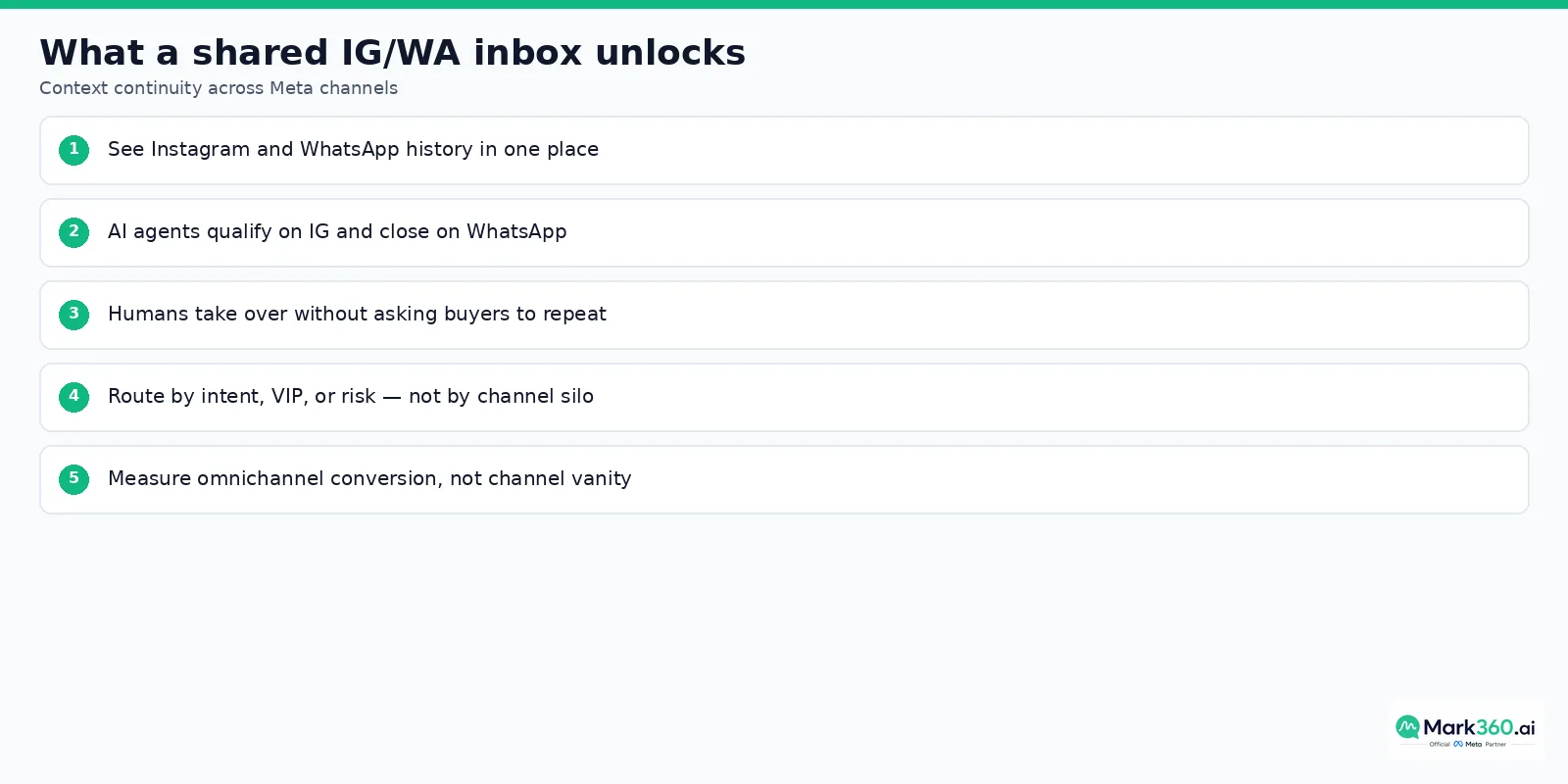
- Shared IG + WhatsApp inboxes prevent “please repeat that” churn.
- Route on intent/risk/value, not only channel.
- Measure combined response time and repeat-ask rate.
- Respect separate Instagram and WhatsApp Meta rules.
- Mark360 focuses on Instagram AI agents + WhatsApp Business API + shared inbox.