
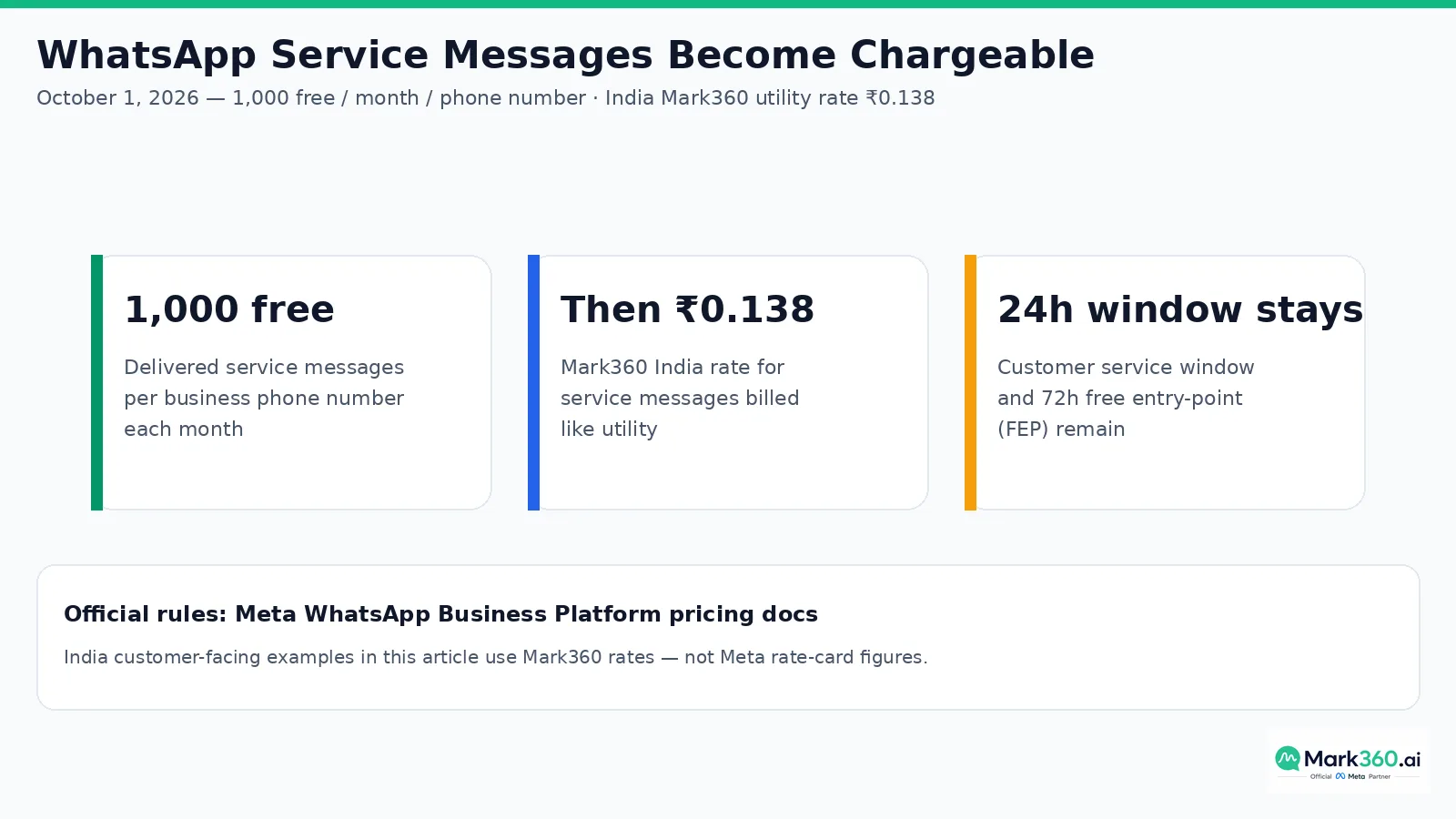
Direct answer: From October 1, 2026, WhatsApp Business Platform service messages become chargeable after 1,000 free delivered service messages per business phone number each month. Utility templates sent inside the 24-hour customer service window also become chargeable. The 24-hour window itself remains, and eligible Click-to-WhatsApp free entry-point (FEP) conversations keep their 72-hour free period.
For India customer-facing forecasts on Mark360, treat service messages above the free allowance like utility at ₹0.138 per delivered message (Marketing remains ₹0.94). These are Mark360 totals — see Meta’s official WhatsApp pricing documentation for category rules.
WhatsApp service message pricing changes on October 1, 2026
If your Shopify or D2C store uses WhatsApp for customer support, order questions, chatbots, or AI agents, prepare for this billing update before October 1, 2026.
From October 1, 2026, service messages on the WhatsApp Business Platform become chargeable after a monthly allowance of 1,000 free service messages per business phone number. Utility messages sent inside an active 24-hour customer service window also become chargeable.
The 24-hour customer service window is not being removed. What changes is how messages your business sends during that window are billed. You will also need a valid payment method on the WhatsApp Business Account when chargeable messaging applies.
What is a WhatsApp service message?
A WhatsApp service message is a free-form message sent by a business in response to a customer’s inquiry while the 24-hour customer service window is open.
Meta describes service messages as responses used to handle incoming customer inquiries. These responses can be sent by a human agent or a conversational AI-powered bot.
For example, a customer sends your store: “Where is my order?” Your support team replies with the latest delivery status in a normal free-form WhatsApp message. That is a service message.
If an AI agent generates the same response, it is still treated according to the applicable WhatsApp message rules. AI generation alone does not create a different pricing category.
What changes from October 1, 2026?
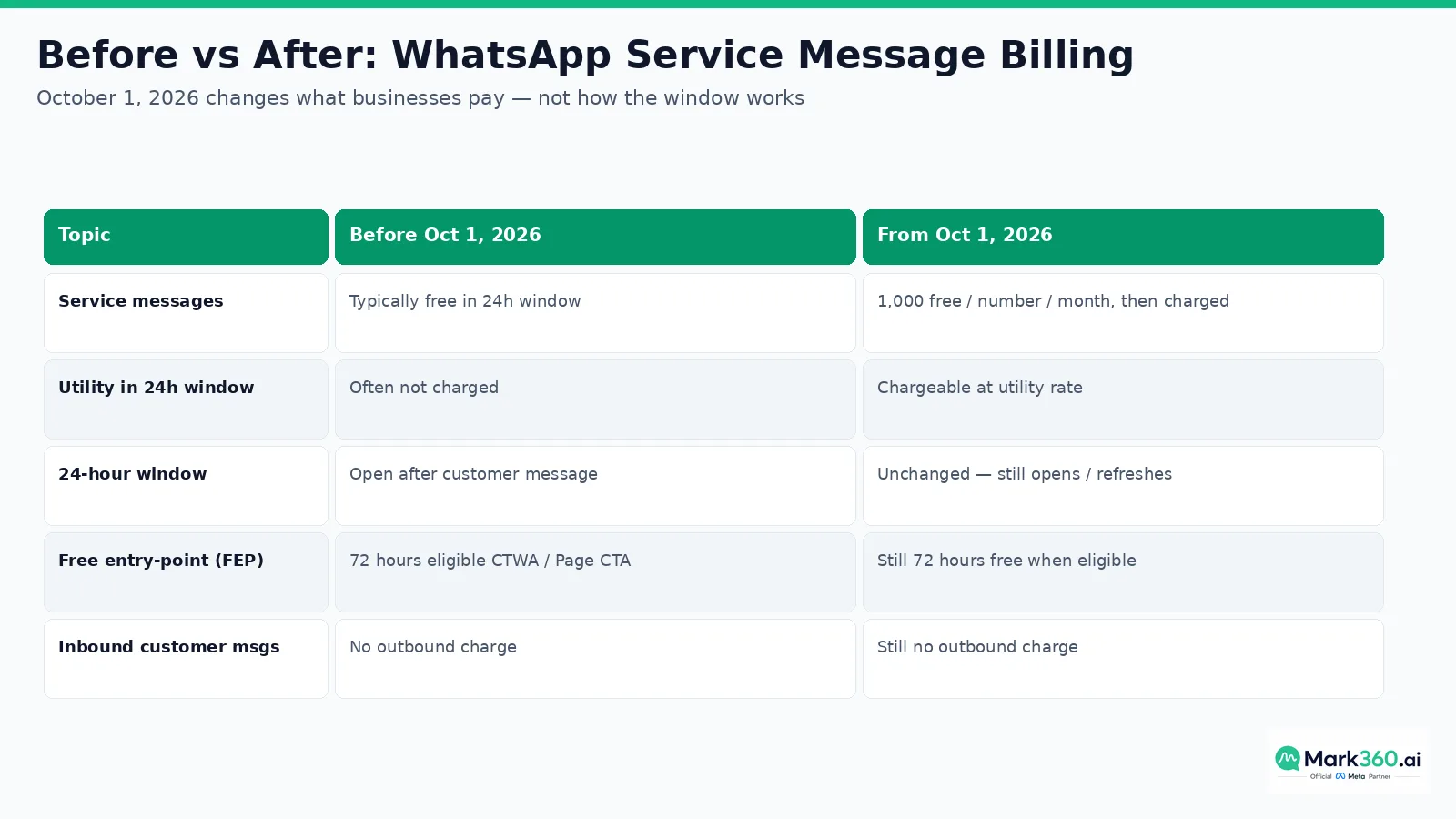
Shopify and D2C teams need to understand two billing changes: service messages become chargeable after the new monthly free allowance, and utility templates sent inside the 24-hour customer service window also become chargeable.
| Message type | From October 1, 2026 |
|---|---|
| Service message | First 1,000 delivered service messages per business phone number each month are free; additional delivered service messages are charged |
| Utility template inside 24-hour window | Charged according to the applicable utility rate for the recipient market |
| Utility template outside 24-hour window | Charged according to the applicable utility rate |
| Marketing template | Charged according to the applicable marketing rate |
| Authentication template | Charged according to the applicable authentication rate |
| Incoming customer message | No outbound business message charge |
| Eligible free entry-point messaging | Business messages remain free for the applicable 72-hour free entry-point period |
WhatsApp Business Platform pricing is based on messages that are delivered. The applicable price depends on the message category and the recipient’s market. For official category definitions and market rules, use Meta’s WhatsApp Business Platform pricing docs.
How the 1,000 free service messages work
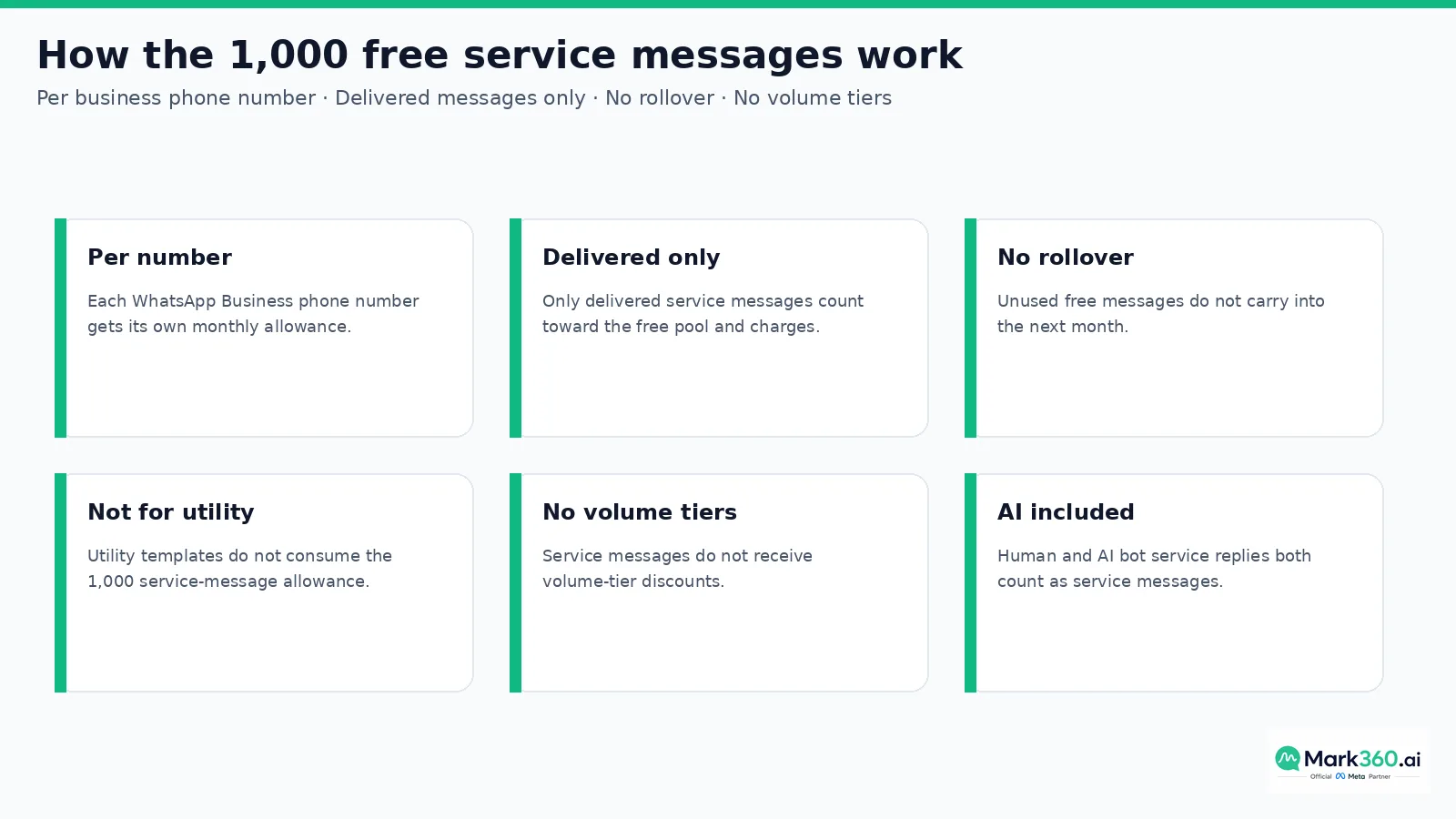
Starting October 1, each WhatsApp Business phone number receives 1,000 free service messages per month.
The allowance applies to delivered service messages. It is not 1,000 conversations, 1,000 customers, or 1,000 customer-service windows.
- Each business phone number gets its own monthly allowance.
- The allowance applies only to service messages.
- Only delivered service messages count toward the applicable message charge.
- Billing begins after the 1,000 free service messages have been used.
- Unused free service messages do not roll over.
- Utility templates do not consume the 1,000 free service-message allowance.
- Service messages do not receive volume-tier discounts.
Example: 800 service messages
If one business phone number delivers 800 service messages during a month, all 800 are covered by the monthly free allowance.
Example: 2,500 service messages
If the same number delivers 2,500 service messages during a month, the first 1,000 are covered by the allowance and the remaining 1,500 are chargeable at the applicable service rate for the recipient market.
Forecast costs using outbound delivered service messages, not only the number of WhatsApp conversations.
How much does a WhatsApp service message cost in India?
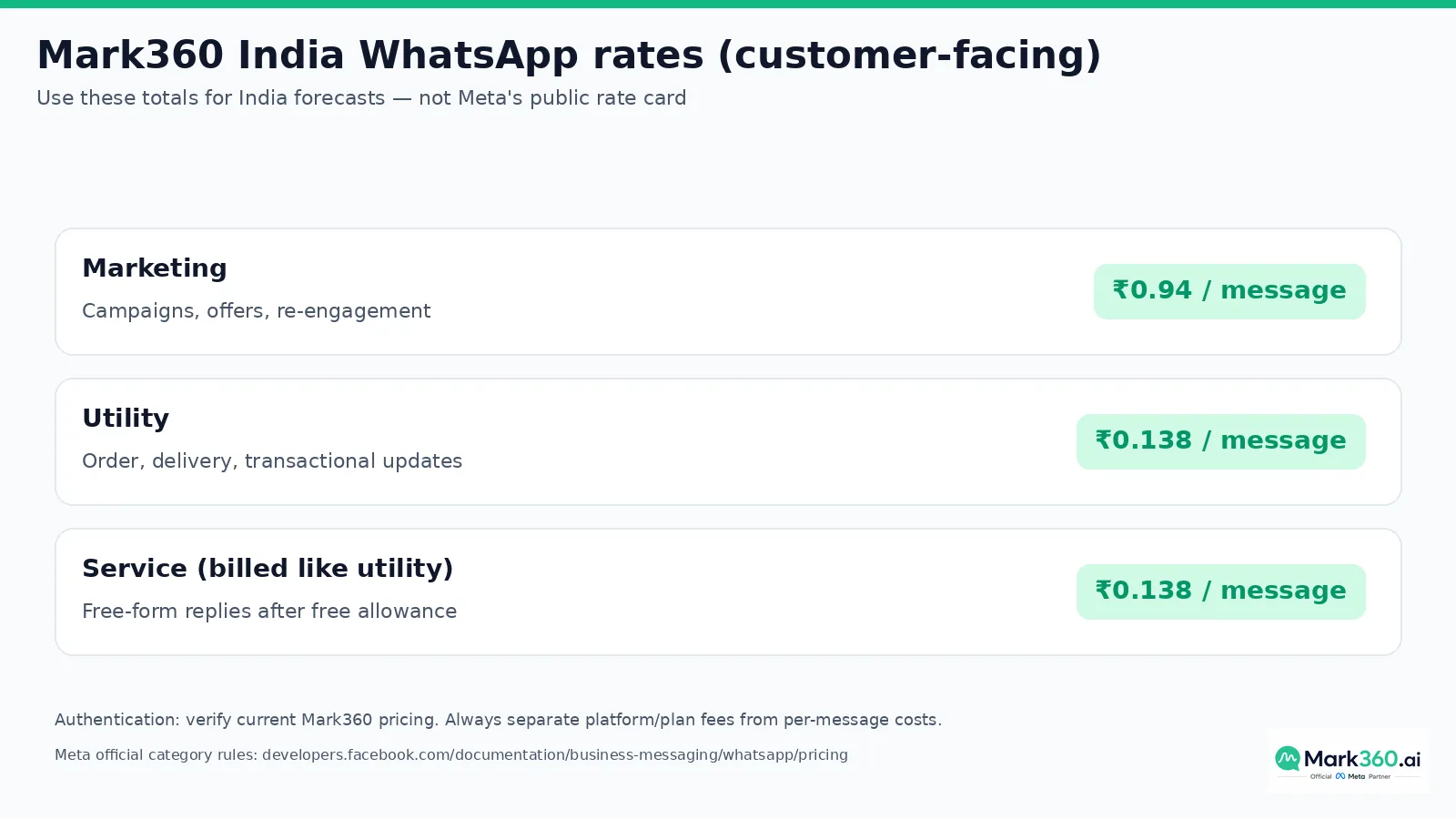
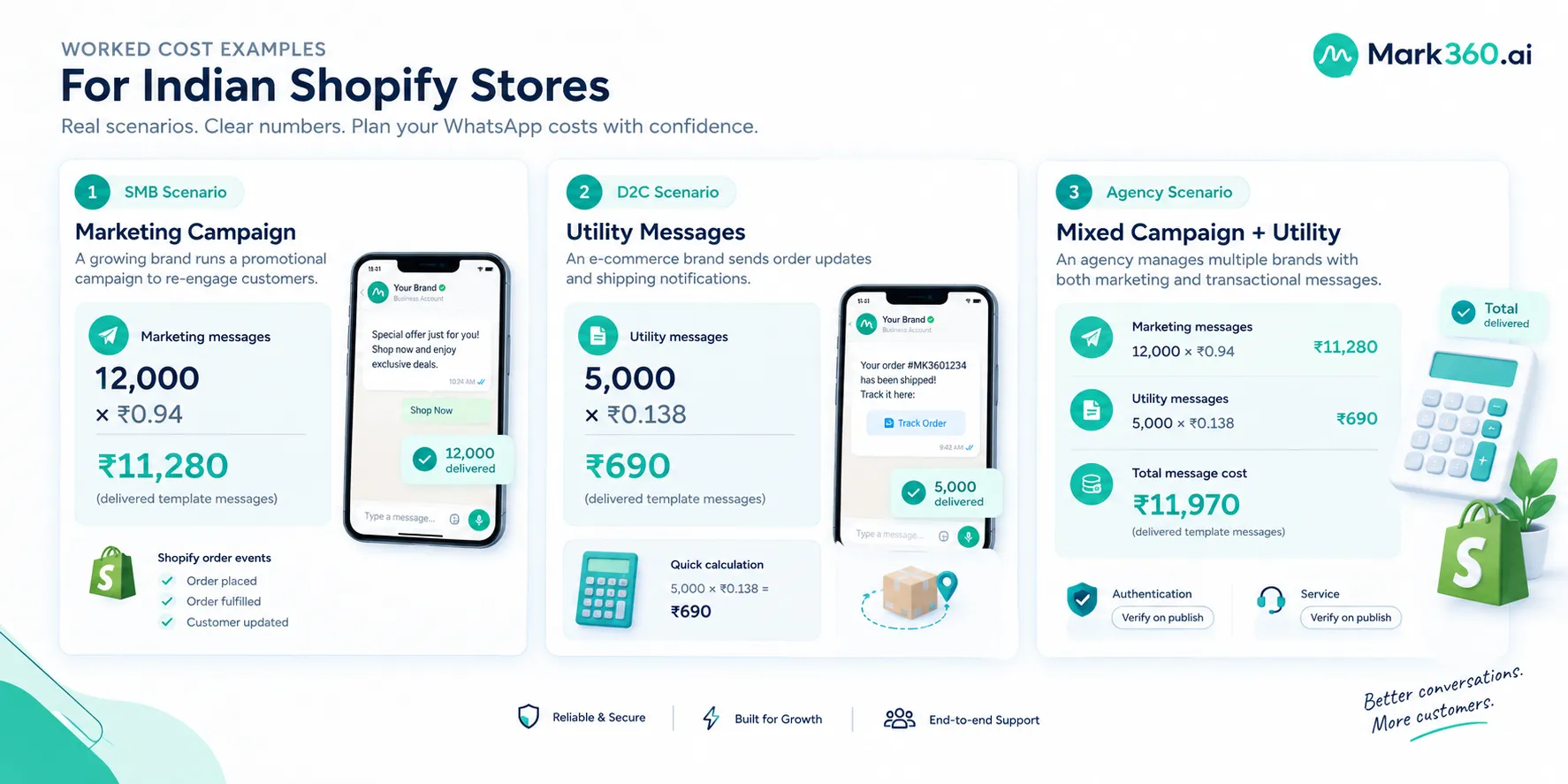
For India customer-facing planning on Mark360, service messages above the free allowance are billed like utility at ₹0.138 per delivered message. Marketing remains ₹0.94 per delivered message.
These figures are Mark360 customer-facing India totals used in this article for forecasting. They are not Meta’s official rate-card figures. Always cross-check category rules in Meta’s pricing documentation, and keep platform or plan fees separate from per-message costs. For a fuller India rate walkthrough, see WhatsApp Business API pricing in India (2026).
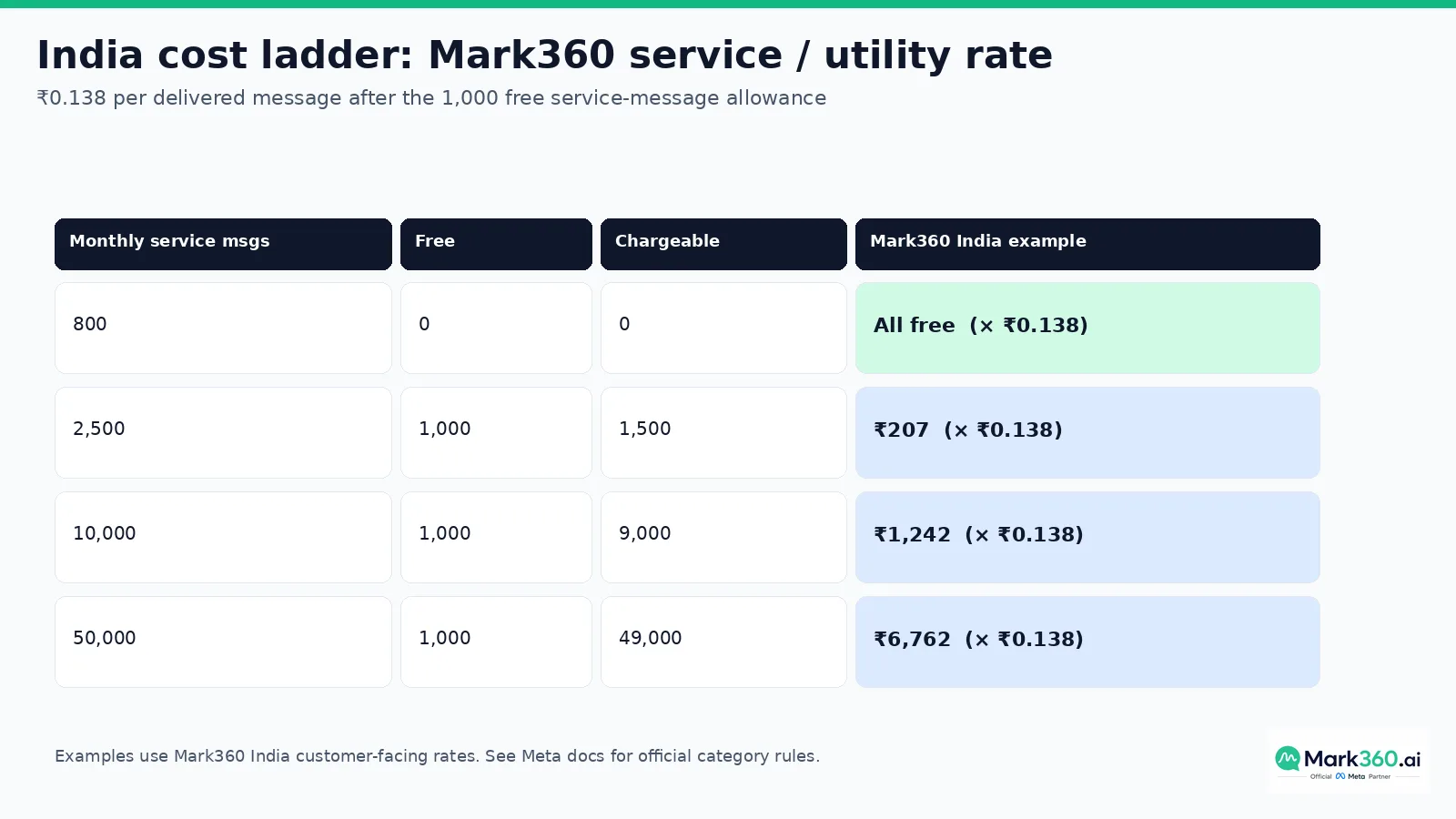
| Monthly delivered service messages | Free messages | Chargeable messages | Mark360 India example at ₹0.138 |
|---|---|---|---|
| 800 | 800 | 0 | ₹0 |
| 2,500 | 1,000 | 1,500 | ₹207 |
| 10,000 | 1,000 | 9,000 | ₹1,242 |
| 50,000 | 1,000 | 49,000 | ₹6,762 |
Worked examples: 1,500 × ₹0.138 = ₹207; 9,000 × ₹0.138 = ₹1,242; 49,000 × ₹0.138 = ₹6,762. These examples show Mark360 India per-message totals only and exclude taxes and separate platform fees.
What stays free vs what becomes chargeable

- Still free / covered: incoming customer messages; the first 1,000 delivered service messages per business phone number each month; eligible 72-hour free entry-point messaging (Click-to-WhatsApp Ads or eligible Facebook Page CTAs).
- Chargeable from October 1: service messages after the free allowance; utility templates inside the 24-hour window; marketing, utility, and authentication templates under their applicable rules.
If you run Click-to-WhatsApp Ads, track the 72-hour free entry-point separately — see our Click to WhatsApp Ads guide for India.
Why the recipient’s country matters
WhatsApp Business Platform pricing depends on the recipient’s market. A business based in India does not automatically pay the Indian rate when messaging a customer in another country.
If your Shopify store sells internationally, model WhatsApp costs by the countries where customers receive messages. The same message category can have different pricing by recipient market.
Do utility messages become paid inside the 24-hour window?
Yes. From October 1, 2026, utility templates sent inside an active 24-hour customer service window become chargeable.
Utility messages are used for specific, user-requested, or transactional information — order confirmations, delivery updates, payment-related updates, and similar notifications that meet Meta’s utility requirements.
Important: the 1,000 free service messages do not cover utility templates. On Mark360 India pricing, utility (and service messages billed like utility after the free allowance) is ₹0.138 per delivered message.
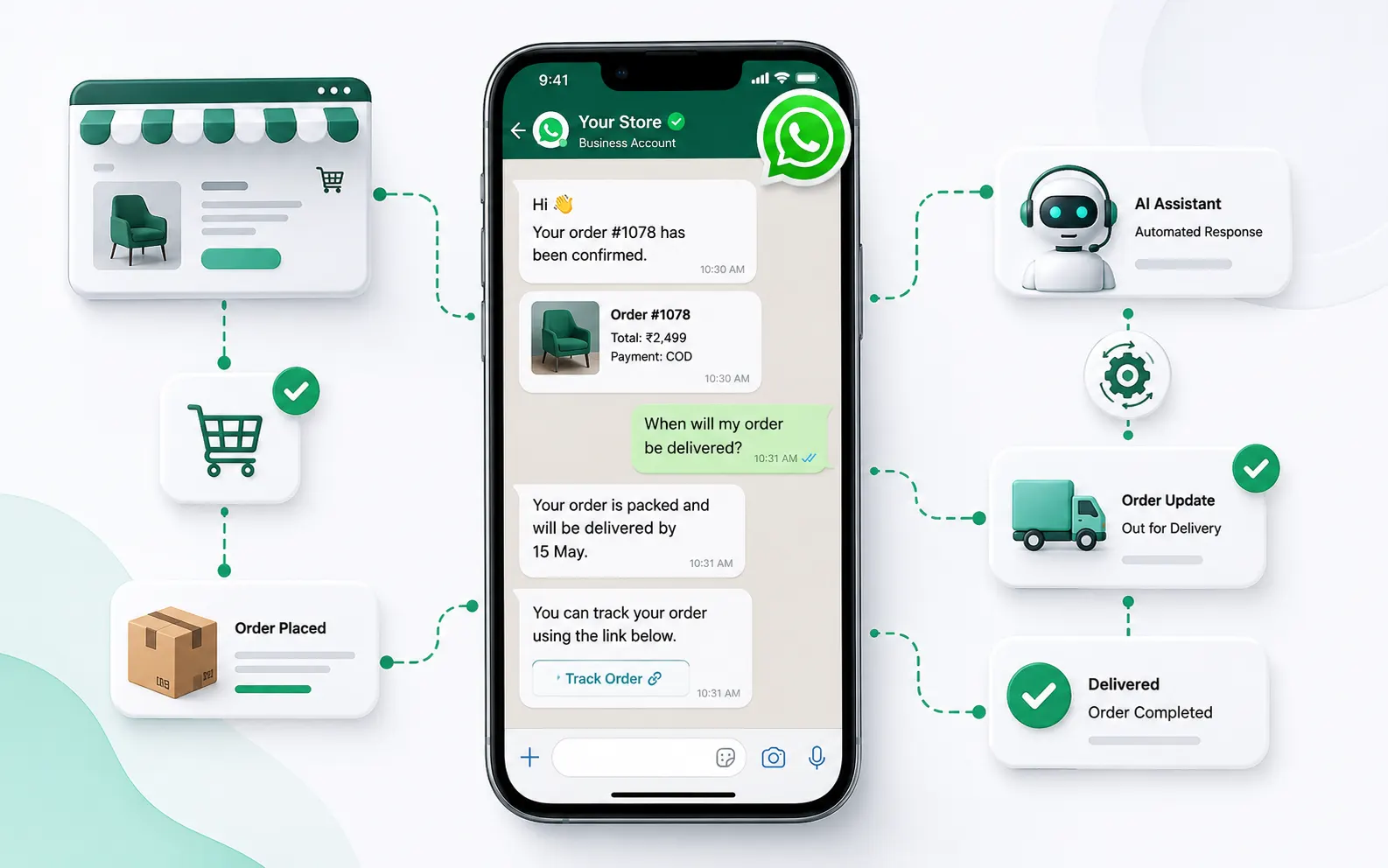
Example: order-status conversation
A customer asks: “Can you tell me when my order will arrive?”
If your agent sends a normal free-form response with delivery information, that response is a service message and counts toward the monthly service-message allowance.
If your workflow sends an approved utility template with the order or delivery information, it is a utility message and is charged separately under utility pricing.
Is the 24-hour WhatsApp customer service window ending?
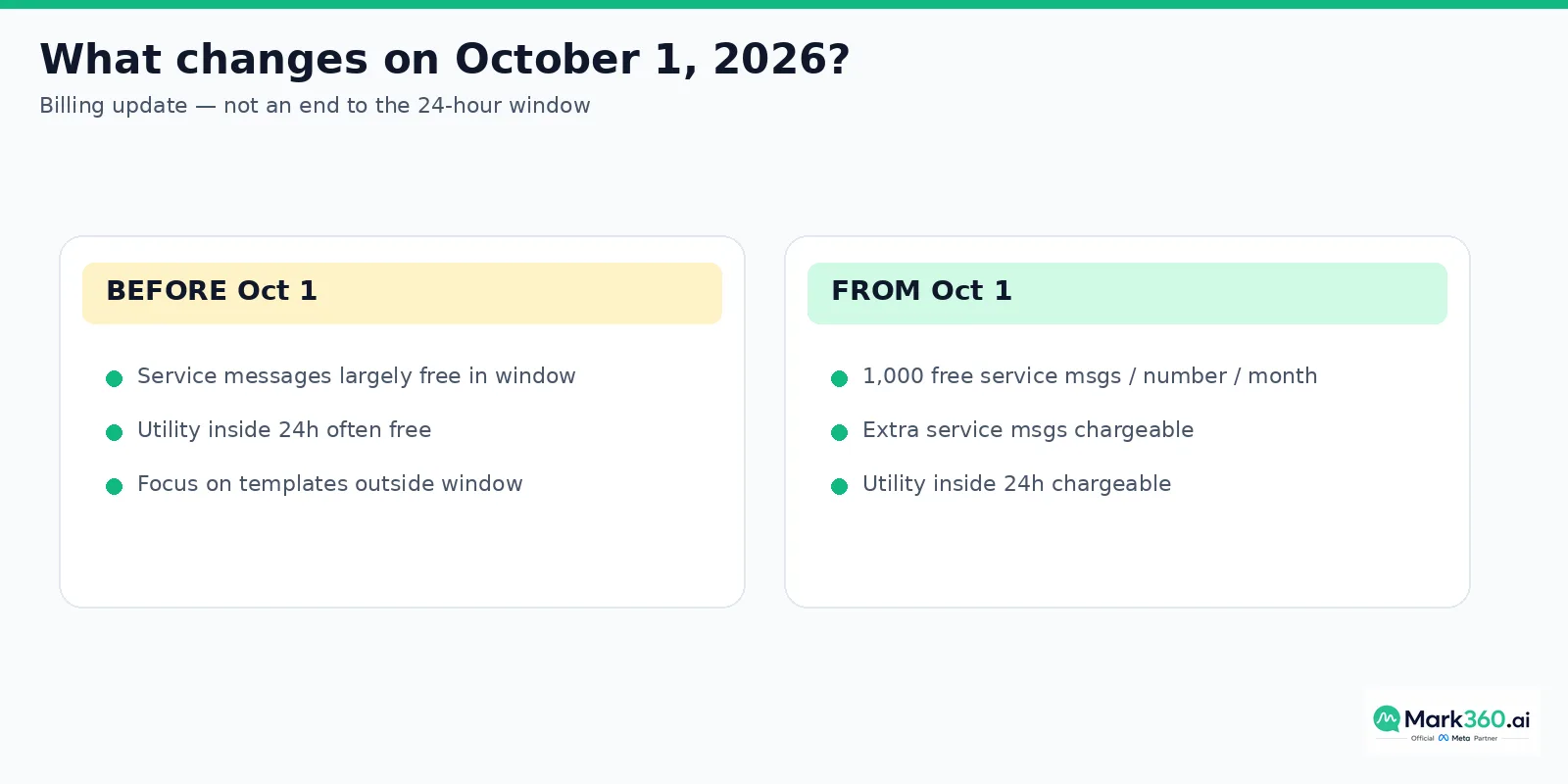
No. The 24-hour customer service window remains.
When a customer messages your business, the customer service window opens. A new customer message refreshes the window.
During the window, businesses can respond with service messages. The October 2026 change affects the pricing of those service messages; it does not remove the window.
When the customer service window is closed, a business-initiated message generally requires an approved message template.
What WhatsApp messages will remain free?
Some WhatsApp messaging remains free under current rules. Incoming customer messages are not charged as outbound business messages, and eligible free entry-point conversations retain their free messaging period.
Meta provides a 72-hour free entry-point window when a customer starts a conversation through an eligible Ad that clicks to WhatsApp or an eligible Facebook Page call-to-action button.
- Incoming customer messages remain free.
- Eligible Click-to-WhatsApp entry-point conversations retain the 72-hour free period.
- Eligible Facebook Page call-to-action entry-point conversations retain the 72-hour free period.
- The 24-hour customer service window remains available for customer-initiated conversations.
What this means for Shopify stores
The pricing change matters most when WhatsApp is a high-volume customer-support channel.
Common Shopify questions — “Where is my order?”, “Can I change my address?”, “Is COD available?”, “When will my refund arrive?”, “Can I return this?” — each drive outbound service replies from your team, chatbot, or AI agent.
Track outbound service messages per resolved customer request, not only conversation count.
Why AI agents need a message-volume audit
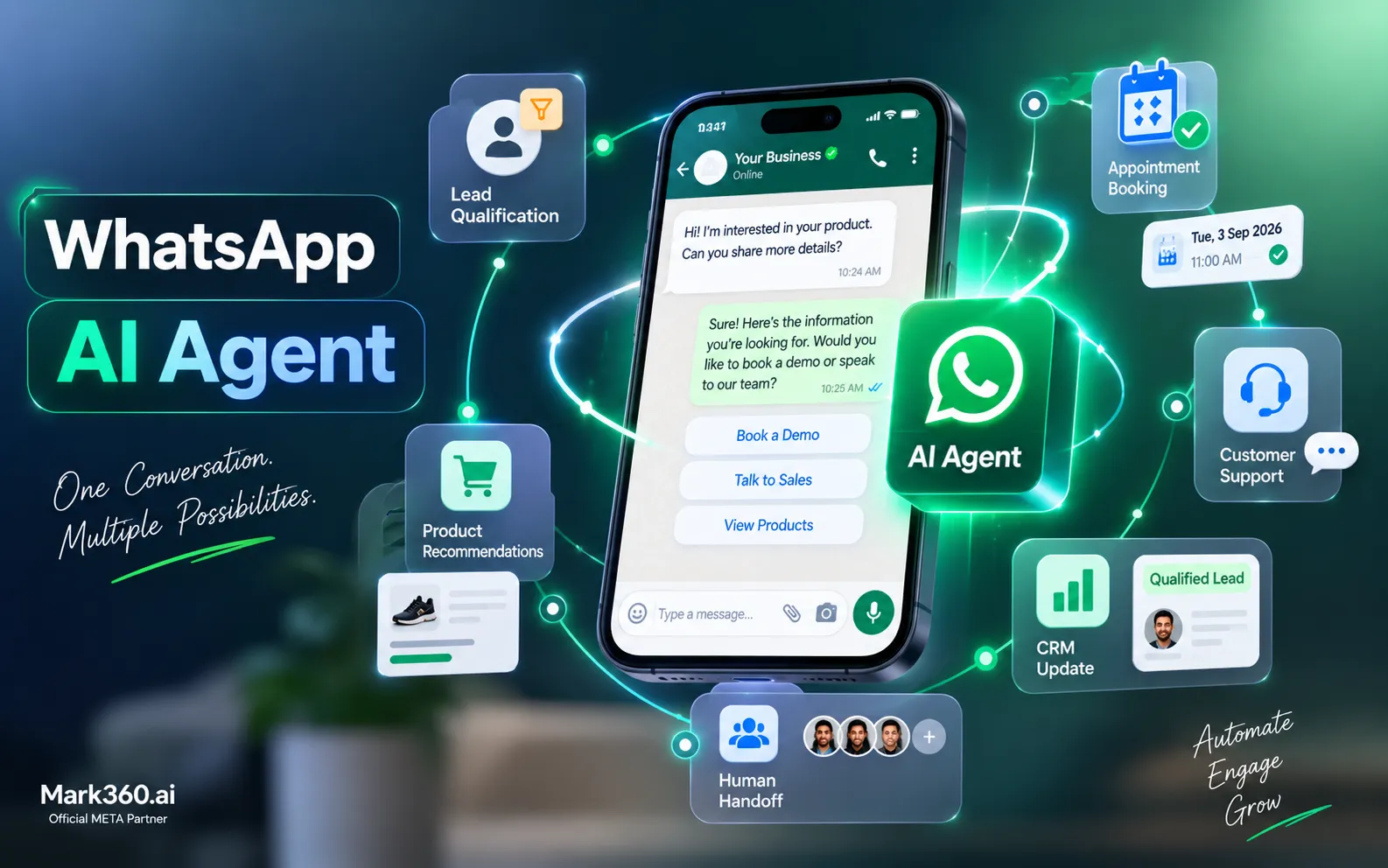
Meta includes conversational AI-powered bots in the service-message use case. If your AI agent responds through the WhatsApp Business Platform, those outbound service messages belong in your cost forecast.
An inefficient AI workflow might send four separate messages (“Sure, let me check.” / “I found your order.” / “It has been shipped.” / “Here is your tracking link.”). A better workflow delivers order status and tracking in one useful response.
That does not mean every reply must be a single message — it means avoid unnecessary splitting when one complete response can solve the request. For how AI agents fit support automation, see the WhatsApp AI Agent for Business complete guide.
How to reduce WhatsApp service-message costs
Understand outbound volume and remove unnecessary messages from workflows.
1. Measure delivered service messages
Separate incoming messages from outbound service messages and count how many service messages are actually delivered.
2. Track messages per resolved request
Use outbound service messages needed to resolve a customer request as both an ops and cost metric.
3. Audit chatbot and AI agent flows
Look for workflows that send several short messages for one simple request — order tracking, COD, returns, refunds, delivery, and product questions.
4. Keep utility templates correctly categorized
Do not classify promotional content as utility. Utility messaging must match the purpose and Meta’s requirements.
5. Use the 24-hour window correctly
The window still determines when service messages can be sent. When it closes, use an approved template for business-initiated messaging.
6. Track free entry-point conversations
If you use Click-to-WhatsApp Ads or eligible Page CTAs, track those conversations separately because the 72-hour free period affects cost.
7. Don’t add phone numbers only to chase free messages
The allowance is per business phone number, but extra numbers add routing, templates, access, history, reporting, and brand overhead. Use multiple numbers when the business structure requires them — not only for allowances.
What should Shopify merchants do before October 1?
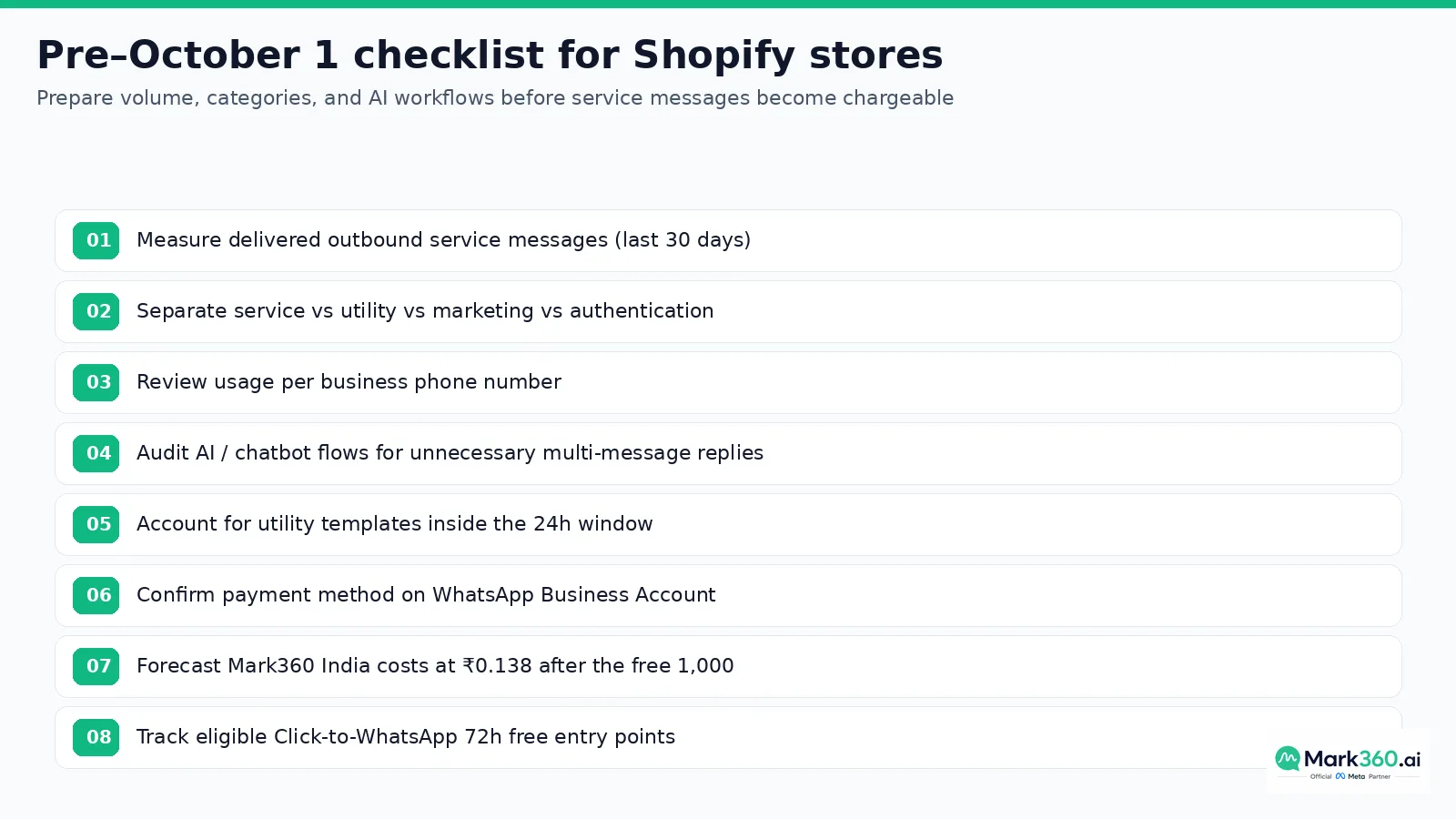
You do not need to rebuild your WhatsApp strategy. You need a clear picture of how existing workflows generate outbound messages.
- Measure service-message volume — review at least the previous 30 days of outbound WhatsApp activity.
- Separate categories — distinguish service, utility, marketing, and authentication traffic.
- Review each phone number — calculate service-message usage separately for every business phone number.
- Check recipient markets — international stores should account for pricing by recipient market.
- Audit AI responses — find workflows that send unnecessary multi-message replies.
- Review utility templates — account for utility messages inside the 24-hour window becoming chargeable.
- Check billing configuration — confirm payment method and WhatsApp Business Account setup for chargeable messaging.
- Build an October forecast — estimate service messages above the 1,000 free allowance (India Mark360 examples at ₹0.138) plus expected utility, authentication, and marketing usage.
FAQs
Does the 1,000 free allowance apply to every WhatsApp message?
No. The 1,000 free messages apply specifically to service messages. Marketing, utility, and authentication follow their applicable pricing. Utility templates inside the 24-hour window become chargeable from October 1, 2026.
Are incoming WhatsApp messages charged?
The service-message charge applies to messages sent by the business. A customer messaging your business is not an outbound service message.
Do WhatsApp service messages have volume discounts?
No. Service messages do not receive volume-tier discounts under the October 2026 pricing model.
Can an AI chatbot send WhatsApp service messages?
Yes. Meta’s service-message definition includes responses handled by conversational AI-powered bots. Include those messages in your volume forecast and follow WhatsApp policies.
Does WhatsApp still allow automation inside the 24-hour window?
Yes. Meta’s Business Messaging Policy permits automation during the 24-hour window when businesses meet applicable requirements and provide clear escalation paths. The October update is a billing change, not an automation ban.
How much does a WhatsApp service message cost in India on Mark360?
For Mark360 India customer-facing forecasts, use ₹0.138 per delivered message for service messages billed like utility after the free allowance, and ₹0.94 for marketing. These are Mark360 totals, not Meta’s official rate card.
How Mark360 helps Shopify teams prepare
For Shopify automation, the answer is not simply “send fewer WhatsApp messages.” Automation should resolve requests with the right information and without unnecessary message splitting.
That means connecting WhatsApp conversations to Shopify context — order status, payment status, delivery information, return eligibility, COD details, and customer history — so an AI agent can answer completely in fewer outbound messages.
Mark360 connects Shopify workflows, WhatsApp automation, and AI-powered customer conversations so teams can automate routine support while keeping a clear path to human assistance.
Explore WhatsApp automation with Mark360 · See Mark360 pricing · WhatsApp automation for ecommerce guide.
WhatsApp service message pricing: what to remember
From October 1, 2026, WhatsApp Business Platform service messages become chargeable after 1,000 free delivered service messages per business phone number each month. Utility templates inside the 24-hour customer service window also become chargeable.
The 24-hour customer service window remains. Incoming customer messages remain free as inbound messages, and eligible Click-to-WhatsApp and Facebook Page entry-point conversations retain their 72-hour free messaging period. Ensure a payment method is ready for chargeable messaging.
For India Mark360 forecasts: service / utility examples use ₹0.138 per delivered message after the free allowance; marketing uses ₹0.94. Link Meta’s docs for official category rules, and track one number before October: outbound service messages per resolved customer request.