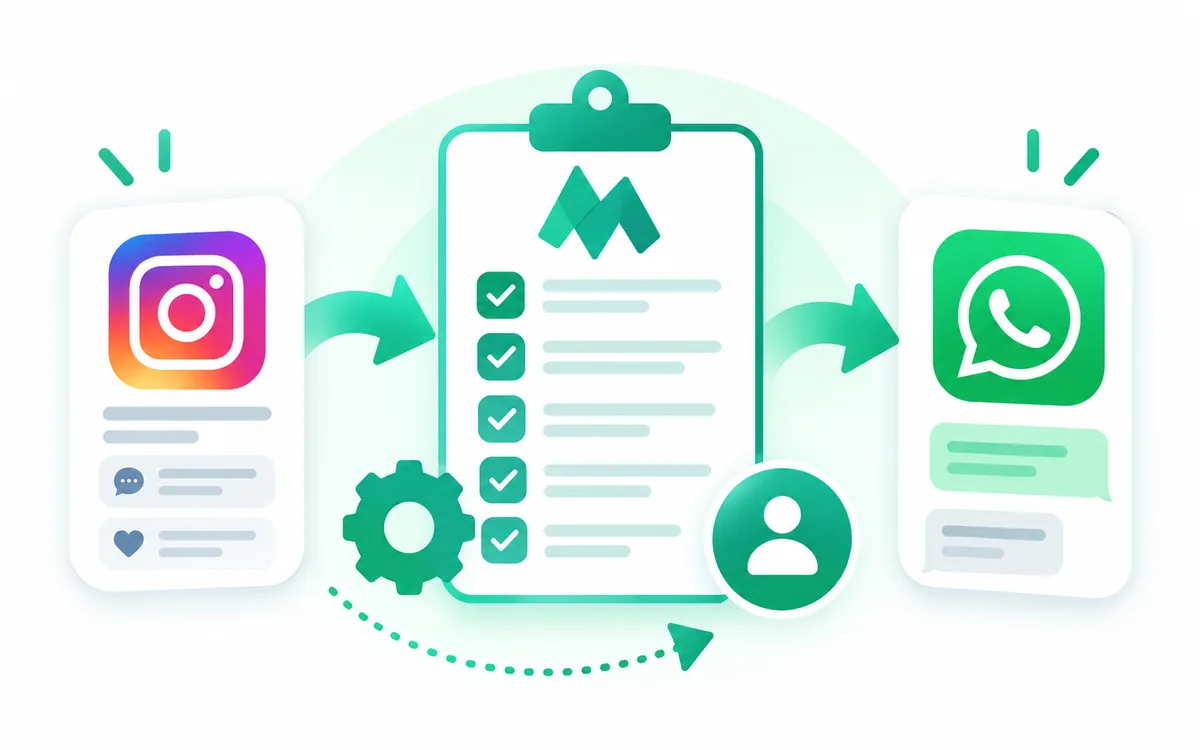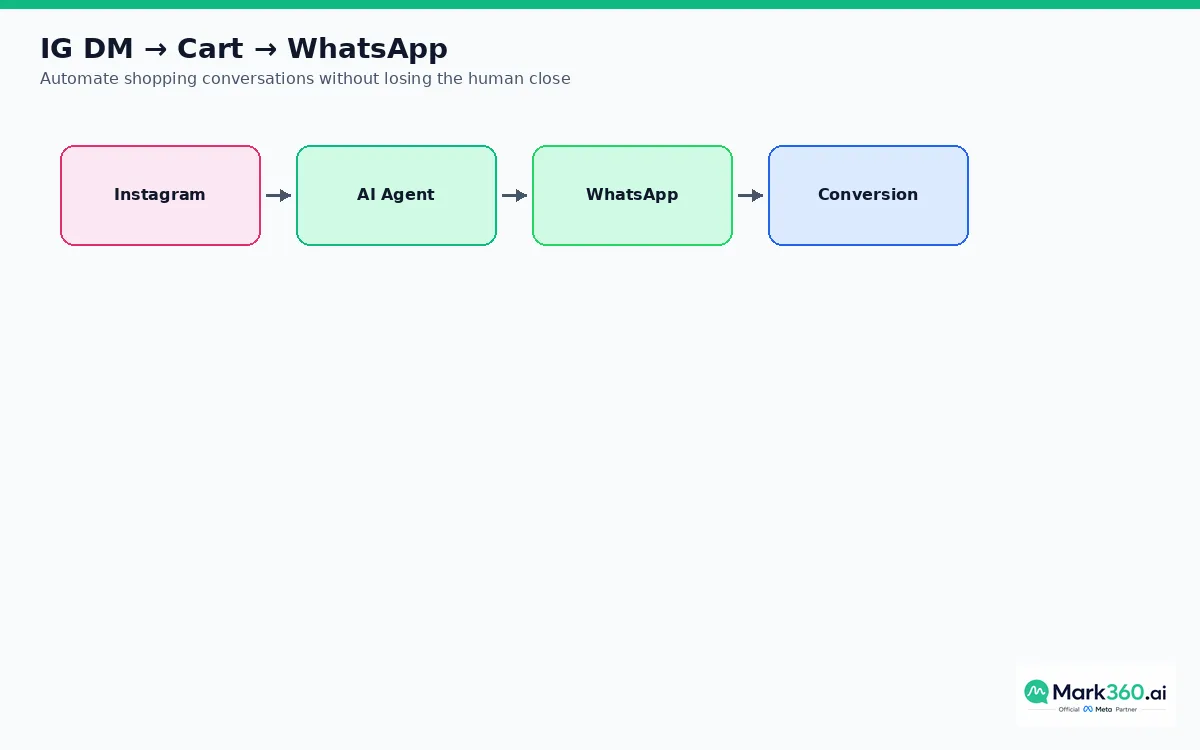


Direct answer: An Instagram comment-to-DM to WhatsApp funnel captures attention with a keyword comment on a post or Reel, opens a private Instagram DM to qualify the buyer with an AI agent or short script, then hands the conversation to WhatsApp Business API for catalogs, templates, payments, and human close. Instagram wins discovery; WhatsApp wins durable conversion when you respect Meta messaging rules and track stage metrics instead of vanity comments.
Why Instagram capture and WhatsApp close belong together

Instagram is where attention lives: Reels, creators, UGC, and social proof. WhatsApp is where commitment lives: catalogs, order updates, appointment reminders, and sales follow-up. Brands that force every close inside Instagram DMs often hit messaging window limits, weak payment UX, or inbox chaos. Brands that jump straight to WhatsApp without an Instagram hook miss Meta's cheapest attention channel.
The complete funnel is a deliberate bridge: comment keyword → DM qualification → WhatsApp handoff → revenue. For channel trade-offs, see Instagram DM automation vs WhatsApp Business API. For tool choice, see best Manychat alternatives 2026.
Funnel stages and the metrics that matter
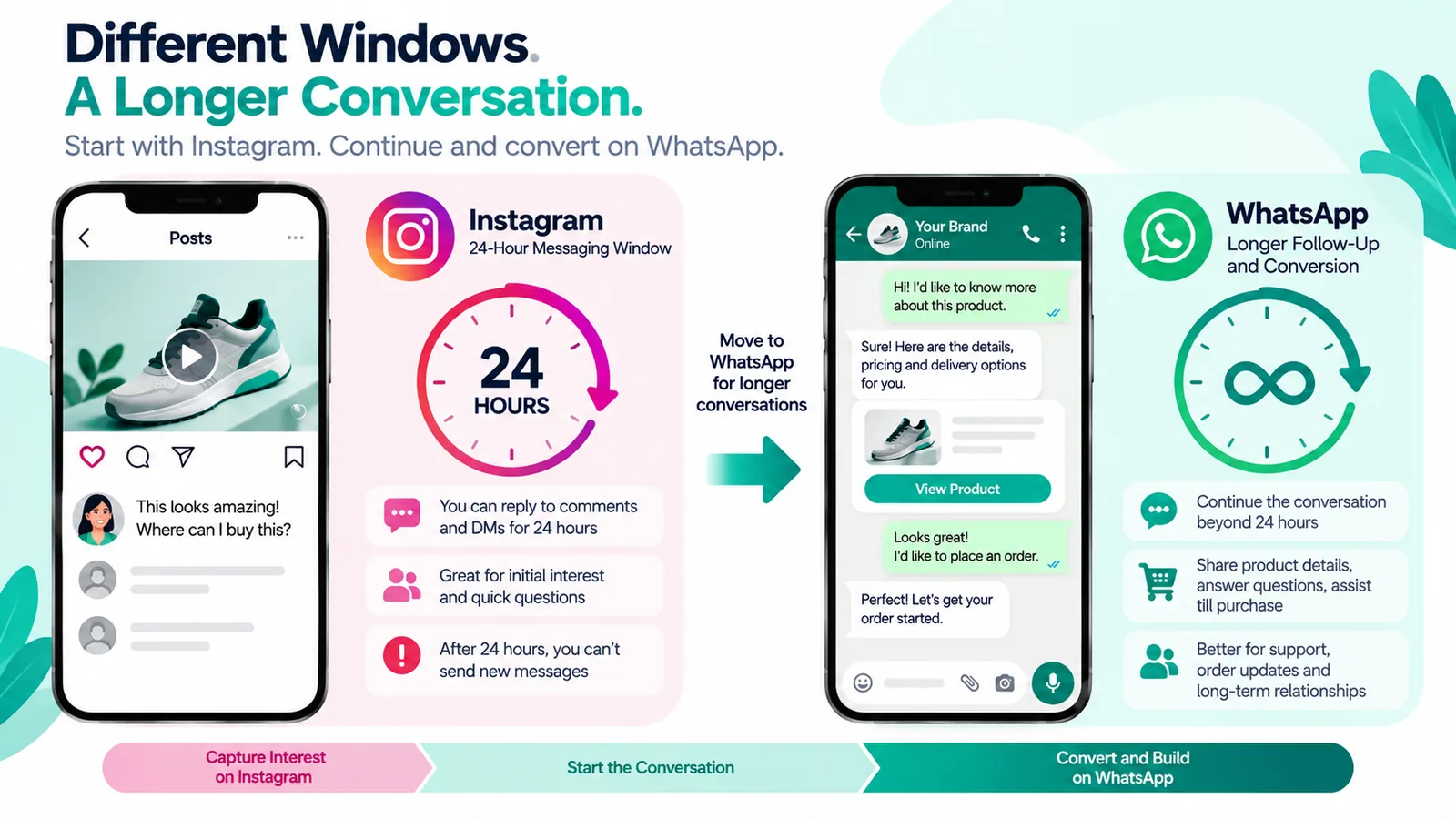
- Attract: Post, Reel, or ad with a clear keyword CTA ("Comment PRICE", "Comment DEMO").
- Trigger: Comment keyword opens a private reply and Instagram DM.
- Qualify: AI agent asks two or three questions — need, budget, timing.
- Handoff: One-tap WhatsApp deep link or Click-to-WhatsApp destination with consent language.
- Close: WhatsApp Business API templates, catalog, and human close when needed.

Optimize stage by stage. A viral Reel with weak DM opens is a creative problem. Strong DM opens with weak WhatsApp starts is a handoff problem. Strong WhatsApp starts with weak revenue is an offer or sales problem.
Instagram Messaging rules you must respect
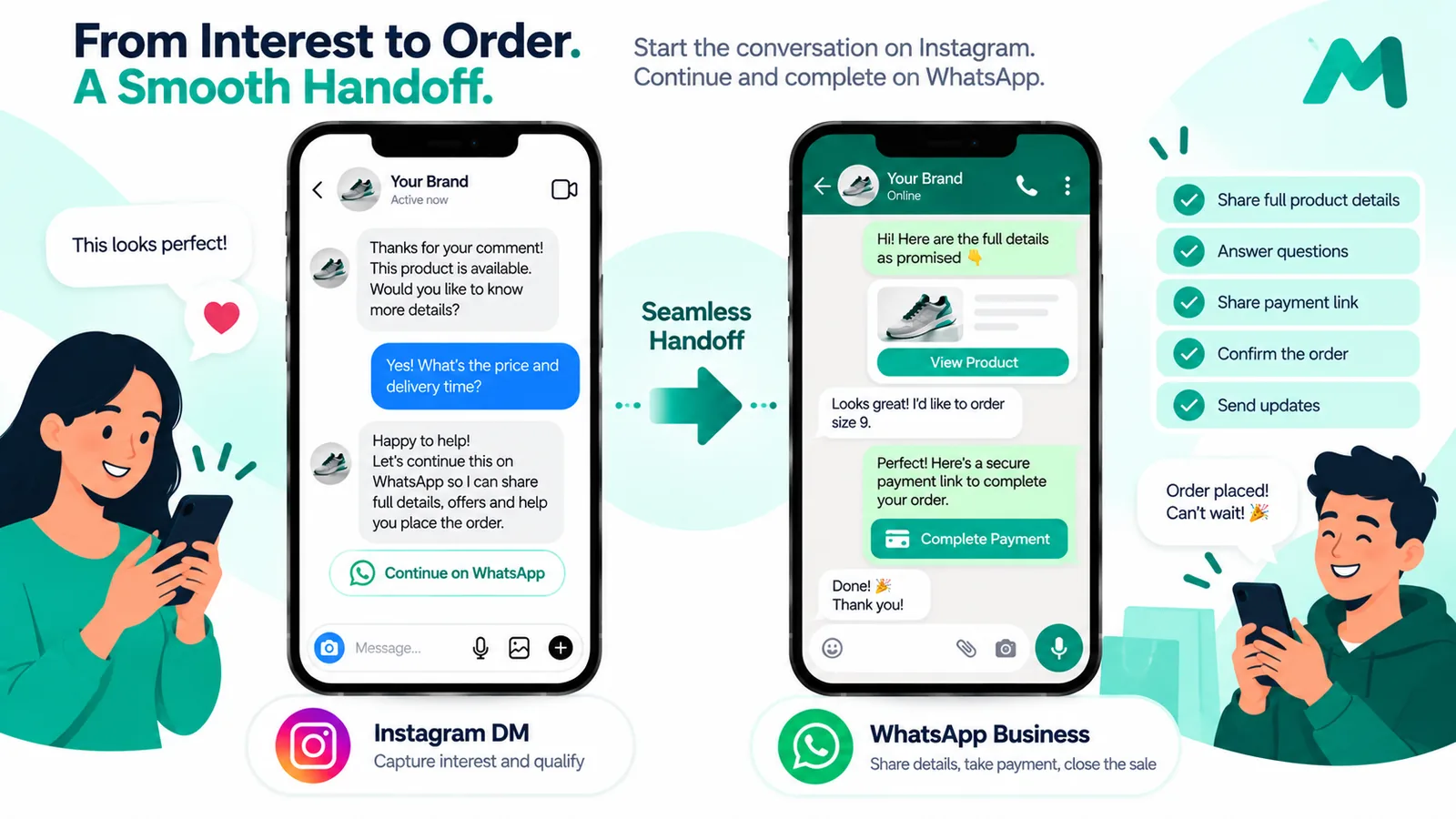
Automation on Instagram is powerful and constrained. Read Meta's Instagram messaging documentation for ice breakers, human agent tags, and messaging windows. Avoid spammy comment loops. Keep private-reply copy clear. If you use AI agents, define escalation for complaints and legal topics.
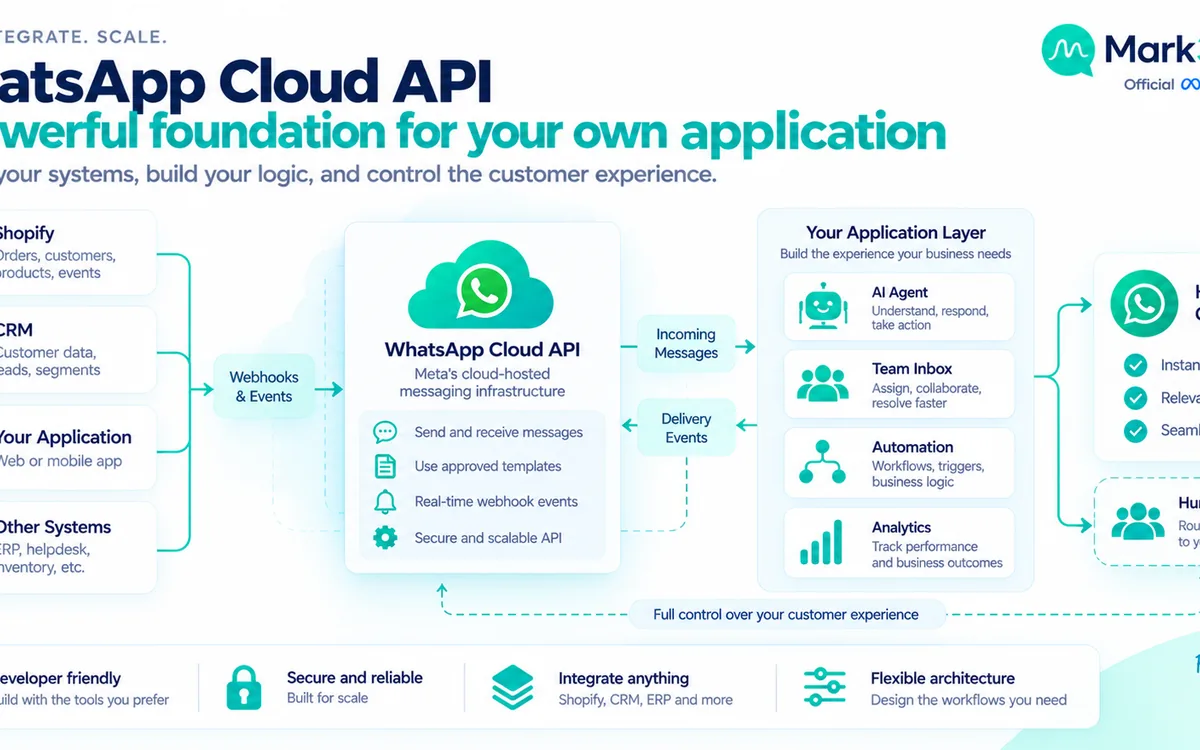
WhatsApp has its own rules: template categories, the customer service window, and market-based pricing. Official reference: WhatsApp Business Platform pricing. For October 2026 service-message changes, see service message pricing.
Instagram-only vs Instagram + WhatsApp

Stay in Instagram DMs for low-ticket impulse offers, content FAQs, and short decision cycles — especially when WhatsApp opt-in is weak.
Move to WhatsApp for higher AOV, consultative sales, multi-day nurture, catalogs, payments, and team shared-inbox ops. Most growth brands eventually need both.
Playbooks by industry

- D2C / ecommerce: CTA like PRICE or SIZE. Qualify in DM; send cart or catalog on WhatsApp.
- Education: CTA like DEMO. Qualify course fit; counselor continues on WhatsApp.
- Local services: CTA like BOOK. Qualify area and timing; confirm on WhatsApp.
- B2B SaaS: CTA like AUDIT. Qualify company size; AE continues on WhatsApp.
Pair organic capture with Click to WhatsApp ads for paid intent.
Setup checklist
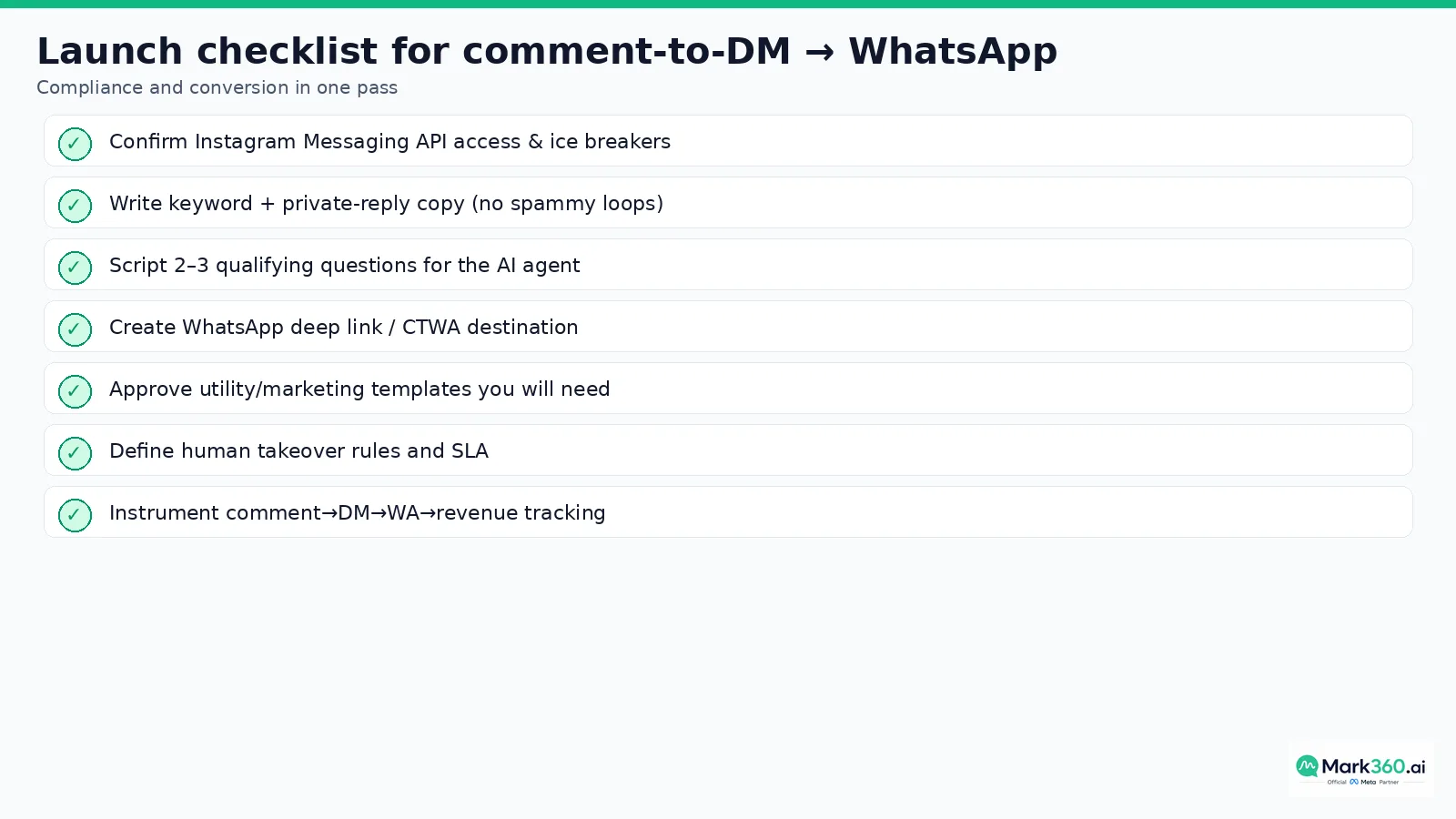
- Confirm Instagram Messaging API access and private-reply permissions.
- Write keyword + private-reply copy that is clear, not spammy.
- Script two or three qualifying questions for the AI agent.
- Create WhatsApp deep link / CTWA destination with transparent consent.
- Submit utility and marketing templates you will need after the window.
- Define human takeover rules and SLAs for VIP and complaints.
- Instrument comment → DM → WhatsApp → revenue tracking in your CRM.
AI agents vs rigid flows inside the funnel
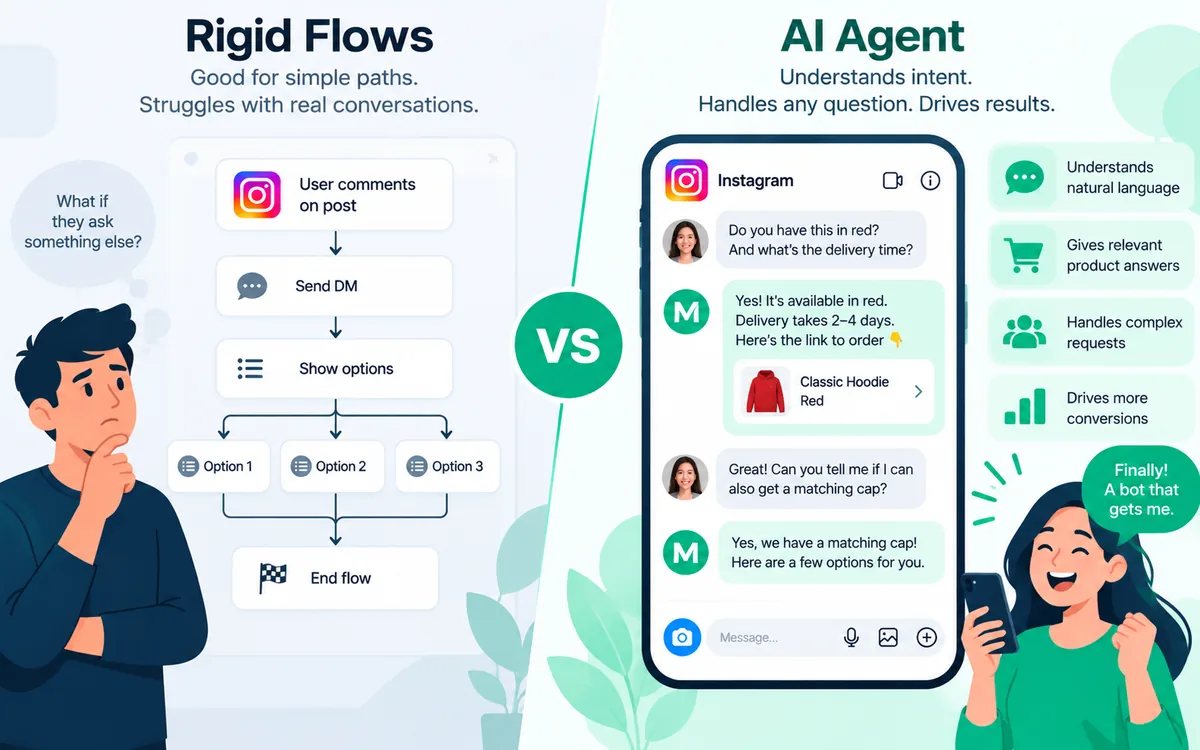
Keyword triggers can stay flow-style. Qualification is where AI agents shine. Recommended pattern: flow trigger for the comment keyword, AI agent for DM turns, WhatsApp Business API for close. Deep dive: Instagram AI agent vs Manychat flows and WhatsApp AI agent for business.
Pricing lens without inventing Meta rate cards
Separate Instagram tooling SaaS from WhatsApp delivered-message pricing. Prefer Meta's docs for category rules. When an India Mark360 example helps: Marketing ₹0.94, Utility ₹0.138 per delivered message — Mark360 totals, not Meta's official rate card. See WhatsApp Business API pricing in India.
Key takeaways
- Instagram wins attention; WhatsApp wins durable conversion
- Measure each stage — do not optimize vanity comments alone
- Keep comment triggers simple; use AI agents for messy qualification
- Handoff with one-tap WhatsApp links and clear consent
- Respect Instagram messaging rules and WhatsApp template categories
- Mark360 connects comment-to-DM capture with WhatsApp Business API close as a Meta Partner
Governance, consent, and brand safety
Every Instagram and WhatsApp automation inherits your brand reputation. Before scaling comment keywords or AI agents, decide how you store opt-in evidence, how you honor opt-outs, and which topics the bot must never answer — legal, medical, or financial advice without a human. Keep a short brand safety sheet next to your prompt library. If a transcript would embarrass you on a public thread, the automation is not ready.
Consent is not a checkbox buried in a flow. Say why you are moving someone to WhatsApp, what they will receive, and how to stop. On WhatsApp Business API, template categories and the customer care window define what you can send and when. Read Meta documentation and do not invent rate cards. When India Mark360 examples help finance teams, use Marketing ₹0.94 and Utility ₹0.138 as Mark360 totals only.
Analytics that executives actually trust
Vanity metrics create false confidence. A thousand comment keywords mean little if DM open rate is poor. DM open rate means little if qualification is weak. Qualification means little if WhatsApp starts never happen. WhatsApp starts mean little if revenue is not attributed. Build a single funnel board with stage conversion and revenue. Sample transcripts weekly. When a stage collapses, fix that stage — do not rebuild the whole stack out of panic.
Attribute carefully. Pass campaign identifiers through WhatsApp deep links into CRM. Distinguish organic comment capture from Click-to-WhatsApp ads. Compare cohorts by creative, keyword, and agent version. The goal is learning velocity, not a dashboard museum.
Team operating model
Tools do not replace ownership. Assign a messaging owner for growth, a messaging owner for support, and a shared escalation path for VIP and PR-risk conversations. Publish business hours and response SLAs. Train humans on how to take over from an AI agent without making the customer repeat themselves. During launches, staff a war room for the first seventy-two hours.
Prompt and flow changes should follow a lightweight change-management process: propose, review, ship, measure. Treat production messaging like production software. Rollbacks should be minutes, not meetings.
Common failure patterns and fixes
Failure pattern one: too many qualifying questions. Fix: ask two or three, then hand off. Failure pattern two: WhatsApp handoff with no context. Fix: pass tags and summary into the WhatsApp thread or CRM. Failure pattern three: templates rejected late. Fix: submit early and keep in-window alternatives. Failure pattern four: AI invents prices. Fix: tool-constrained catalog lookups and hard refusals. Failure pattern five: no human path. Fix: explicit speak-to-human intents and VIP routing.
Most “AI didn’t work” postmortems are actually process failures. Fix the process, then tune the model.
Governance, consent, and brand safety
Every Instagram and WhatsApp automation inherits your brand reputation. Before scaling comment keywords or AI agents, decide how you store opt-in evidence, how you honor opt-outs, and which topics the bot must never answer — legal, medical, or financial advice without a human. Keep a short brand safety sheet next to your prompt library. If a transcript would embarrass you on a public thread, the automation is not ready.
Consent is not a checkbox buried in a flow. Say why you are moving someone to WhatsApp, what they will receive, and how to stop. On WhatsApp Business API, template categories and the customer care window define what you can send and when. Read Meta documentation and do not invent rate cards. When India Mark360 examples help finance teams, use Marketing ₹0.94 and Utility ₹0.138 as Mark360 totals only.
Analytics that executives actually trust
Vanity metrics create false confidence. A thousand comment keywords mean little if DM open rate is poor. DM open rate means little if qualification is weak. Qualification means little if WhatsApp starts never happen. WhatsApp starts mean little if revenue is not attributed. Build a single funnel board with stage conversion and revenue. Sample transcripts weekly. When a stage collapses, fix that stage — do not rebuild the whole stack out of panic.
Attribute carefully. Pass campaign identifiers through WhatsApp deep links into CRM. Distinguish organic comment capture from Click-to-WhatsApp ads. Compare cohorts by creative, keyword, and agent version. The goal is learning velocity, not a dashboard museum.
Team operating model
Tools do not replace ownership. Assign a messaging owner for growth, a messaging owner for support, and a shared escalation path for VIP and PR-risk conversations. Publish business hours and response SLAs. Train humans on how to take over from an AI agent without making the customer repeat themselves. During launches, staff a war room for the first seventy-two hours.
Prompt and flow changes should follow a lightweight change-management process: propose, review, ship, measure. Treat production messaging like production software. Rollbacks should be minutes, not meetings.
Common failure patterns and fixes
Failure pattern one: too many qualifying questions. Fix: ask two or three, then hand off. Failure pattern two: WhatsApp handoff with no context. Fix: pass tags and summary into the WhatsApp thread or CRM. Failure pattern three: templates rejected late. Fix: submit early and keep in-window alternatives. Failure pattern four: AI invents prices. Fix: tool-constrained catalog lookups and hard refusals. Failure pattern five: no human path. Fix: explicit speak-to-human intents and VIP routing.
Most “AI didn’t work” postmortems are actually process failures. Fix the process, then tune the model.
Governance, consent, and brand safety
Every Instagram and WhatsApp automation inherits your brand reputation. Before scaling comment keywords or AI agents, decide how you store opt-in evidence, how you honor opt-outs, and which topics the bot must never answer — legal, medical, or financial advice without a human. Keep a short brand safety sheet next to your prompt library. If a transcript would embarrass you on a public thread, the automation is not ready.
Consent is not a checkbox buried in a flow. Say why you are moving someone to WhatsApp, what they will receive, and how to stop. On WhatsApp Business API, template categories and the customer care window define what you can send and when. Read Meta documentation and do not invent rate cards. When India Mark360 examples help finance teams, use Marketing ₹0.94 and Utility ₹0.138 as Mark360 totals only.
FAQs
What is an Instagram comment-to-DM funnel?
A prospect comments a keyword on your post or Reel; automation opens a private reply and Instagram DM to continue without clogging public comments.
Why move from Instagram DM to WhatsApp?
WhatsApp is better for multi-day nurture, catalogs, payments, templates outside the messaging window, and team inbox operations.
Do I need the WhatsApp Business API?
For scale, templates, multi-agent inbox, and CTWA ops, yes.
How many qualifying questions should the AI ask?
Two or three. More than that and drop-off rises.
Is comment-to-DM allowed by Meta?
Yes when you follow Instagram messaging policies — avoid spammy loops and respect windows. Read Meta's Instagram messaging docs.
How do I attribute revenue?
Pass UTM or campaign IDs through the WhatsApp deep link and write them into CRM at WhatsApp start.

Soft next step with Mark360
Mark360 helps you run Instagram AI agents and WhatsApp Business API in one Meta Partner stack — capture on Instagram, close on WhatsApp, with a shared inbox for humans.
Explore WhatsApp automation · See pricing · Compare Manychat alternatives.
Additional implementation detail 4
Document your keyword list, agent intents, WhatsApp templates, escalation phrases, quiet hours, and CRM field map in one living runbook. Review it every two weeks with growth and support leads. Update examples from real transcripts so new teammates learn from production, not theory. Consistency across people matters as much as consistency across tools.
Additional implementation detail 5
Document your keyword list, agent intents, WhatsApp templates, escalation phrases, quiet hours, and CRM field map in one living runbook. Review it every two weeks with growth and support leads. Update examples from real transcripts so new teammates learn from production, not theory. Consistency across people matters as much as consistency across tools.
Additional implementation detail 6
Document your keyword list, agent intents, WhatsApp templates, escalation phrases, quiet hours, and CRM field map in one living runbook. Review it every two weeks with growth and support leads. Update examples from real transcripts so new teammates learn from production, not theory. Consistency across people matters as much as consistency across tools.
Additional implementation detail 7
Document your keyword list, agent intents, WhatsApp templates, escalation phrases, quiet hours, and CRM field map in one living runbook. Review it every two weeks with growth and support leads. Update examples from real transcripts so new teammates learn from production, not theory. Consistency across people matters as much as consistency across tools.
Additional implementation detail 8
Document your keyword list, agent intents, WhatsApp templates, escalation phrases, quiet hours, and CRM field map in one living runbook. Review it every two weeks with growth and support leads. Update examples from real transcripts so new teammates learn from production, not theory. Consistency across people matters as much as consistency across tools.