



Instagram follow-gate and Follow to DM are two different automation patterns. A follow gate checks whether someone already follows your Instagram account during an existing conversation flow—such as a comment-to-DM freebie—and can ask non-followers to follow before releasing the requested resource. Follow to DM is different: it is a Meta-controlled capability that can automatically greet eligible new followers and continue the conversation after the required interaction.
That distinction matters. A business can use a follower check as a condition inside a comment-to-DM journey, while Follow to DM is a trigger caused by a new follow. They solve related growth problems, but they are not interchangeable.
As of 2026, Follow to DM remains a beta capability in Manychat, with eligibility controlled by Meta. Manychat documents a limit of one Follow to DM message per user per week, and the feature triggers only once per follower. The exact availability and platform rules can change, so businesses should verify the latest Meta and Manychat documentation before launching a production workflow.
What Is Follow to DM on Instagram?
Follow to DM on Instagram is a newer automation pattern designed to send a private message when an eligible user follows an Instagram account. Instead of waiting for the person to comment or send a message first, the follow itself can start the automation.
Manychat currently documents this capability as a beta feature called “Follow to DM.” It can be used for a welcome message, an exclusive discount, a shop or course link, promotion of another platform, or confirmation of a giveaway entry. Eligibility is determined by Meta rather than by the automation platform.
The important point is that Follow to DM is not a follow gate. It does not mean “follow us before we give you the freebie.” Instead, it means “you followed us, so an eligible automation may greet you.”
What Is an Instagram Follow Gate?
An instagram follow gate is a condition placed inside an existing Instagram conversation flow. The automation checks whether the person follows the business account and changes what happens next based on that status.
For example, imagine a creator publishes a Reel offering a free Instagram content calendar. The post says, “Comment CALENDAR and I’ll DM you the guide.” When the automation begins, it can check whether the person follows the account.
- If the user follows: the automation can continue toward the requested resource.
- If the user does not follow: the automation can ask them to follow first and then continue according to the supported flow.
Manychat documents follower status as a usable system field and also documents comment automations that can conditionally ask users to follow before delivering a link.
Follow Gate vs Follow to DM: The Critical Difference
The simplest way to remember the difference is this:
| Capability | What starts it? | What does it check? | Main purpose |
|---|---|---|---|
| Instagram follow gate | Existing conversation trigger such as a comment | Whether the person follows the business | Follow-before-unlock |
| Follow to DM | New Instagram follow | Meta eligibility and follow event | Welcome and start a conversation |
A follow gate therefore belongs inside another automation. Follow to DM is itself a trigger.
This distinction prevents a common implementation mistake: assuming that the new-follower feature can replace a follower check inside a freebie campaign. It cannot. If the business requirement is “follow before I release this resource,” the relevant pattern is a follower condition in the existing conversation flow.
How the Follow-Before-Unlock Flow Works
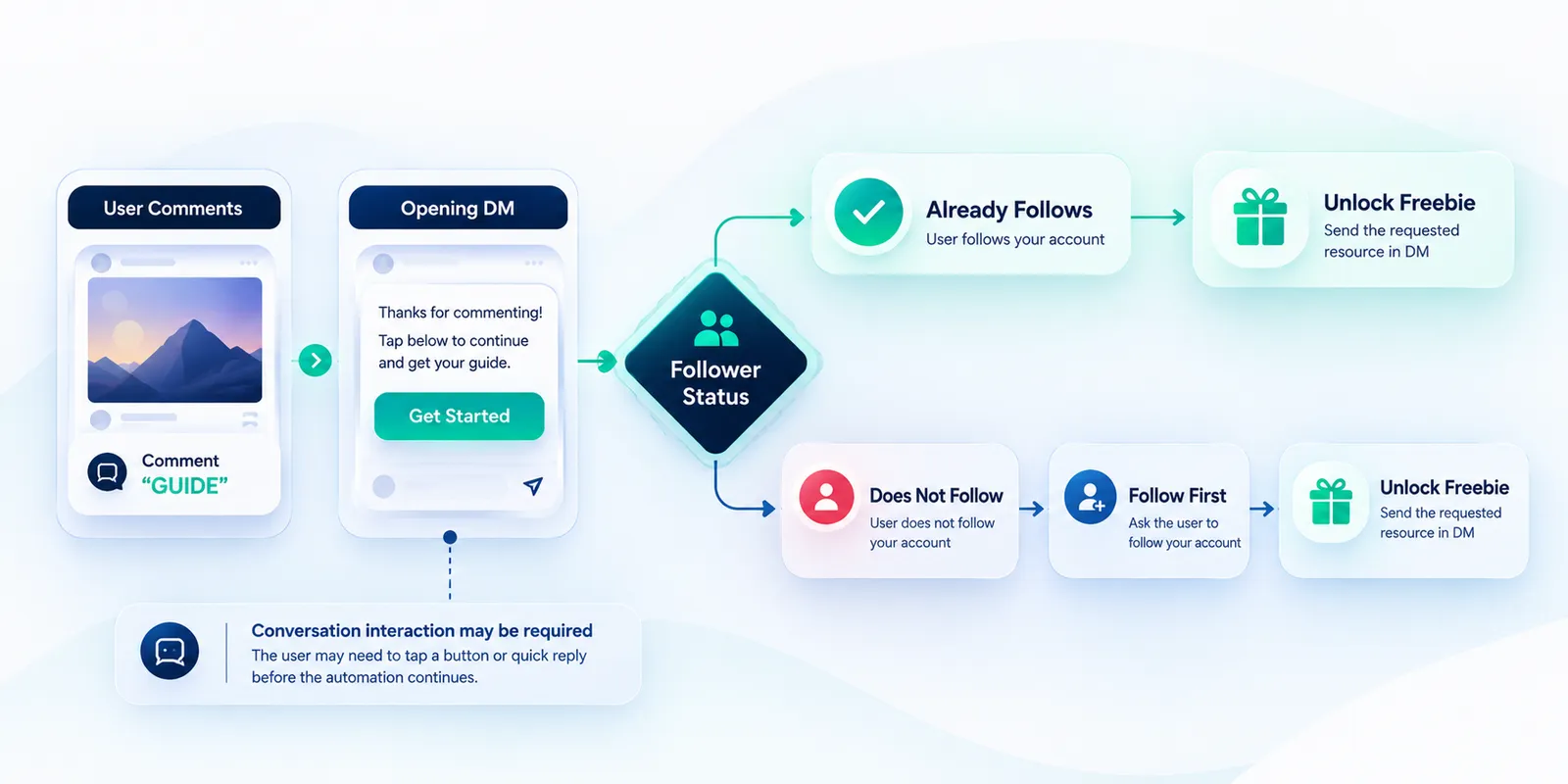
A typical instagram dm automation follow gate begins with a customer action. A comment on a post or Reel is a common example. The automation sends the opening interaction, checks or requests the relevant next action, and then releases the resource according to the user's status and the flow's rules.

The conceptual flow is:
- Publish content with a clear freebie or resource CTA.
- User comments using the requested keyword or interaction.
- Automation starts the supported Instagram conversation.
- User interacts with the opening message when required.
- The automation evaluates follower status.
- If the user follows, deliver the reward or next step.
- If the user does not follow, explain that following is required before unlocking.
- After the user follows, continue only when the platform and automation can reliably read the relevant status and proceed.
The exact mechanics depend on the automation provider and current Instagram API behaviour. Manychat's current documentation specifically describes an “Ask for a follow” step in comment-based automation, where the system checks whether the user follows the Instagram account and can prompt non-followers to follow before the link is delivered.
Why the Follower Check Happens After the Conversation Starts
A useful implementation detail is that follower status should not be confused with the initial conversation opt-in. The automation may need the user to interact with the opening message before subsequent messaging becomes available.
Manychat documents that Instagram buttons or Quick Replies can be used to establish the interaction needed to continue a conversation. A URL button by itself does not count as the same opt-in interaction in the documented comment automation flow.
This means a campaign may have two distinct concepts:
- Conversation interaction: the user taps a supported button or otherwise interacts so the automation can continue.
- Follower status: the system determines whether the user follows the business and branches accordingly.
Keeping these concepts separate makes both the flow and troubleshooting much easier.
Does the User Have to Tap a Button?
Often, yes, when the next stage of the automation requires an interaction that opens or confirms the relevant messaging opportunity. The exact interaction requirements depend on the flow and current platform rules.
For example, Manychat documents that in Instagram comment automations, a button or Quick Reply interaction can opt the user into the conversation and open a 24-hour messaging window for subsequent messages. A button that simply opens a website does not count as that opt-in interaction in the documented flow.
This is why a good follow-gate CTA should not simply say “Click here.” It should make the interaction meaningful and explain what happens next.
Example opening copy
“I’ve got the guide ready. Tap below and I’ll send it to you.”
After the interaction, the flow can evaluate the follower condition and either deliver the requested resource or ask the person to follow first.
What Happens to a Non-Follower?
The non-follower path should be simple and transparent. The person already demonstrated interest by commenting, so the automation should not turn the experience into a long sales sequence.
A practical flow might say:
“Almost there! Follow @yourbrand first, then I’ll unlock the free guide for you.”
The important part is the relationship between the requested action and the reward. The user should understand why they are being asked to follow and what they receive afterward.
If the follower status is not immediately reflected or the platform does not allow the automation to continue as expected, the flow should provide a useful fallback instead of repeatedly demanding the same action.
What Happens to an Existing Follower?
Existing followers should experience the shortest possible path. If the follower condition is already satisfied, there is no reason to make the person go through a follow request again.
A clean reward journey looks like:
Comment → conversation interaction → follower check → reward
This is one reason follow gates are useful in content-led campaigns: the business can distinguish people who already follow from people who have engaged with the content but have not yet followed.
How Follow to DM Works for New Followers
Follow to DM begins at a different point. The user follows the account, and an eligible automation can send a welcome message.
Manychat currently documents the feature as a beta and says Meta determines eligibility. It also states that the automation triggers only once per follower; unfollowing and following again does not cause the same automation to run again. Most importantly, Meta currently limits Follow to DM to one such message per user per week. If a person follows multiple accounts using the feature, only the first eligible account they follow may send the Follow to DM message.
These restrictions are important because Follow to DM is designed as a controlled onboarding mechanism, not an unlimited outbound messaging channel.
Follow to DM Is Not Follow-Gate
These terms are easy to mix up because both involve Instagram follows, but their business logic is different.
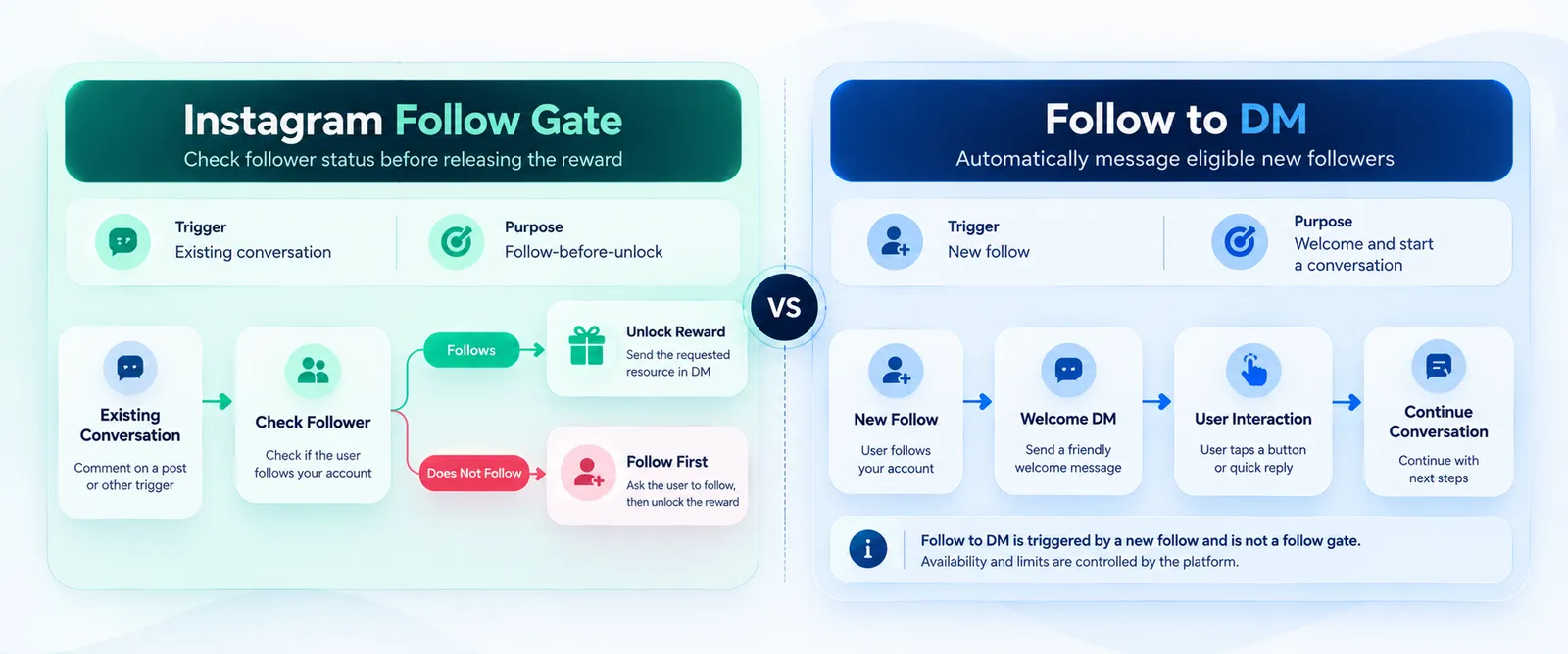
Follow gate: “Did this person follow us? If not, ask them to follow before releasing the requested resource.”
Follow to DM: “This person just followed us. If the account and user are eligible, start a welcome conversation.”
A brand could potentially use both in a broader Instagram strategy, but they should not be treated as the same automation.
Freebie Playbook: Guide, Checklist or Template
The classic follow-gate use case is a downloadable resource. A Reel or carousel introduces a useful asset, and the CTA asks people to comment with a keyword.
Examples include:
- Instagram content calendar
- Marketing checklist
- Product comparison guide
- Industry template
- Educational PDF
- Event or webinar resource
The flow should keep the reward tightly connected to the original content. A user who comments “CHECKLIST” should not suddenly receive a generic promotional sequence.
Sample CTA
“Want the checklist? Comment CHECKLIST and I’ll send it in DM.”
For a follow gate, the private message can then explain the follow requirement clearly before unlocking the resource.
Coupon Playbook: Follow Before Unlocking an Offer
Coupons can work similarly, but the automation should make the offer terms clear. The reward might be a coupon code, product link, or campaign landing page.
A simple flow can be:
- Customer comments “DEAL.”
- Opening DM asks the customer to interact.
- Follower condition is checked.
- Existing follower receives the coupon.
- Non-follower receives a concise follow-first message.
- The reward is delivered according to the supported automation and messaging rules.
Do not hide material conditions behind the automation. If a coupon has an expiry date, product restriction, minimum order value, geography restriction, or other limitation, communicate it where appropriate.
Guide Playbook: Educational Lead Generation
Educational brands can use follow gates for guides, frameworks, checklists, tutorials, or event resources. This works particularly well when the Instagram content itself demonstrates enough value that the follow feels like a natural continuation rather than an arbitrary requirement.
For example, a B2B SaaS brand could publish a carousel explaining five customer-engagement mistakes and offer a longer implementation checklist through DM.
The objective should be useful content first. The follow request is a secondary action, not a reason to make the user fight through a promotional funnel.
Follow to DM Welcome Playbook
Follow to DM is better suited to welcoming a new follower than to enforcing a follow requirement.
Possible opening messages include:
- “Thanks for following. What brought you here?”
- “Welcome! Want our latest guide?”
- “Thanks for joining us. Looking for products, tips, or support?”
- “Welcome to the community. Tap below if you'd like the starter guide.”
Manychat's current beta documentation describes an opening DM followed by a user interaction and then a subsequent message containing a link. It also notes that the user needs to interact with the opening message before the continued conversation can proceed within the documented 24-hour window.
This makes the opening message especially important: it should feel like a welcome, not an unsolicited advertisement.
Instagram Message Requests and Messaging Windows
Instagram automation is constrained by messaging rules and interaction windows. Businesses should not assume that once a person has followed, commented, or received one message, they can send unlimited future messages.
For example, Manychat documents a 24-hour messaging window after the required user interaction in several Instagram automation flows. Its Follow to DM documentation likewise explains that the recipient's interaction with the opening message enables the remaining messages in the documented automation within that window.
The practical lesson is simple: design the automation around the interaction that the platform actually permits. Do not build a journey that assumes indefinite access to the user's DM channel.
Consent and No-Spam Design
Automation should make the customer's action and the brand's next step obvious. A user commenting for a freebie should receive the promised resource, not a sequence of unrelated promotions.
Use clear copy, relevant triggers, reasonable frequency, and easy escalation. Avoid scraping users, using unofficial messaging methods, or treating a follow as blanket permission for arbitrary promotional outreach.
Manychat itself advises varying automated comment replies and avoiding overly short or emoji-only responses to reduce the risk of automated replies being treated as spam.
Meta controls platform rules. An automation vendor can expose supported capabilities, but it cannot override Meta's eligibility or messaging restrictions. Manychat explicitly describes Meta as the party that controls Follow to DM eligibility.
CTA Copy That Works With the Flow
The best CTA explains the value and the requested action without making the automation feel mysterious.
| Goal | Example CTA |
|---|---|
| Free guide | “Comment GUIDE and I’ll send you the checklist.” |
| Follow gate | “Comment TEMPLATE. Follow us to unlock the free template in DM.” |
| Coupon | “Comment SAVE and follow us to unlock the offer.” |
| New follower welcome | “Thanks for following! Tap below if you want the starter guide.” |
| Human support | “Need help choosing? Tap below and our team can take over.” |
These are patterns rather than guaranteed platform-compliant scripts. Review the current rules and the specific automation provider's supported actions before deploying.
Troubleshooting Instagram Follow Gates
If a follow gate does not behave as expected, check the flow in layers rather than changing everything at once.
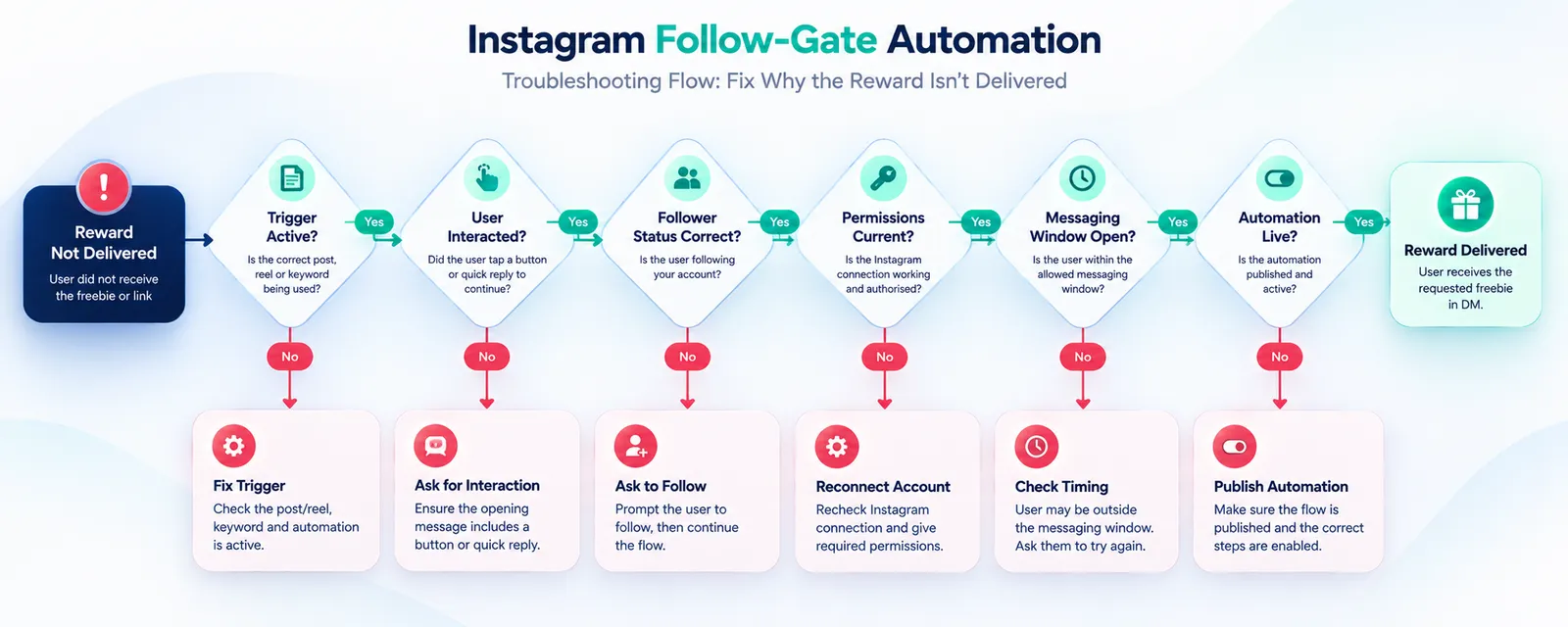
- Check the trigger: confirm the correct post, Reel, keyword, or supported entry point is being used.
- Check the first interaction: verify the user completed the button or Quick Reply interaction required by the flow.
- Check follower status: test with an account that definitely follows and another that definitely does not.
- Check permissions: confirm the Instagram connection is current and has the required permissions.
- Check the message window: verify the user is still within the applicable messaging window.
- Check eligibility: Follow to DM availability can depend on Meta-controlled account eligibility.
Manychat recommends the newer Instagram connection method for access to the latest Instagram features and notes that advanced capabilities can depend on how the Instagram account is connected.
Troubleshooting Follow to DM
Follow to DM has additional failure points because it is a beta capability with Meta-controlled eligibility.

If a newly followed user does not receive the expected message, verify:
- The account is eligible for the beta feature.
- The Instagram connection uses the required supported connection method.
- The user has not already triggered the automation through the applicable restriction.
- The user has not been subject to the Meta one-message-per-week Follow to DM limit.
- The automation is actually live.
- The opening message and subsequent interaction requirements are configured correctly.
Manychat currently states that Follow to DM eligibility is reviewed by Meta and that availability can change. It also says the beta currently requires the newer Unified Instagram Onboarding flow for eligible accounts.
How Instagram Comment Automation Fits In
Instagram comment automation remains one of the most practical entry points for follow-gated campaigns because the user has already taken a visible action on a specific piece of content.
Manychat documents comment triggers for Instagram posts and Reels that can send a public reply, continue through a private DM, capture leads, and use conditions such as follower status.
This makes comment automation a useful bridge between content and conversation:
Content → Comment → DM → Follower condition → Reward → Optional qualification → Human or WhatsApp continuation
The flow should remain connected to the original content. If the user asks for a guide, deliver the guide. If they ask for a product link, make the product path obvious.
How Instagram Growth Tools Fit Into the Bigger Stack
Instagram growth tools cover a broad category: content analytics, scheduling, comment automation, DM automation, lead capture, follower-growth workflows, and conversation management.
A follow gate is a conversion mechanism inside that broader stack. Follow to DM is a new-follower engagement mechanism. Neither should be viewed as a substitute for content quality, audience fit, or a useful customer experience.
The strongest architecture connects the pieces without pretending they are one feature. Content creates interest. A supported trigger starts a conversation. Automation handles the predictable part. A human takes over when needed. A separate customer channel such as WhatsApp can become the next step when the customer explicitly chooses it and the relevant messaging permissions and windows allow it.

Where Mark360.ai Fits
For Mark360.ai, the useful product opportunity is not to blur follow gate and Follow to DM into one feature. It is to treat Instagram intent as the beginning of a customer journey.
A practical roadmap can start with supported Instagram triggers and intent signals, then connect those conversations to automation, lead context, human routing, and—when the customer chooses it—WhatsApp engagement.
That can eventually support a journey such as:
Instagram content → comment or DM intent → follower condition where appropriate → resource or response → intent qualification → customer-selected WhatsApp transition → WhatsApp shared inbox → human agent.
The important product principle is customer choice. A person who asks for a guide should receive the guide. A person who wants support should be able to reach support. A person who prefers WhatsApp can be given an appropriate route to WhatsApp when the channel transition is supported and permitted.
This makes Instagram automation part of a broader conversational marketing architecture rather than an isolated follower-growth trick.
Implementation Checklist for 2026

- Decide whether the requirement is a follow gate or Follow to DM.
- Choose the supported Instagram trigger.
- Define the exact reward or welcome experience.
- Write the opening message and interaction CTA.
- Keep the follower condition separate from conversation opt-in logic.
- Build a short non-follower path.
- Build an even shorter existing-follower path.
- Add a human fallback.
- Check applicable messaging windows.
- Test follower and non-follower accounts separately.
- Verify the current Meta and automation-provider eligibility requirements.
- Review the flow periodically because platform capabilities and rules can change.
Related reading: ManyChat alternatives for Instagram comment-to-DM, Instagram auto reply and Story reply automation, Instagram DM automation and WhatsApp shared inbox, and ecommerce Instagram DM automation.
Key Takeaways
- Follow to DM Instagram and an Instagram follow gate are different capabilities.
- An instagram follow gate checks follower status inside an existing conversation flow before releasing a reward or resource.
- Follow to DM starts from a new follower and is currently a Meta-controlled beta capability in Manychat.
- Manychat currently documents a one-Follow-to-DM-message-per-user-per-week Meta limit.
- Conversation interaction and follower status are separate concepts.
- A button or Quick Reply interaction may be required before the automation can continue within the relevant messaging window.
- Freebies, coupons, guides, and templates are natural follow-gate use cases.
- New-follower welcomes are natural Follow to DM use cases.
- Automation should be relevant, consent-aware, and designed around supported Meta capabilities.
- Instagram can be treated as an intent and discovery channel before a customer-selected transition into WhatsApp operations.