
Direct answer: There is no fully free WhatsApp API. The WhatsApp Business app is free, and Meta charges nothing to access the official Cloud API, but messages you send through it are billed per delivered message. In 2026 the free parts are messages customers send you, the first 1,000 service replies per number each month, chats from Click-to-WhatsApp ads, and Meta's developer test number.
Key takeaways
- Meta charges nothing to access the official WhatsApp Cloud API, but most messages you send through it are billed per delivered message.
- Free in 2026: messages customers send you, the first 1,000 service replies per business number each month, every message in a free entry point window from a Click-to-WhatsApp ad, and Meta's test number for developers.
- Since 1 October 2026, service replies after the first 1,000 and utility templates sent inside the 24-hour window are charged.
- A free BSP plan or trial removes the platform fee, not Meta's message charges.
- Unofficial "free WhatsApp API" tools that link through a QR code break WhatsApp's Terms of Service and can get your number banned.
Every Meta rule below was checked on Meta's WhatsApp Business Platform pricing documentation on 17 October 2026, and every provider plan on that provider's own pricing page the same day. Meta can change pricing on the first day of any quarter, so confirm before you budget.
Is the WhatsApp API free? The short answer
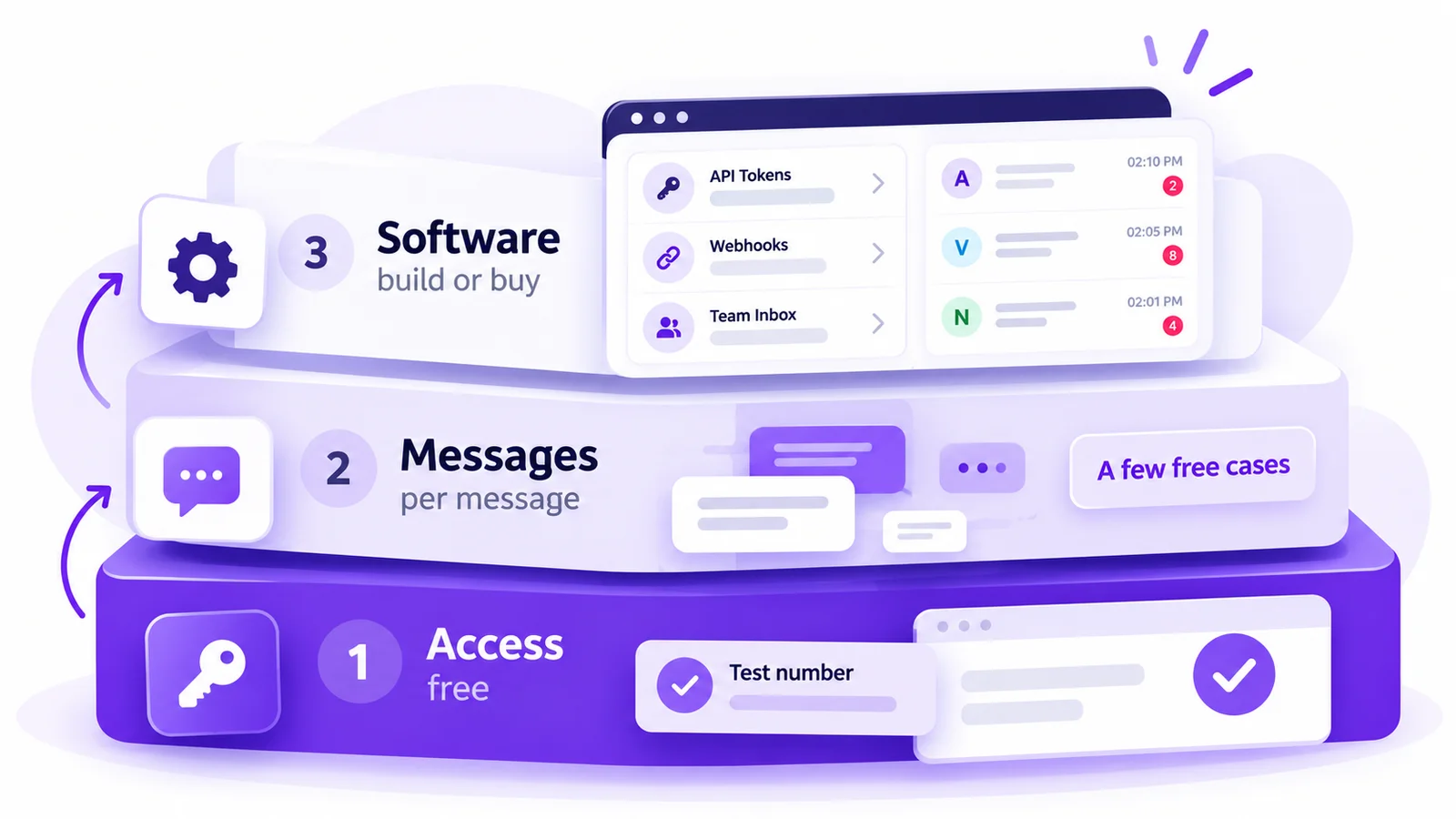
Search "WhatsApp API free" and you'll find pages promising a free API in big letters, with the real price further down. Here's the plain version. There are three layers to what you pay:
- Access. Meta doesn't charge a licence or setup fee for the WhatsApp Business Platform. Its developer hub offers free test numbers, code samples, webhooks and a sandbox.
- Messages. Meta bills per delivered message, by category (marketing, utility, authentication, service) and by the recipient's country. A few situations are free, covered below.
- The software you run it on. The Cloud API has no app of its own. You either build your own inbox, templates screen and webhook server, or you pay a provider (a Business Solution Provider, or BSP) for a dashboard.
So "free WhatsApp Business API" usually means one of these layers is free, not all three. The WhatsApp Business app on your phone is free, but it's built for manual chats from a phone, with no message templates or API access. If you're still deciding between the app, the Cloud API and a provider, read WhatsApp Cloud API vs Business App vs BSP first.
What's actually free on the WhatsApp Business Platform in 2026
Meta's pricing documentation lists only two cases where it doesn't charge for a message a business sends, plus one rule for incoming messages. Here they are, with the fine print.
1. Messages customers send you
Meta doesn't charge for messages from a WhatsApp user to a business. A customer can send you 50 messages and you pay nothing for them. You pay when you reply or reach out.
2. The first 1,000 service messages per number each month
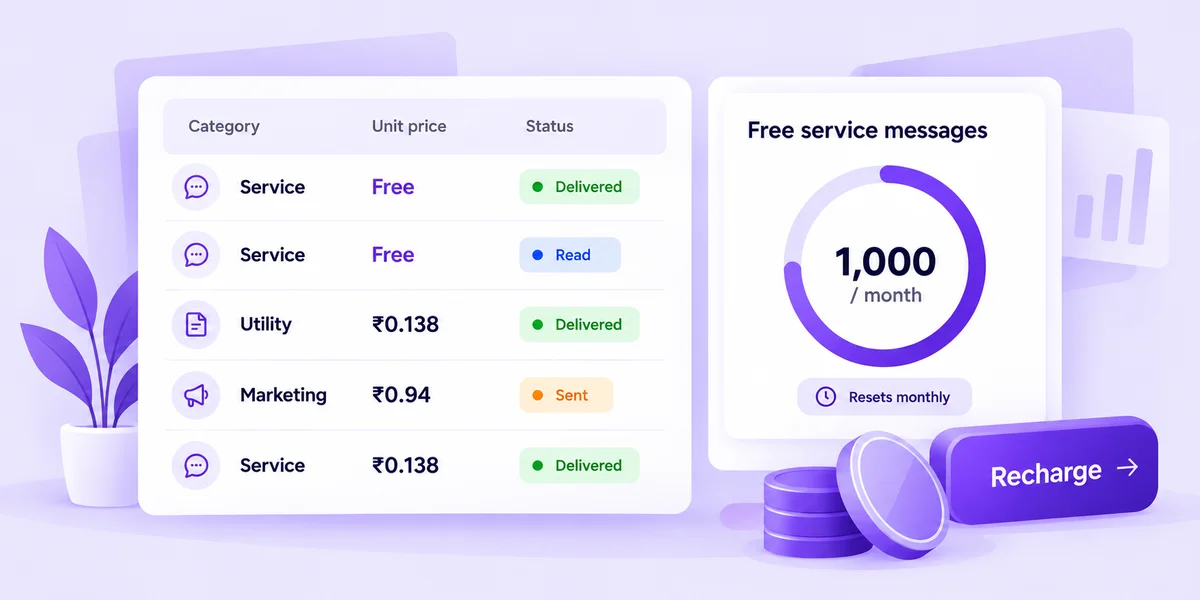
A service message is a free-form reply (text, image, document and so on) sent inside the 24-hour customer service window that opens when a customer messages you. Replies from a person or a third-party chatbot both count. Service replies were free from November 2024 until 30 September 2026. Since 1 October 2026, Meta gives each business phone number 1,000 free service messages a month, then charges from the 1,001st. Unused messages don't roll over, and the tier resets every month.
Two more details matter. Utility templates sent inside the 24-hour window, such as an order confirmation right after a customer asks, are now charged too. And if your WhatsApp account has no payment method, Meta stops delivering service messages once the free 1,000 are used. For the full breakdown with India cost examples, see WhatsApp service message pricing from October 1, 2026.
3. Everything in a free entry point window
When someone taps a Click-to-WhatsApp ad on Facebook or Instagram and messages you from the WhatsApp phone app, and you reply within 24 hours, your reply is free and opens a free entry point window. While it's open, Meta doesn't charge for marketing, utility, authentication or service messages. That makes it the biggest genuinely free allowance on the platform.
The window was 72 hours for years. Meta's pricing documentation now says it can stay open for up to 7 days for chats that start from an ad, but some Meta pages still say 72 hours, so plan around 72 hours and treat any extra time as a bonus. Replies from Meta's own Business Agent are still charged inside the window. To set up ad-started chats, see Click-to-WhatsApp on Mark360 and our Click-to-WhatsApp ads guide for India.
4. Cloud API access and Meta's test number
Meta hosts the WhatsApp Cloud API, so there's no server licence to buy. A developer can create a Meta app, get a test business number and a temporary access token, and send a first message at no cost. What isn't free is everything around it: a webhook server to receive messages, a system-user token, an approved display name, a real business number, and someone to build and maintain the interface your team works in.
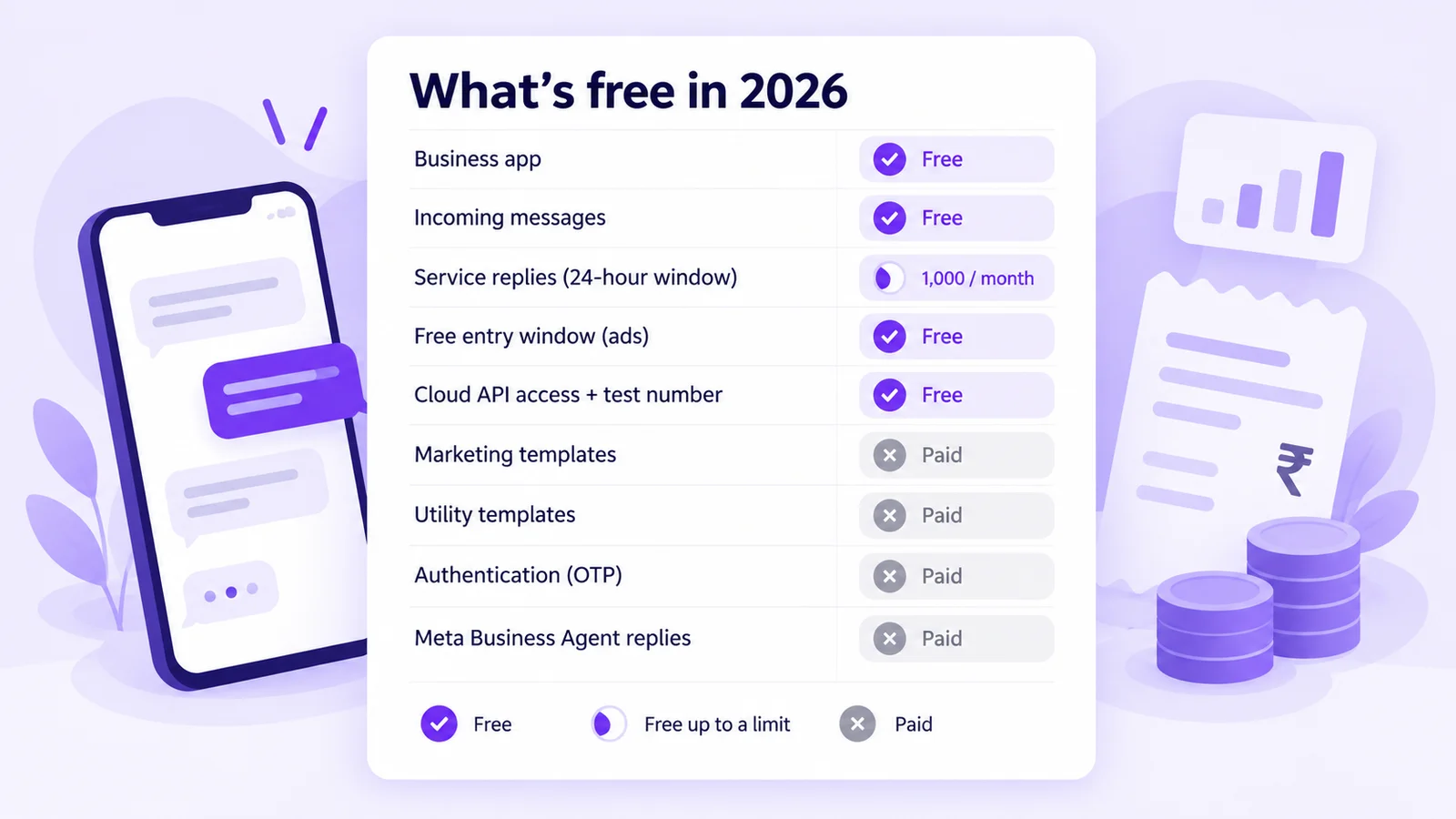
What's free vs what you pay: the full table
Here's every item side by side, as of 17 October 2026:
| What | Cost in 2026 | Condition |
|---|---|---|
| WhatsApp Business app | ✓ Free | Manual chats from the app; no templates, API or automations beyond basic replies |
| Messages customers send you | ✓ Free | Always free on the API |
| Service replies inside the 24-hour window | ◐ Free up to a limit | First 1,000 per business phone number each month; charged from the 1,001st (since 1 Oct 2026) |
| Any message in a free entry point window | ✓ Free | Customer came from a Click-to-WhatsApp ad and you replied within 24 hours; Meta Business Agent replies are still charged |
| Cloud API access and Meta test number | ✓ Free | You host the webhook server and build the inbox yourself, or pay a provider |
| Marketing templates | ✗ Paid | Per delivered message, by recipient country |
| Utility templates (order and delivery updates) | ✗ Paid | Charged inside the 24-hour window too since 1 Oct 2026; volume tiers apply |
| Authentication (OTP) templates | ✗ Paid | Per delivered message; volume tiers apply |
| Meta Business Agent replies | ✗ Paid | $2.00 per 1M tokens, even inside a free entry point window |
The pattern is simple: replies to customers who came to you are free up to a limit, and anything you start (campaigns, order updates, OTPs) is paid unless it happens inside a free entry point window.
The hidden costs nobody puts on the banner
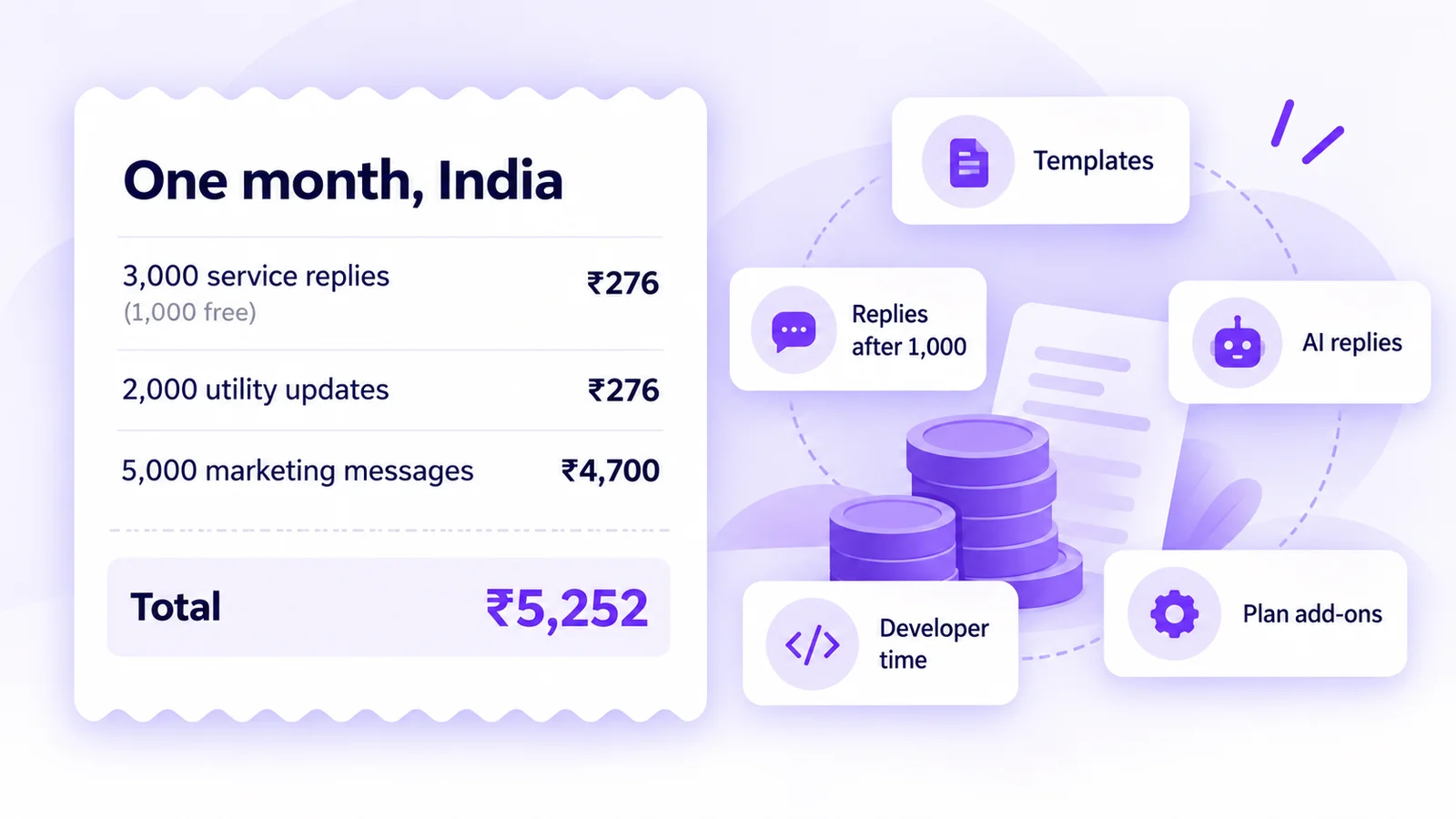
Even with the free allowances, a working WhatsApp setup has costs that "free API" headlines skip:
- Templates. Every campaign, abandoned-cart reminder, order update or OTP is a template message, charged per delivery by category and country.
- Service replies after 1,000. A busy support number or a chatty bot can pass 1,000 replies in days. Long bot flows that send five messages where two would do cost more.
- AI replies. Meta Business Agent costs $2.00 per million tokens, which Meta estimates at about 4–5 US cents per message. Third-party AI usually adds its own AI fee on top of the service-message charge.
- Developer time. Going direct on the Cloud API means building and hosting webhooks, a shared inbox, template management, opt-out handling and reporting yourself.
- Platform plans and add-ons. Many providers charge a monthly plan, then extra for chatbots, AI agents or more agent seats.
- Taxes and currency. In India, check whether a provider's prices include GST and whether you're billed in INR or USD.
Here's a worked example for an Indian online store using Mark360's published India prices (₹0.138 per utility message, with service replies after the free 1,000 billed like utility, and ₹0.94 per marketing message):
| Message type | Sent in a month | Free | Mark360 India price | Cost |
|---|---|---|---|---|
| Service replies (chat and bot) | 3,000 | 1,000 | ₹0.138 | ₹276 |
| Utility templates (order updates) | 2,000 | 0 | ₹0.138 | ₹276 |
| Marketing templates (campaigns) | 5,000 | 0 | ₹0.94 | ₹4,700 |
| Total | 10,000 | 1,000 | ₹5,252 |
That's ₹5,252 in message costs for 10,000 messages, plus the plan fee and before taxes. The 1,000 free service replies saved ₹138, and any chats that started from Click-to-WhatsApp ads would cost nothing at all. Run your own numbers in the WhatsApp API pricing calculator.
"Free" WhatsApp API plans from providers: what they really include
Providers use the word free in three different ways. All of them still pass on Meta's message charges.
- Free-forever platform plans. AiSensy's pricing page lists a Free Forever plan at ₹0, but broadcasting isn't available on it, and chatbot flows cost ₹2,500 a month extra. Its paid plans start at ₹1,500 a month billed monthly. Mark360's Free plan is $0 with no credit card and covers Instagram DM and comment automation so you can try the product.
- Free trials and offers. Twilio offers a free trial with no credit card, then charges $0.005 per message, inbound or outbound, on top of Meta's fees. Gupshup's India CX plan is ₹5,000 a month, currently free for the first 3 months as a limited-time offer. On Mark360, the Scale plan, which includes the WhatsApp API, comes with a 7-day free trial.
- Paid from day one. 360dialog charges from €49 per number per month plus Meta's fees, with no free plan listed.
Before you sign up for a free plan, check three things: can you broadcast on it, which features (chatbot, AI, extra seats) are add-ons, and what one message costs in your country. For full side-by-side pricing, see WhatsApp API pricing compared.
Going direct on the Cloud API: free hosting, real work
Developers often ask whether connecting straight to Meta's Cloud API is the real free WhatsApp API. It's the cheapest route on paper, because you pay only Meta's message charges. But you also need a Meta business portfolio, a business phone number, a payment method, a server that receives webhooks around the clock, and code for templates, opt-outs, agent assignment and reporting. For a developer building a single integration, that's fine. For a sales or support team that needs a shared inbox, broadcasts and chatbots next week, a provider is usually cheaper once you count engineering hours.
Unofficial "free WhatsApp API" tools and the ban risk
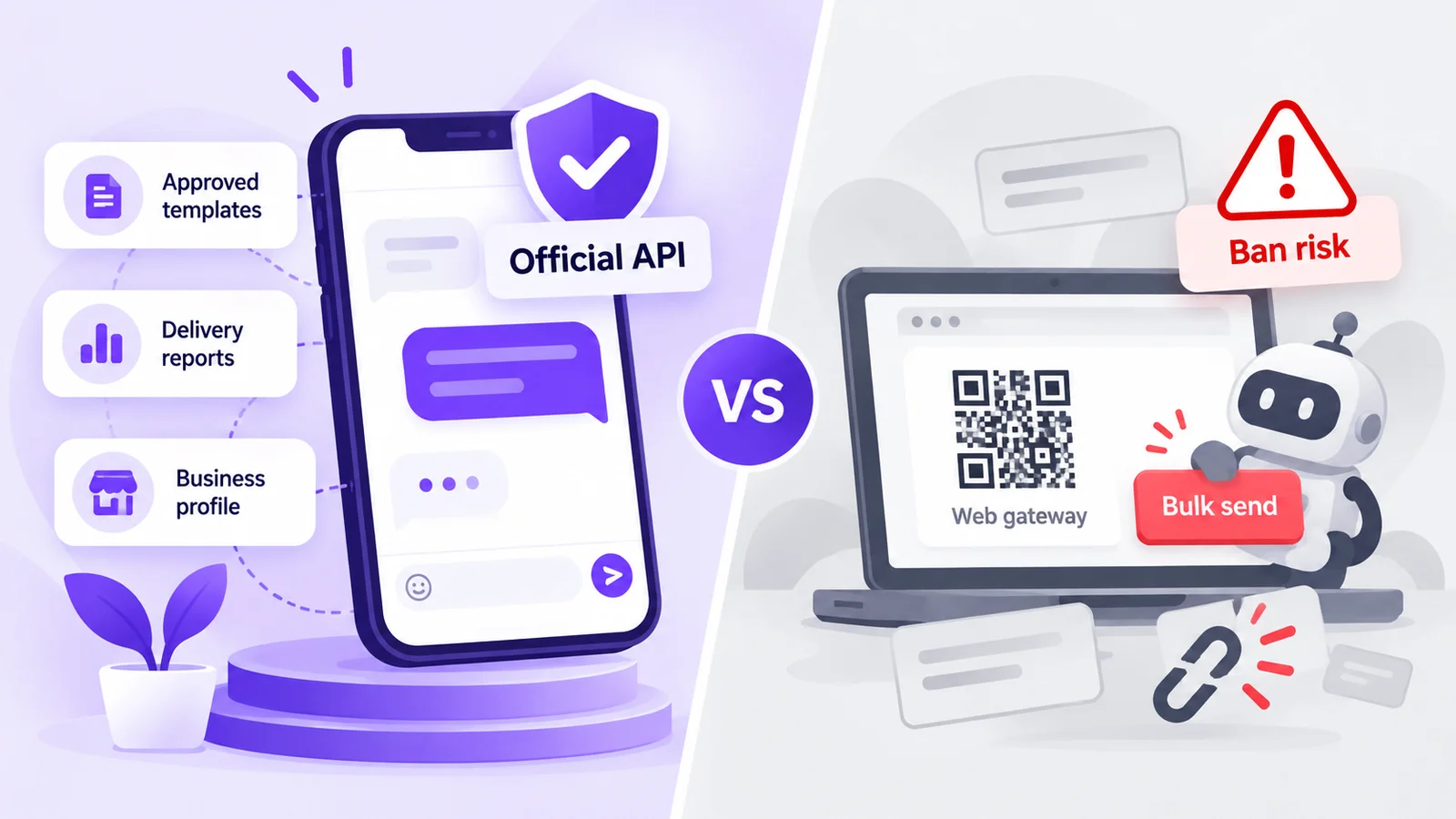
The other "free" results are unofficial: open-source gateways that link to WhatsApp Web through a QR code, bulk-sender browser extensions, and modified apps. They're free because they skip Meta's official platform, and that's the problem.
WhatsApp's help center says that using or linking your account to unofficial versions of WhatsApp violates its Terms of Service and that the account "might also be temporarily or permanently banned". Its page on unauthorized automated or bulk messaging says bulk and automated messaging "have always been a violation of our Terms of Service", and that WhatsApp bans accounts and takes legal action against companies behind it.
In practice, an unofficial tool can stop working after any WhatsApp update, gives you no approved templates or delivery reports, and puts the number your customers know at risk. If your number has already been restricted, see why WhatsApp Business accounts get banned and how to fix it.
How to keep your WhatsApp API bill close to zero
- Let customers start the chat. Inbound-led flows from your website chat button, QR codes and Instagram bio link stay inside the 24-hour window and the free 1,000 replies.
- Use Click-to-WhatsApp ads for campaigns. Reply within 24 hours and follow-ups inside the free entry point window cost nothing.
- Keep bot flows short. Every bot message is a service message, so combine answers into fewer replies.
- Send marketing templates to opted-in segments only. Fewer, better-targeted sends cost less and protect your number's quality rating.
- Add a payment method. Otherwise service replies stop after the first 1,000 in a month.
- Watch a per-message ledger. Check category, unit price and status for every message, not just a monthly total.
Start on the official WhatsApp API with Mark360
Mark360 is an Official Meta Business Partner based in Surat, India, trusted by 100+ businesses. You get the official WhatsApp Business API with templates, broadcasts, chatbots and a shared inbox in one dashboard, with no setup fee and no ban risk from unofficial tools. In India a marketing message is ₹0.94 and a utility message ₹0.138, and service replies after the free 1,000 are billed like utility. These are final prices, with a ledger line for every message.
Start free on Mark360, then turn on the WhatsApp API with the Scale plan ($19 a month billed quarterly), which includes a 7-day free trial. Compare features on the plan comparison page.