

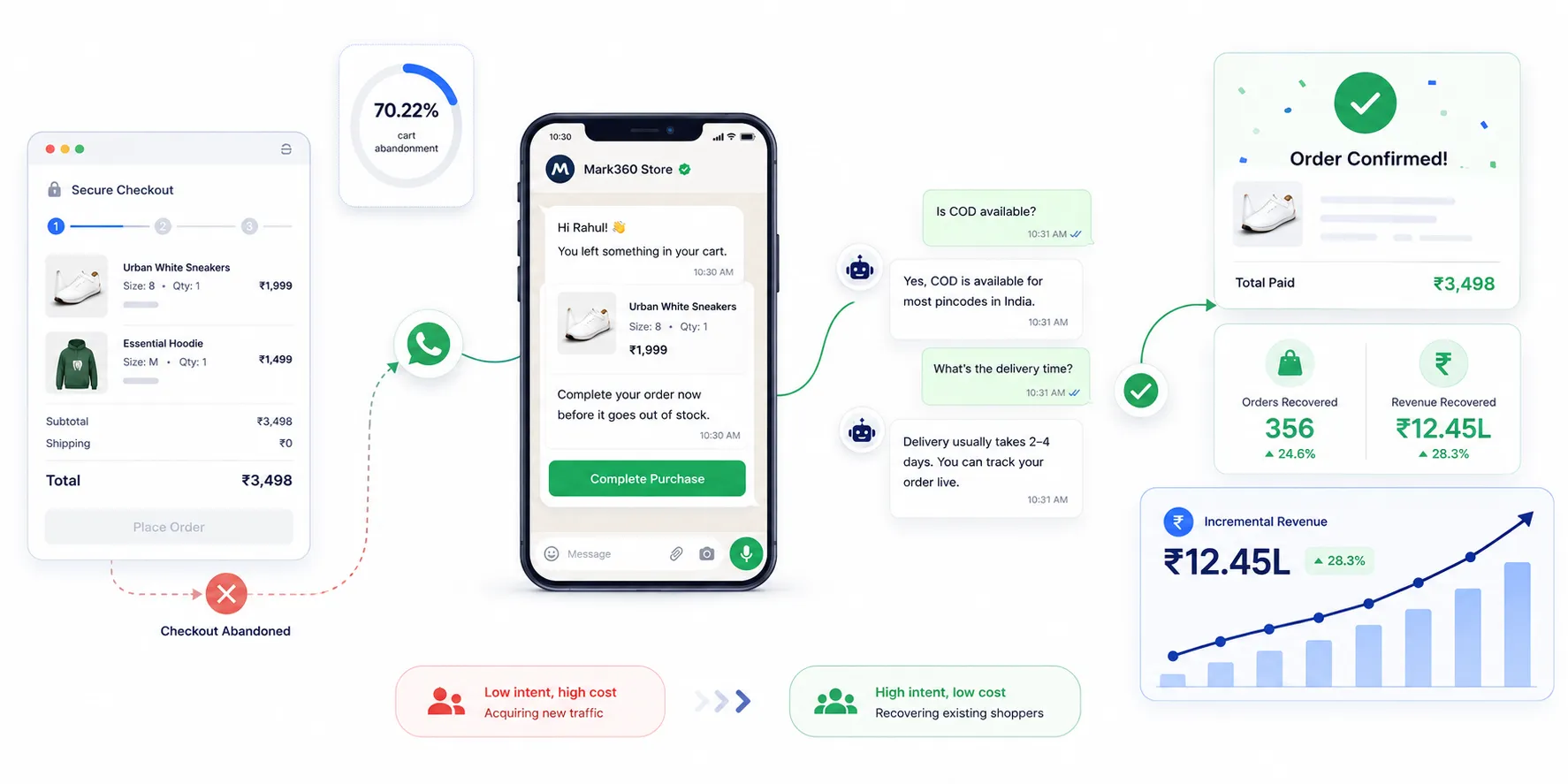

Abandoned cart recovery can add meaningful revenue without buying more traffic
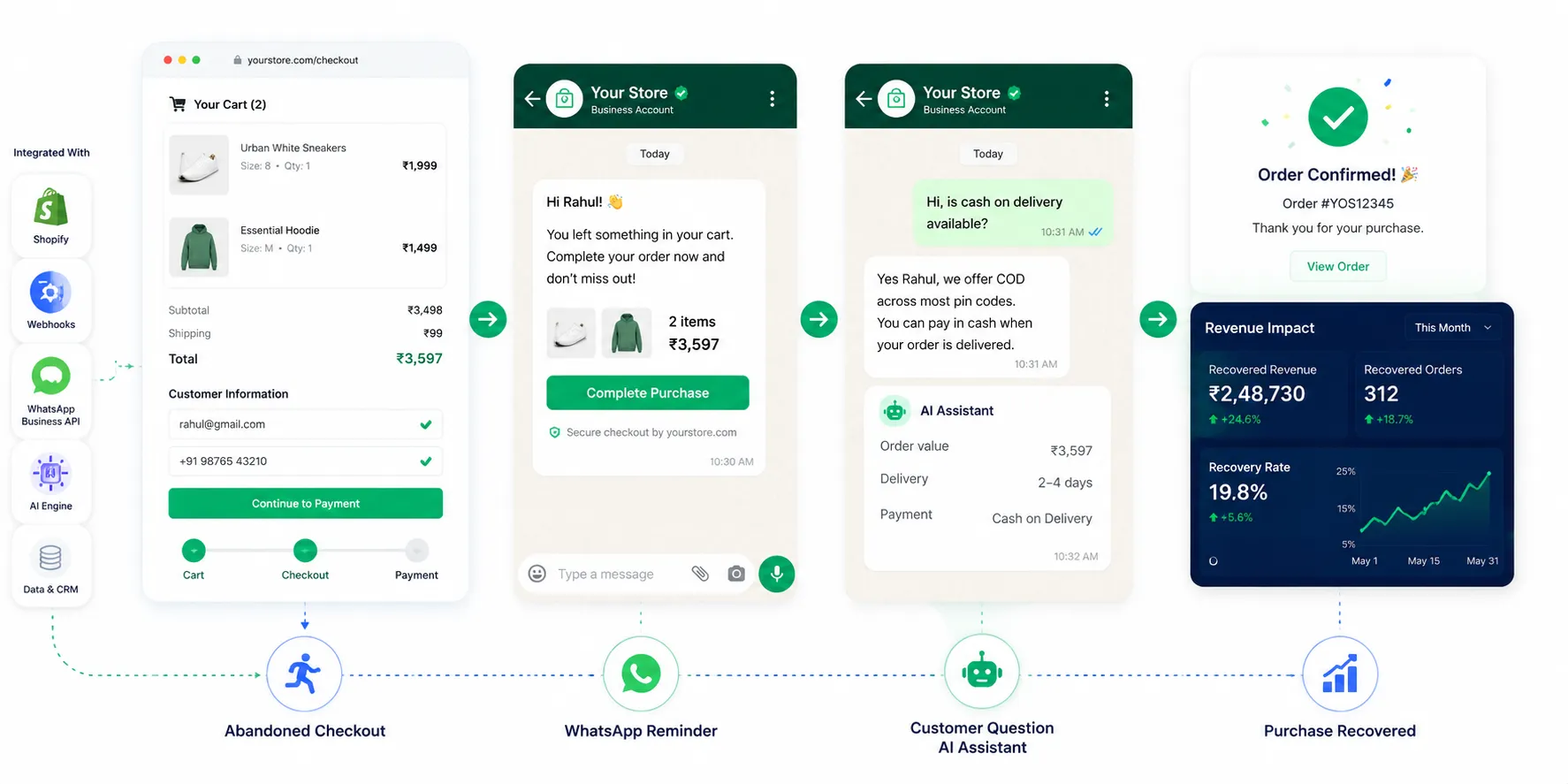
Abandoned cart recovery brings shoppers back after they add products or start checkout but leave before purchasing. The revenue opportunity is large because the shopper has already shown purchase intent: Baymard Institute's 2026 dataset puts average ecommerce cart abandonment at 70.22% across 50 studies.
But “increase revenue by up to 25%” should not be treated as a universal benchmark. A 25% lift is an aggressive outcome, not a promise. Public case studies show that recovery programs can produce double-digit incremental revenue or conversion gains, while benchmark data shows abandoned-cart flows are among the strongest automated revenue drivers. Your actual lift depends on abandonment volume, customer intent, average order value, message timing, checkout friction, channel reach, and how you measure incrementality.
What is abandoned cart recovery?
Abandoned cart recovery is the process of identifying a shopper who started a purchase but did not complete it, then giving that shopper a relevant reason and an easy path to return. The recovery message can be sent through email, WhatsApp, SMS, push notifications, or a combination of channels, depending on consent, customer data, and the tools connected to your store.
For Shopify merchants, the useful event is usually an abandoned checkout rather than a vague “cart” event. Shopify defines an abandoned checkout as an incomplete checkout where the customer added items and provided contact information but did not complete the purchase. Shopify's current Admin GraphQL object also exposes customer details, line items, pricing, timestamps, and a recovery URL that can be used to bring the shopper back to checkout.
Why abandoned carts are one of the easiest revenue leaks to work on

You already paid to acquire the visitor. They found a product, considered the price, added something, and in many cases entered checkout information. Recovery works on the demand you already created instead of requiring another acquisition campaign.
Baymard's research puts average cart abandonment at 70.22%. Its checkout research also identifies avoidable friction such as extra costs, slow delivery estimates, payment concerns, forced account creation, and long or complicated checkout processes. That distinction matters: a recovery message can bring a shopper back, but it cannot permanently fix a checkout that is causing the abandonment in the first place.
- Traffic acquisition creates visits.
- Conversion optimization improves the checkout itself.
- Cart recovery gives qualified abandoners another chance to buy.
The strongest ecommerce programs do all three. If you only add more reminder messages while shipping costs or payment failures remain unclear, you're treating the symptom instead of the cause.
Can abandoned cart recovery really increase revenue by 25%?
It can, but you should treat 25% as an upper-end target rather than a standard industry result. There is no credible industry-wide benchmark saying every ecommerce store can increase total revenue by 25% through abandoned cart recovery alone.
There is, however, enough evidence to justify taking the opportunity seriously. Klaviyo's analysis of more than 143,000 abandoned-cart flows using 2023 data found an average abandoned-cart flow revenue per recipient of $3.65 and a 3.33% placed-order rate; the top 10% generated $28.89 revenue per recipient and a 7.69% placed-order rate. Those are flow-level metrics, not a claim that a store's total revenue rises by the same percentage.
Public implementation case studies also report double-digit outcomes. For example, one ecommerce case study reports 14% of monthly revenue attributed to browse and cart recovery, while another reports 29% incremental revenue from an abandoned-cart email series. These examples are useful proof that large lifts are possible, but they are vendor-reported case studies and should not be used as universal benchmarks.
Use 25% as a planning scenario to test, not as a result to promise before you have baseline data.
Understand the difference between cart recovery rate and revenue increase

This is where many ecommerce reports become misleading. A 20% cart recovery rate does not mean revenue increased by 20%.
| Metric | Formula | What it tells you |
|---|---|---|
| Cart abandonment rate | Abandoned carts or checkouts ÷ eligible carts or checkouts | How much purchase intent is being lost before completion |
| Cart recovery rate | Recovered orders ÷ recovery-eligible abandonments | How effectively the recovery program converts abandoners |
| Recovered revenue | Revenue from orders attributed to recovery | How much sales value the program brings back |
| Revenue lift | Incremental recovery revenue ÷ baseline revenue | How much the recovery program changes total revenue |
| Revenue per recipient | Attributed revenue ÷ delivered recovery messages | Whether the campaign makes economic sense at message level |
For example, imagine a store doing ₹20 lakh in monthly revenue. A 25% revenue lift means ₹5 lakh in incremental revenue, taking the store to ₹25 lakh. That does not require recovering 25% of all abandoned carts; the required recovery rate depends on how much abandoned checkout value exists and how much of the recovered revenue is genuinely incremental.
Where the 25% opportunity comes from
A recovery program can improve revenue through several mechanisms at once. The first is simply bringing high-intent shoppers back. The second is removing uncertainty. The third is making the next action easier.
1. Recover shoppers who were ready but distracted
Some abandonments are not objections. The shopper got a call, switched apps, ran out of time, or intended to return later. A timely reminder with the exact product and checkout link can close that sale without a discount.
2. Answer the question that stopped the purchase
For ecommerce, the missing answer is often practical: “Will this reach me by Friday?”, “Can I pay cash on delivery?”, “What size should I take?”, “Can I exchange it?”, or “Is this available in my pincode?” A recovery flow becomes much more valuable when it can answer those questions instead of sending the same coupon to everyone.
3. Remove checkout friction
If shoppers are abandoning because shipping appears late, delivery dates are unclear, payment fails, or account creation is required, recovery should address the problem. Baymard's research shows that extra costs, slow delivery estimates, payment concerns, forced account creation, and complicated checkout steps are significant abandonment drivers.
4. Prioritize high-value abandonments
A ₹500 cart and a ₹25,000 cart should not always receive the same recovery treatment. Segment by cart value, product category, customer history, geography, and purchase intent. High-AOV carts may justify a faster human handoff or AI-assisted conversation; low-value carts may be better handled with a simple automated reminder.
Why WhatsApp can be powerful for cart recovery in India
For stores that already have valid WhatsApp consent, WhatsApp can turn cart recovery from a passive reminder into a conversation. A customer can ask a question, tap a checkout link, confirm an address, or request help without moving to email.
That does not mean WhatsApp should replace email. The better setup is usually channel orchestration: use the channel where the customer has given permission and where the message makes sense. For WhatsApp, businesses must secure the necessary rights, consents, and permissions and honor user opt-outs under WhatsApp's business terms. Message design and template use also need to follow the current WhatsApp Business policies and product documentation.
A practical WhatsApp recovery sequence
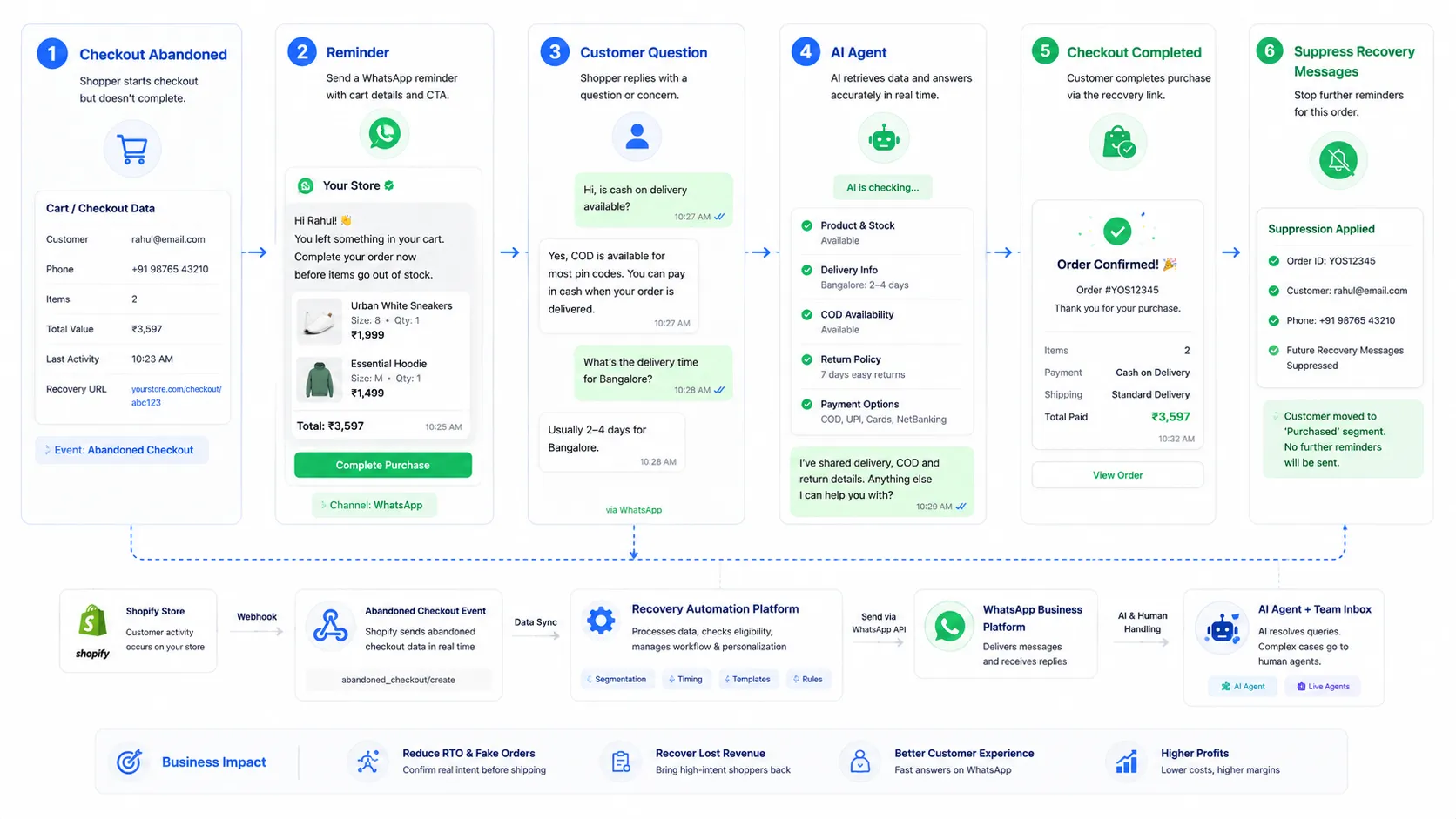
Message 1 — reminder: Send a short reminder after abandonment with the product name and a direct checkout link. Don't lead with a discount if the customer has not shown price sensitivity.
Message 2 — objection handling: If the customer engages, let the workflow or AI agent answer questions about delivery, sizing, payment, returns, or product details using current store data.
Message 3 — final nudge: If appropriate, send one final reminder with a clear reason to act. Use a real incentive only when your margin and promotion strategy support it.
For WhatsApp, the recovery experience should feel like help with a purchase, not a broadcast campaign. The moment the customer completes the order, suppress further cart-recovery messages.
How Shopify abandoned cart recovery works technically
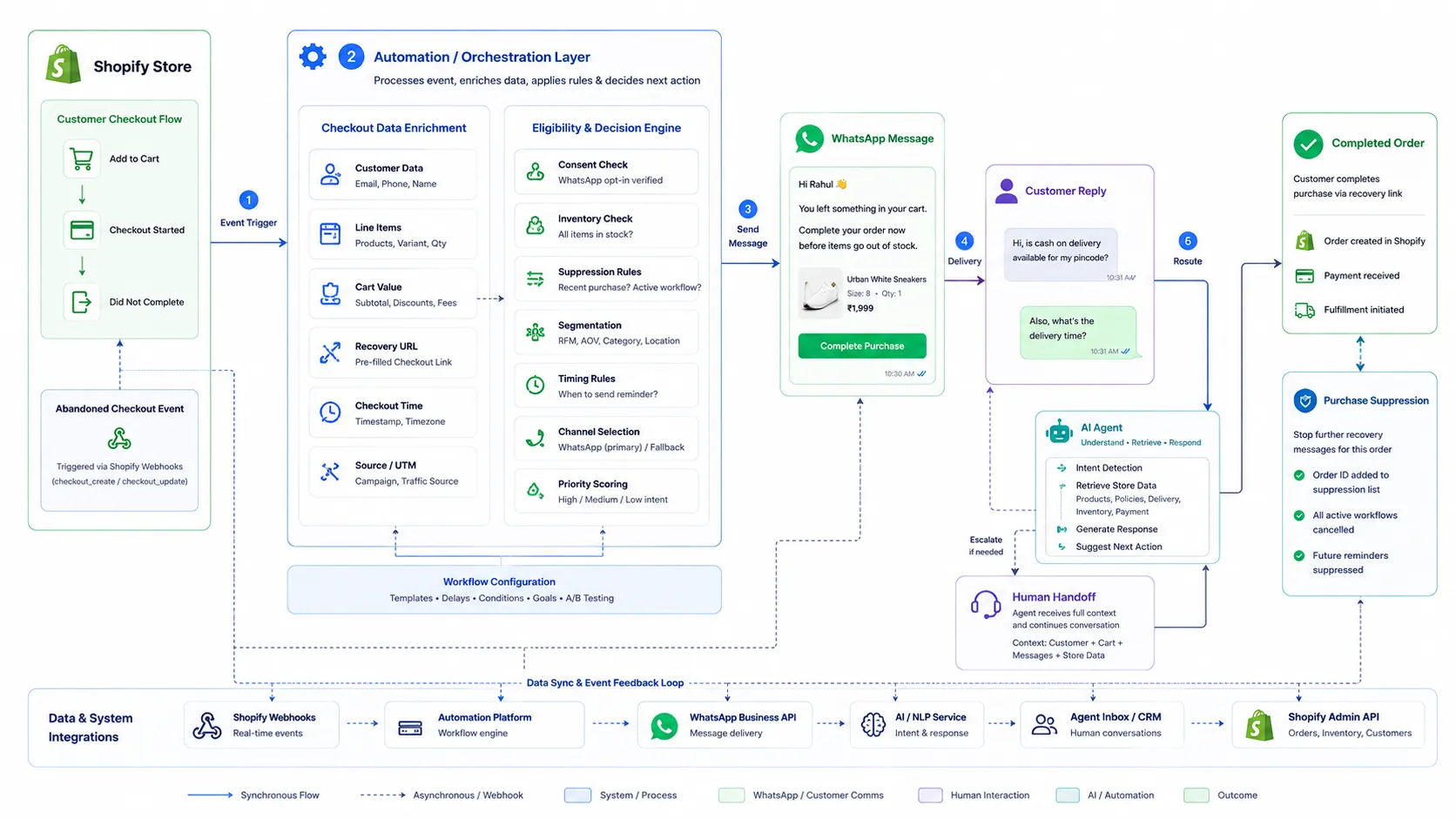
A useful Shopify recovery system starts with the store event and ends with a measurable order outcome. Shopify provides abandoned-checkout data and a recovery URL, while Shopify Flow can start a workflow when a customer abandons checkout. An integration can use these events and data to trigger a recovery sequence.
- Detect: Shopify records an incomplete checkout.
- Enrich: Retrieve the customer, line items, cart value, product details, and recovery URL.
- Check eligibility: Confirm consent, channel eligibility, inventory, suppression rules, and whether an order has already been created.
- Choose the message: Apply rules based on cart value, customer type, product, and abandonment reason when known.
- Send: Deliver the approved message through the selected channel.
- Listen: Capture clicks, replies, purchases, and objections.
- Suppress: Stop recovery messages as soon as the customer purchases or opts out.
- Measure: Attribute revenue and compare against a baseline or holdout where possible.
Shopify's current documentation states that abandoned checkout data can include customer details, line items, pricing information, timestamps, and a recovery URL. That makes the recovery link a core part of the workflow rather than a generic store homepage link.
Why timing matters more than sending more messages
The first recovery message should arrive while the purchase is still mentally active. Waiting a full day for every shopper throws away context, while sending too quickly can feel intrusive.
There is no universal “best” delay. Test your own data. A practical starting framework is to test an early reminder, a later objection-handling message, and a final nudge, then compare recovered revenue per eligible abandonment rather than only open or click rates.
| Stage | Goal | Message approach |
|---|---|---|
| Early | Recover distracted shoppers | Product reminder + checkout link |
| Middle | Resolve hesitation | Questions, delivery, payment, sizing, returns |
| Late | Close remaining high-intent shoppers | Final reminder or qualified incentive |
Don't give every abandoned cart a discount

Discounting is one of the fastest ways to make a recovery dashboard look good while making your contribution margin worse. If a customer would have returned after a reminder, a coupon simply transfers margin to the customer.
Use incentives as a controlled experiment. Segment price-sensitive shoppers, test a discount against a no-discount reminder, and measure incremental profit, not just recovered orders.
For example, a ₹500 discount that recovers a ₹3,000 order may look successful in an order-count report. If your gross margin is already tight, it may be a poor recovery strategy. A delivery reassurance message or product question answered by an AI agent could have converted the same shopper without the discount.
AI agents can improve recovery when the problem is a question
Rule-based automation is excellent when the next action is predictable. AI becomes useful when the shopper's reason for abandoning is expressed in natural language.
Suppose a customer replies, “I want this, but will it reach Pune before Monday and can I exchange if the size doesn't fit?” A static chatbot may force the shopper through menus. An AI agent can identify the two questions, retrieve the relevant delivery and exchange information, answer them, and send the checkout link if the customer is ready.
The important implementation detail is access to reliable data. An AI agent should not invent stock, delivery dates, discounts, return rules, or payment options. Connect it to the information it is allowed to retrieve and give it a clear escalation path when it cannot answer safely.
What a high-performing abandoned cart recovery flow looks like
The best flow is not the one with the most messages. It is the one that makes the next purchase step easier while avoiding unnecessary contact.
Segment before you message
- First-time vs returning customer
- Low vs high cart value
- Product category or margin band
- COD vs prepaid preference where applicable
- Customer location and delivery constraints
- Known support or payment issue
Use one clear CTA
Give the shopper one obvious next action: Complete your purchase, Ask a question, or Get help. Multiple competing CTAs make the recovery message harder to act on.
Make suppression part of the architecture
Suppression is not a copywriting detail. It is a system rule. If an order is created after the first message, stop the recovery sequence. If the customer opts out, stop promotional messages. If inventory changes and the product is no longer available, don't send a message that tells the shopper to buy it.
How to calculate whether cart recovery is actually profitable
Start with a simple monthly model.
Recovered revenue = eligible abandoned checkout value × recovery rate × attribution confidence.
Then subtract the costs required to produce that revenue: discounts, message fees, software, payment costs, and human support time. The result is a more useful measure than “orders recovered.”
| Metric | What to watch |
|---|---|
| Eligible abandonments | How many contacts can legally and technically receive recovery messages? |
| Recovery rate | What percentage of eligible abandoners place an order? |
| Recovered revenue | How much sales value is attributed to the flow? |
| Incremental revenue | How much is above the expected natural conversion rate? |
| Discount cost | How much margin is given away to recover orders? |
| Cost per recovered order | Messaging + software + human effort divided by recovered orders |
| Net contribution | Gross profit from incremental orders minus recovery costs |
Use holdouts if you want to know the real revenue lift
Attribution can overstate recovery because some shoppers would have purchased anyway. The cleanest way to estimate incremental revenue is to keep a small, properly designed holdout group that does not receive the recovery treatment, then compare purchase rates and revenue with the treated group.
For example, if the recovery group converts at 8% and the holdout converts at 5%, the program's measured incremental conversion is 3 percentage points, not 8%. The same logic applies to revenue.
If a holdout is not practical, use a consistent attribution window and compare recovery revenue with historical performance. Be explicit about the method in your reporting so the number can be trusted.
Common abandoned cart recovery mistakes
Sending the same message to everyone
High-value customers, first-time shoppers, repeat customers, and low-intent visitors do not have the same objections. Segmentation usually creates more value than adding another generic reminder.
Waiting too long
A delayed reminder can still work, but it competes with the customer's next purchase, other brands, and a forgotten product. Test timing instead of assuming one delay works for every category.
Using the homepage instead of the recovery checkout
Every extra step creates friction. If your commerce platform provides a valid recovery URL, use it so the customer can resume the purchase rather than starting again.
Discounting every cart
This trains customers to wait for coupons and cuts margin. Start with a reminder and useful information; reserve incentives for segments where they are justified.
Ignoring the reason for abandonment
If the real problem is delivery, payment, sizing, or returns, another “You forgot something” message does not solve it.
Measuring clicks instead of money
A high click rate can look impressive while producing little profit. The dashboard should end with recovered orders, recovered revenue, incremental revenue, and net contribution.
What Shopify stores should automate first
If you're starting from zero, don't build a 12-step customer journey. Start with one recovery workflow that has a clear event, a clear audience, and a clear revenue outcome.
- Abandoned checkout detection — capture the event and relevant checkout data.
- Eligibility and suppression — check consent, existing orders, inventory, and opt-outs.
- First reminder — send the recovery link with minimal friction.
- Reply handling — let an AI agent or human answer common purchase questions.
- Purchase suppression — stop the sequence immediately after conversion.
- Revenue reporting — measure recovered and incremental revenue.
Once that works, add segmentation, testing, channel orchestration, and high-value human escalation.
Abandoned cart recovery vs fixing checkout
Recovery should not become an excuse to leave a broken checkout untouched. If 70% of shoppers abandon, recovering a fraction of them is useful, but reducing the abandonment itself can create a larger and more durable improvement.
Use your recovery data as a diagnostic tool. If customers repeatedly ask about shipping, make shipping information visible earlier. If payment failures dominate replies, investigate the gateway. If shoppers ask about returns, improve the product and policy pages. Your recovery conversations are a source of checkout research.
How Mark360 can fit into the recovery workflow
Mark360 is built around the part of ecommerce recovery that generic broadcast tools often miss: connecting WhatsApp conversations to store events and customer context.
A Shopify store can trigger a recovery workflow when an eligible checkout is abandoned. The system can send a personalized WhatsApp message, provide the recovery link, answer customer questions with an AI agent when the required data is available, and hand the conversation to a human when the issue needs judgment.
The goal isn't to send more WhatsApp messages. It's to recover more profitable orders with less manual follow-up.
Explore Mark360 WhatsApp automation or connect your recovery workflow to the Shopify events and customer data that already exist in your store.
Start with the revenue you are already leaving behind
Before spending more on acquisition, calculate how much checkout value your store loses each month. Then identify which abandonments are recoverable, which channel you have permission to use, and which customer questions are blocking purchase.
A 25% revenue lift may be possible for some stores, but the path to it is rarely “send more reminders.” It is better event data, faster recovery, relevant conversations, tighter suppression, fewer checkout obstacles, and measurement you can trust.
Related reading: WhatsApp abandoned cart recovery for Shopify and WhatsApp automation for ecommerce.