

COD confirmation can reduce RTO before the parcel ever leaves your warehouse
COD confirmation reduces Return to Origin (RTO) by checking whether a cash-on-delivery customer still intends to receive the order before you dispatch it. The strongest version is an automated WhatsApp flow that shows the order amount and delivery details, asks the buyer to confirm or cancel, and holds unconfirmed orders instead of shipping them blindly.
For the “real percentage” question, there is no credible industry-wide number saying COD confirmation always cuts RTO by a fixed amount. Current Indian ecommerce sources put COD RTO around 26% in broad datasets, while published brand case studies report relative RTO reductions ranging from roughly 12.6% to 32% after broader RTO or COD-verification interventions. Those case studies are not a universal benchmark, but they give you a realistic range to test. citeturn2search14turn2search12turn2search5turn3search0

What is COD confirmation?
COD confirmation is a pre-dispatch verification step for cash-on-delivery orders. After the order is placed, the customer receives a message asking them to confirm that they placed the order, that the delivery address is correct, and that they still want the parcel.
A typical automated flow has three outcomes:
- Confirm: release the order for packing and dispatch.
- Cancel: cancel or hold the order before shipping.
- No response: send a reminder and then route the order to a defined review or cancellation rule.
The key is that confirmation must happen before dispatch. Asking “Will you accept the parcel?” after the courier has already attempted delivery is NDR management, not COD confirmation.
What is RTO in ecommerce?
RTO, or Return to Origin, happens when a shipped order cannot be delivered and is sent back to the seller. Common causes include customer refusal, an incorrect or incomplete address, an unavailable recipient, fake or low-intent orders, delivery delays, and customers changing their minds.
RTO is different from a customer return. With a customer return, the buyer first receives the product. With RTO, the sale fails before successful delivery, while the merchant can still incur forward shipping, reverse logistics, handling, packaging, and operational costs.
For COD-heavy Indian D2C stores, this distinction matters because the order may look like revenue in the order dashboard until it eventually comes back undelivered.
What is the average COD RTO rate in India?
There is no single India-wide COD RTO rate that applies to every category, courier, pin code, and customer mix. A useful current benchmark is around 26% for COD/non-prepaid orders in data cited by Amazon Shipping India from Shipway's FY25 ShipNotes analysis. GoKwik's current RTO guide similarly states that Indian ecommerce COD orders see RTO rates of nearly 26%, compared with less than 2% for prepaid orders. citeturn1search4turn2search14
That means a store shipping 1,000 COD orders at a 26% RTO rate would see approximately 260 parcels return to origin. The number can be much higher or lower depending on the category. GoKwik says Indian D2C RTO can reach 40% in high-risk categories and pin codes, while other current industry sources publish ranges rather than one national average. citeturn2search14turn1search3
So if your COD RTO is 30%, don't immediately conclude that your courier is the problem. First split the number by payment mode, product category, pin code, customer type, AOV, courier, and acquisition source.
How much can COD confirmation reduce RTO?
A reasonable evidence-based answer is: published case studies currently show roughly 12.6% to 32% relative RTO reductions after COD/RTO interventions that include confirmation or verification. You should not present that as an industry guarantee because the interventions differ and most case studies are vendor-reported. citeturn2search12turn2search5turn3search0
| Published result | Reported change | What was implemented |
|---|---|---|
| Hopscotch / GoKwik | 12.6% reduction in COD RTO orders | RTO intelligence and interventions across high-risk areas |
| FanCode / GoKwik | 15.5% decrease in COD-led RTO | COD confirmation prompts plus prepaid incentives and COD restrictions |
| Anonymous Bangalore skincare D2C / NimbleBiz | 32% RTO reduction | WhatsApp COD confirmation combined with risk scoring and cart recovery |
These numbers show why a “COD confirmation reduces RTO by exactly X%” claim is misleading. Confirmation is one control inside a larger RTO system. The result depends on how many fake, impulsive, incorrect, or unreachable orders you catch before dispatch and what happens to the remaining orders.
What does a 20% RTO reduction actually mean?
A 20% RTO reduction is usually a relative reduction, not a reduction of 20 percentage points.
Suppose you dispatch 1,000 COD orders and your RTO rate is 26%:
- Current RTO orders: 260
- At a 20% relative reduction: 260 × 20% = 52 fewer RTOs
- New RTO orders: 208
- New RTO rate: 20.8%
That is very different from saying the RTO rate fell from 26% to 6%. The latter would be a 20-percentage-point reduction and would represent a much larger change.
Always report both numbers: before RTO rate → after RTO rate and relative RTO reduction.
Why COD orders have a higher RTO risk
COD removes the payment commitment that exists with a prepaid order. A shopper can place an order without paying and make the final decision when the courier arrives.
That creates room for several failure modes:
- Impulse orders: the customer placed the order quickly and later changed their mind.
- Fake or low-intent orders: the order was never intended to be completed.
- Address errors: the buyer entered an incomplete or incorrect address.
- Recipient unavailable: the customer cannot accept the parcel during the delivery attempt.
- Payment readiness: the customer selected COD but is no longer ready to pay the amount when delivery happens.
- Delivery delay: the customer loses interest while the parcel is in transit.
Confirmation attacks the first three problems especially well. It can also surface availability or payment concerns early enough to change the outcome.
Why WhatsApp COD confirmation works better as a conversation than a checkbox
A checkout checkbox records intent at one point in time. A WhatsApp confirmation creates a second intent check closer to fulfillment.
For an India-focused D2C store, the message can show the exact order, amount, and address and ask the customer to confirm. If the buyer replies with a question, the same conversation can handle it instead of sending the customer to a support form.
That creates a useful distinction:
| Basic confirmation | Conversation-led confirmation |
|---|---|
| YES / NO | YES / NO + questions |
| Filters obvious fake orders | Filters fake orders and resolves purchase objections |
| Manual review for exceptions | AI or human escalation for exceptions |
| Order status update | Order status + address + payment + delivery support |
What should a WhatsApp COD confirmation message contain?
Keep the first message operational. The customer needs to know what they are confirming and what happens next.
Example:
Hi {{name}}, we received your COD order #{{order_number}} for {{product}} worth ₹{{amount}}. Delivering to {{city/pincode}}. Please confirm your order so we can dispatch it.
Then give clear actions:
- Confirm order
- Cancel order
- Update address / Talk to support
If your economics support it, a separate option can offer prepaid payment. Don't hide cancellation behind a support agent. If the customer genuinely doesn't want the order, cancelling before dispatch is cheaper than shipping a parcel that will return.
When should you send COD confirmation?
Send confirmation before fulfillment starts. The exact delay should be tested against your warehouse cutoff and courier pickup schedule.
A practical starting workflow is:
- Immediately after COD order: send the first confirmation.
- After a defined interval: remind customers who have not responded.
- Before the dispatch cutoff: hold, cancel, or manually review unconfirmed orders according to your risk policy.
- After confirmation: release the order to fulfillment.
Do not wait until the parcel is out for delivery. At that point, the cost of a bad order has already increased.
What should happen to an unconfirmed COD order?
Don't automatically treat every non-response as a fake order. A customer may miss a WhatsApp message, have notifications disabled, or simply be busy.
Instead, create risk-based rules. For example, a repeat customer with a strong delivery history can be handled differently from a first-time customer with a high-value COD order going to a historically high-RTO pin code.
| Order signal | Suggested action |
|---|---|
| Repeat customer + low AOV + good delivery history | Confirm quickly and release |
| First order + high AOV | Require confirmation before dispatch |
| High-RTO pin code | Confirmation + address verification |
| Customer says “cancel” | Cancel before dispatch |
| Customer asks to change address | Hold order and update only after validation |
| No response from high-risk order | Manual review or cancellation rule |
How COD confirmation reduces RTO step by step
The mechanism is simple: detect bad intent before paying to ship it.
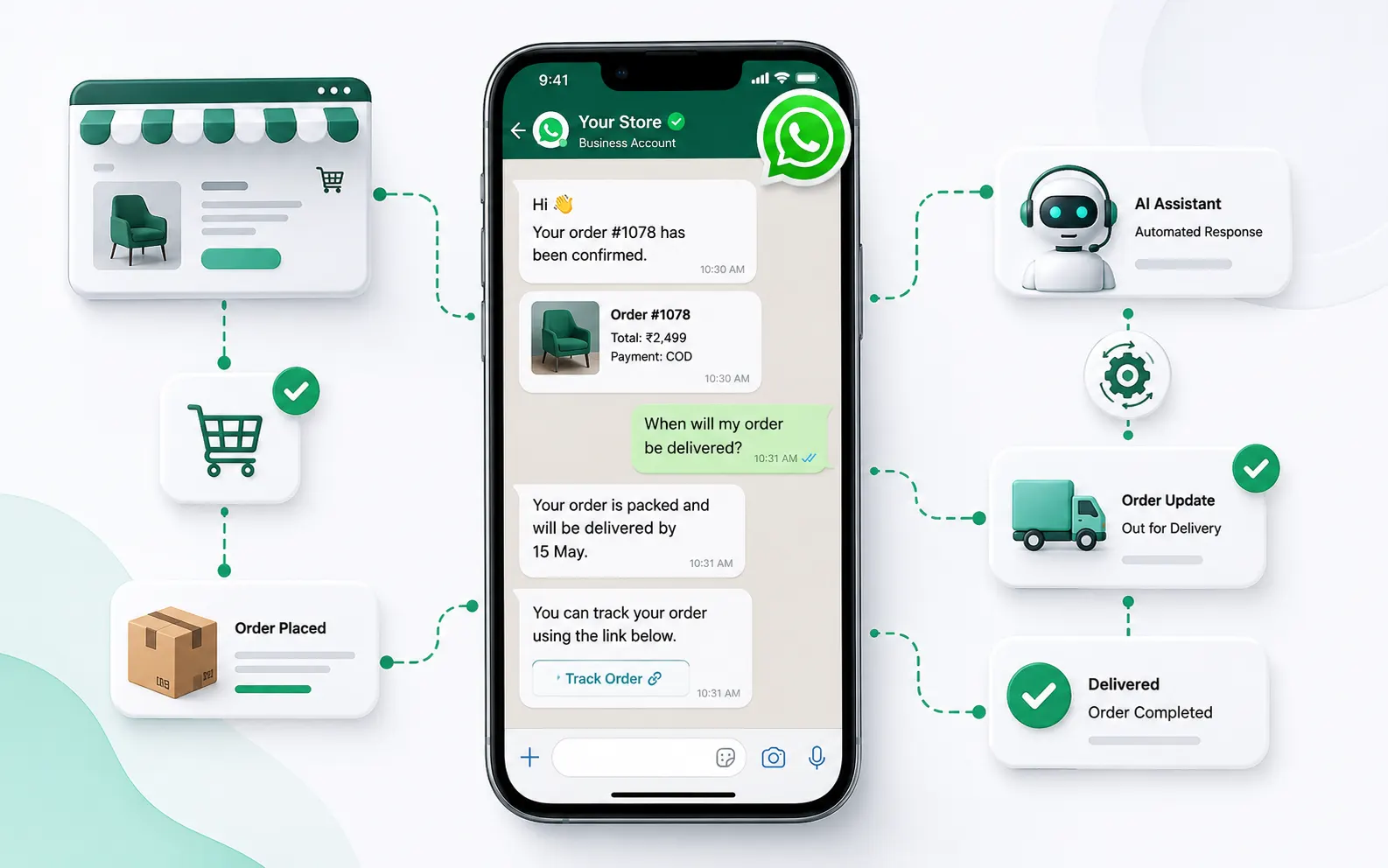
- Order placed: Shopify or your ecommerce platform records the COD order.
- Risk check: The workflow evaluates customer history, AOV, location, SKU, and other available signals.
- WhatsApp confirmation: The customer receives the order details and confirmation action.
- Customer response: Confirmed, cancelled, changed, or unanswered.
- Fulfillment decision: Confirmed orders proceed; risky unconfirmed orders are held or reviewed.
- Order status sync: The confirmation status is written back to the ecommerce system.
- Delivery communication: Once shipped, the customer receives tracking and delivery information.
The value comes from moving the decision earlier in the order lifecycle. You are not trying to convince the customer to accept a parcel at the doorstep. You're finding out whether the parcel should be dispatched in the first place.
How Shopify stores can automate COD confirmation
For Shopify, the workflow should connect the order event to WhatsApp and then write the confirmation result back into the order or your operations system. Shopify supports order and fulfillment webhooks, allowing apps to react to order and fulfillment changes instead of repeatedly polling for updates. citeturn0search0turn0search6
A practical architecture looks like this:
Shopify COD order
        ↓
Risk / eligibility check
        ↓
WhatsApp confirmation
   ↙          ↓          ↘
Confirm     Question     Cancel
   ↓           ↓           ↓
Release     AI / human   Cancel before
to fulfillment escalation  dispatch
        ↓
Shipping + tracking
        ↓
Delivery / NDR follow-up
For a Shopify merchant, the important part isn't the diagram. It's the state management behind it. A confirmation reply should update the same order record that fulfillment uses. Otherwise, your warehouse may still ship an order that the customer already cancelled on WhatsApp.
Where AI agents fit into COD confirmation
Use rules for the decision and AI for the conversation. That's the architecture that makes the most sense for COD operations.
The confirmation itself should be deterministic: confirmed means confirmed, cancelled means cancelled. But customers rarely reply with perfectly structured answers.
For example:
“Yes but please deliver after 6 pm. Also I entered the wrong pincode.”
A rule-only system may fail to understand the request. An AI agent can identify the confirmation intent, detect the address issue, retrieve the order information, and route the change to the appropriate workflow or human agent.
The AI should not invent delivery promises or silently change critical order information. Give it access only to the data and actions it is authorized to use.
Can COD confirmation also increase prepaid conversion?
Yes. The confirmation step can become a controlled opportunity to move eligible customers from COD to prepaid. Instead of asking every customer to pay online, offer a prepaid option when the customer has already confirmed the order or when your risk model identifies COD as a higher-risk payment method.
For example:
“Your COD order is ready to ship. Prefer prepaid? Pay securely by UPI and get ₹100 off.”
This can remove COD risk entirely for customers who accept the prepaid option. GoKwik's current RTO products explicitly use risk-based interventions, prepaid incentives, and COD controls as part of RTO management. citeturn2search1turn2search3
Measure this separately from COD confirmation. A prepaid conversion is not the same thing as an RTO reduction, although it can improve the final delivery economics.
COD confirmation vs NDR management: don't confuse them
These two workflows solve different problems.
| Workflow | When it happens | Main objective |
|---|---|---|
| COD confirmation | Before dispatch | Prevent low-intent or incorrect orders from entering the shipping network |
| NDR follow-up | After a failed delivery attempt | Recover a delivery by arranging reattempt, address correction, or availability |
| Delivery notification | During transit / out for delivery | Prepare the customer to receive the parcel |
The best RTO program uses all three. Confirmation prevents avoidable shipments. Delivery communication improves readiness. NDR automation rescues orders that still fail on the first attempt.
What percentage of RTO can COD confirmation prevent?
Don't promise a fixed percentage. Use your own RTO baseline to calculate the opportunity.
Current published case studies provide a useful reality check:
- Hopscotch reported a 12.6% reduction in COD RTO orders after RTO-focused interventions. citeturn2search12
- FanCode reported a 15.5% decrease in COD-led RTO after using COD confirmation prompts alongside other interventions. citeturn2search5
- A 2026 NimbleBiz case study reports a 32% RTO reduction for an Indian skincare brand using WhatsApp COD confirmation combined with risk scoring and other automation. citeturn3search0
These results suggest that 10–30% relative RTO reduction is a reasonable test range for planning experiments, but this is an inference from published case studies, not an industry benchmark. Your result can be lower or higher.
How much money can a lower RTO rate save?
Use your actual RTO cost rather than a generic “RTO is expensive” statement.
RTO savings = avoided RTO orders × average avoidable RTO cost per order.
Suppose your store dispatches 10,000 COD orders per month:
- Baseline RTO: 26%
- RTO orders: 2,600
- Average avoidable RTO cost: ₹250
- Monthly RTO cost: ₹6.5 lakh
If COD confirmation and related interventions reduce RTO by 20% relative:
- Avoided RTOs: 520
- Estimated cost saved: ₹1.3 lakh/month
The ₹250 figure above is only an example. Replace it with your actual forward freight, reverse freight, handling, packaging, labor, and inventory costs. GoKwik currently describes RTO as carrying a loss of roughly ₹100–₹150 per order in its RTO product material, while other logistics sources report different costs depending on parcel and zone. citeturn2search0
How to calculate your real COD confirmation ROI
Your dashboard should answer four questions:
- How many COD orders were eligible for confirmation?
- How many were confirmed, cancelled, or left unanswered?
- What was the RTO rate for confirmed vs unconfirmed orders?
- How much contribution margin did the intervention save after WhatsApp, software, discounts, and support costs?
A useful calculation is:
RTO reduction % = (baseline RTO rate − post-confirmation RTO rate) ÷ baseline RTO rate × 100
For example, if your COD RTO falls from 25% to 20%:
(25 − 20) ÷ 25 × 100 = 20% relative RTO reduction.
Report the percentage-point change too: the rate fell by 5 percentage points.
Why you should test confirmation with a control group
If you send confirmation to every COD customer and RTO falls, you know the number changed. You don't automatically know how much of the improvement came from confirmation.
Seasonality, courier changes, delivery speed, product mix, promotions, and customer acquisition sources can all change RTO at the same time.
The strongest test is to keep a comparable control group that follows your normal process while the treatment group receives COD confirmation. Compare RTO, delivery rate, cancellation rate, prepaid conversion, and contribution margin.
If a control group is not operationally possible, compare matched cohorts by customer type, AOV, category, pin code, and courier and clearly label the result as observational.
What makes a COD confirmation flow fail?
Shipping before confirmation
If the warehouse releases every order immediately, the confirmation message is just another notification. The system needs a real fulfillment state that can hold the order.
One message with no escalation
Some customers will ask questions instead of pressing a button. Give them a way to get help. WhatsApp's current business policy allows automated responses within the customer-service window but requires a clear and direct escalation path. citeturn4search6turn4search13
Ignoring address changes
An order can be genuine and still fail because the address is wrong. Confirmation should give customers a way to flag address issues before dispatch.
Automatically cancelling every non-response
This can reduce RTO but also cancel legitimate orders. Use customer history and order risk to decide how long an order should remain on hold.
Sending promotional content in the operational message
Keep the confirmation focused on the order. WhatsApp businesses need the required customer permissions and must follow applicable business messaging policies and documentation. citeturn4search1turn4search4
Measuring only confirmation rate
A 90% confirmation rate sounds good, but it doesn't prove the program reduced RTO. The real KPI is the difference in delivery and RTO outcomes between comparable groups.
How to build a high-performing COD confirmation workflow
Start simple, then add intelligence after you have clean data.
Stage 1: Basic confirmation
- Trigger immediately after COD order creation.
- Show customer name, order number, amount, and delivery area.
- Provide confirm and cancel actions.
- Hold unconfirmed orders before dispatch.
Stage 2: Address verification
- Ask customers to confirm or correct the delivery address.
- Flag mismatched or incomplete information.
- Route complex changes to an agent.
Stage 3: Risk-based confirmation
- Use customer delivery history.
- Segment by pin code RTO history.
- Consider AOV and product category.
- Apply stronger verification to high-risk orders.
Stage 4: Prepaid conversion
- Offer UPI/prepaid payment to selected customers.
- Measure conversion separately from RTO reduction.
- Protect margin by limiting incentives.
Stage 5: AI-assisted conversations
- Answer product and delivery questions.
- Identify cancellation intent.
- Handle address-change requests through approved workflows.
- Escalate exceptions to humans.
What should you automate first if your RTO is above 25%?
Start with pre-dispatch COD verification, not a complicated AI system. If a quarter or more of your COD shipments are returning, first establish a clean baseline and stop obvious bad orders from entering fulfillment.
- Measure RTO by payment mode.
- Measure RTO by pin code, courier, category, AOV, and customer type.
- Introduce WhatsApp confirmation for a controlled COD cohort.
- Hold or review unconfirmed high-risk orders.
- Track confirmed vs unconfirmed delivery outcomes.
- Add NDR automation for orders that still fail delivery.
- Add AI only where customer conversations are creating operational work.
This sequence matters. AI cannot compensate for a fulfillment process that doesn't know whether an order is confirmed.
WhatsApp COD confirmation and compliance
For businesses using the WhatsApp Business Platform, customer consent and messaging policy requirements matter. WhatsApp's current resources state that businesses need the necessary rights, consents, and permissions to communicate with customers, and the Business Messaging Policy requires appropriate opt-in practices. WhatsApp also requires approved message templates when businesses initiate conversations outside the applicable customer-service window. citeturn4search1turn4search4turn4search6
For a COD confirmation workflow, work with your WhatsApp setup and template categories carefully. Keep operational messages specific to the order, maintain opt-out handling, and provide a direct escalation path for customers who need human help.
How Mark360 can automate COD confirmation for Shopify
Mark360 can sit between the Shopify order event and the customer conversation: detect eligible COD orders, trigger WhatsApp confirmation, collect the customer's response, and connect that response to the next fulfillment action.
The useful part isn't the message itself. It's the state change behind it:
- COD order created → confirmation pending
- Customer confirms → release to fulfillment
- Customer cancels → cancel before dispatch
- Customer asks a question → AI agent or human handles it
- No response → reminder, hold, or review based on risk
- Order shipped → stop confirmation flow and start delivery communication
That makes COD confirmation part of your ecommerce operations instead of a separate WhatsApp campaign.
Explore Mark360 WhatsApp automation for Shopify order workflows, COD confirmation, customer conversations, and AI-assisted support.


FAQ: COD confirmation and RTO
What is the average COD RTO rate in India?
There is no single rate for every ecommerce category. Current sources cite roughly 26% RTO for COD/non-prepaid orders in broad Indian ecommerce data, with significantly higher rates in some categories and pin codes. Benchmark your store by payment mode, category, location, courier, and customer segment instead of using one national number. citeturn1search4turn2search14
How much can WhatsApp COD confirmation reduce RTO?
There is no universal percentage. Published case studies currently report relative RTO reductions such as 12.6%, 15.5%, and 32% after interventions that include COD confirmation or verification, but these are vendor or company case studies rather than an independent industry benchmark. citeturn2search12turn2search5turn3search0
Does COD confirmation prevent fake orders?
It can prevent some fake or low-intent orders from being dispatched because the customer must confirm before fulfillment. It will not catch every fraudulent order, so combine confirmation with risk scoring, address validation, customer history, and post-dispatch NDR management.
Should every COD order require WhatsApp confirmation?
Not necessarily. A risk-based approach can reduce friction for trusted repeat customers while applying stronger verification to first-time, high-AOV, or high-RTO orders. Test confirmation coverage against RTO savings and conversion impact.
Can COD confirmation convert customers to prepaid?
Yes. A confirmation conversation can offer a prepaid UPI option to eligible customers. Track prepaid conversion separately so you can distinguish payment-method improvement from the direct effect of COD confirmation on RTO.
Can AI agents handle COD confirmation?
AI agents are useful for the conversational part: answering questions, detecting cancellation intent, and routing address or delivery issues. The final fulfillment decision should remain controlled by explicit business rules and approved actions.
The real goal is fewer bad shipments, not more confirmations
COD confirmation works because it moves the decision point before the shipping cost is incurred. A customer who confirms is giving you a stronger signal than a customer who simply clicked “Place COD Order.”
The percentage to watch is not the confirmation rate. It's the RTO rate after confirmation, the RTO rate for the control group, and the net money saved.
If your COD RTO is around 25–30%, even a 15–20% relative reduction can remove a meaningful number of failed shipments. Start with WhatsApp confirmation, connect it to your Shopify fulfillment state, measure the result with a control group, and then add risk scoring, prepaid conversion, NDR automation, and AI support where the data shows they are needed.