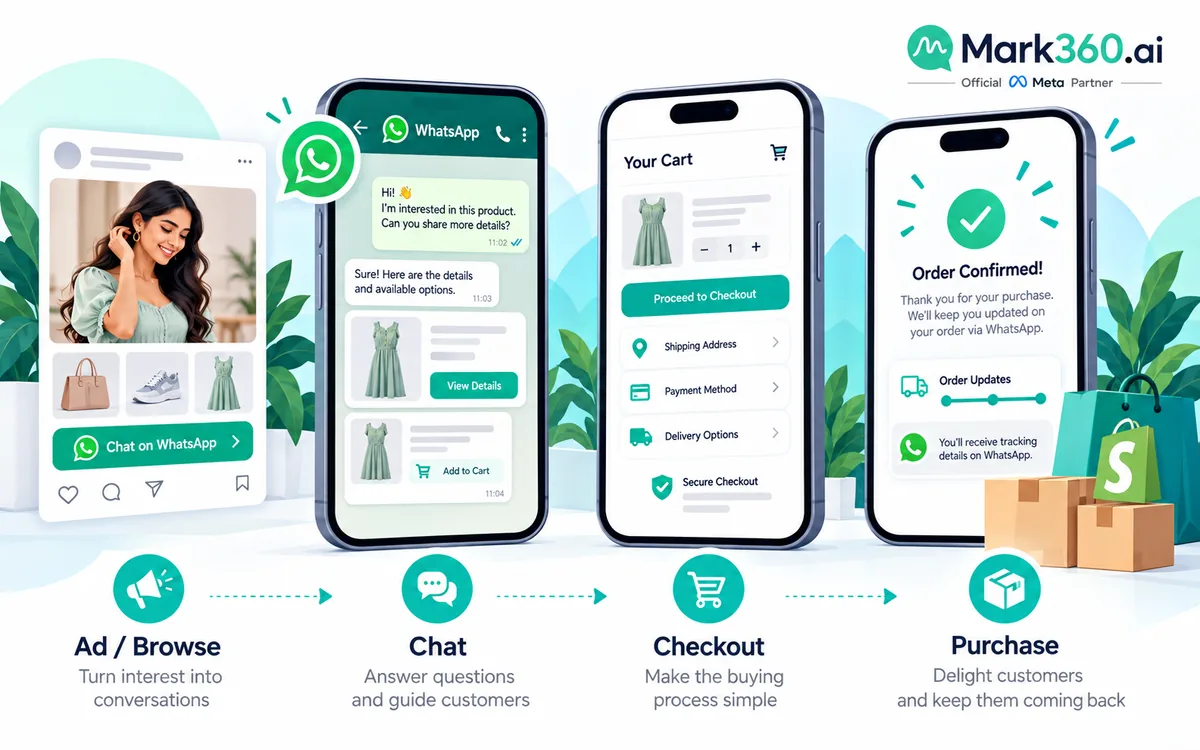

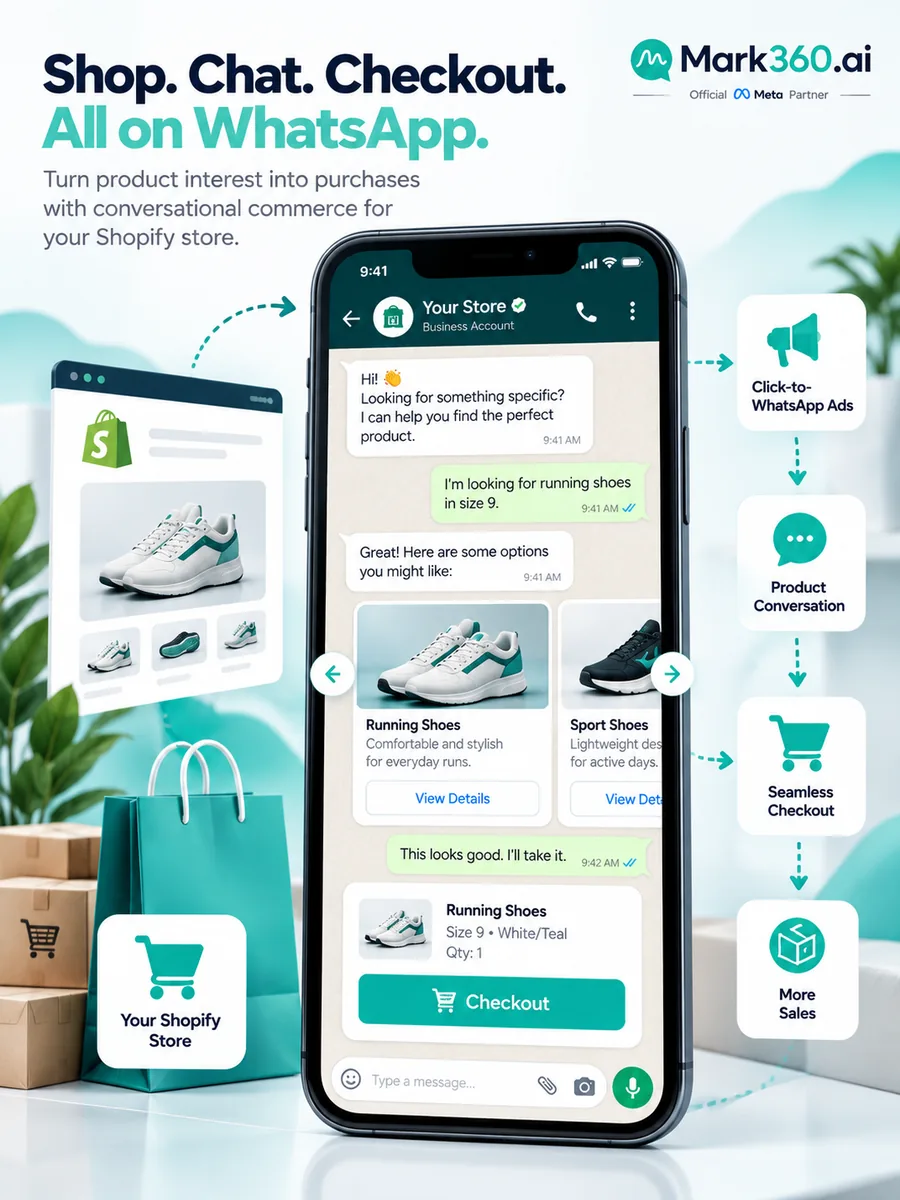
Click-to-WhatsApp Ads for Shopify Stores (Global 2026): Ad Click → Conversation → Checkout
For a Shopify store, the expensive part of a Meta ad click isn't the click itself. It's losing the shopper between ad intent, product questions, checkout, and purchase. Click-to-WhatsApp Ads give you another route: move the shopper from Facebook or Instagram into a WhatsApp conversation, answer the question that blocks purchase, send the right product or checkout link, and connect the conversation back to the Shopify order.
This guide is written for global Shopify teams, including merchants selling in the US, UK, EU, MENA, and APAC. It focuses on the sales system after the ad click rather than repeating a generic Ads Manager tutorial. For India-specific CTWA setup and costs, use the dedicated IndiaClick-to-WhatsApp Ads guide. For the broader Instagram and Meta funnel, see the Click-to-WhatsAppInstagram ads funnel guide.
Quick answer: How do Click-to-WhatsApp Ads work for Shopify stores?
Click-to-WhatsApp Ads open a WhatsApp chat from a Meta ad so Shopify brands can qualify intent, share catalog or product details, and send a checkout link—then match conversations to Shopify orders for attribution. After the messaging window, approved templates with appropriate consent can continue the journey. Results vary by geo, creative, audience, offer, and operational execution, so published CPL or CVR figures should be treated as illustrative ranges, not guarantees.
Five key takeaways
- Optimize for the conversation, not just the click. A low-cost click is not useful if shoppers never start or continue a meaningful WhatsApp conversation.
- Give the chat a Shopify-specific job. Product discovery, size or variant questions, availability, checkout links, and order context are stronger than a generic "Hi, how can we help?".
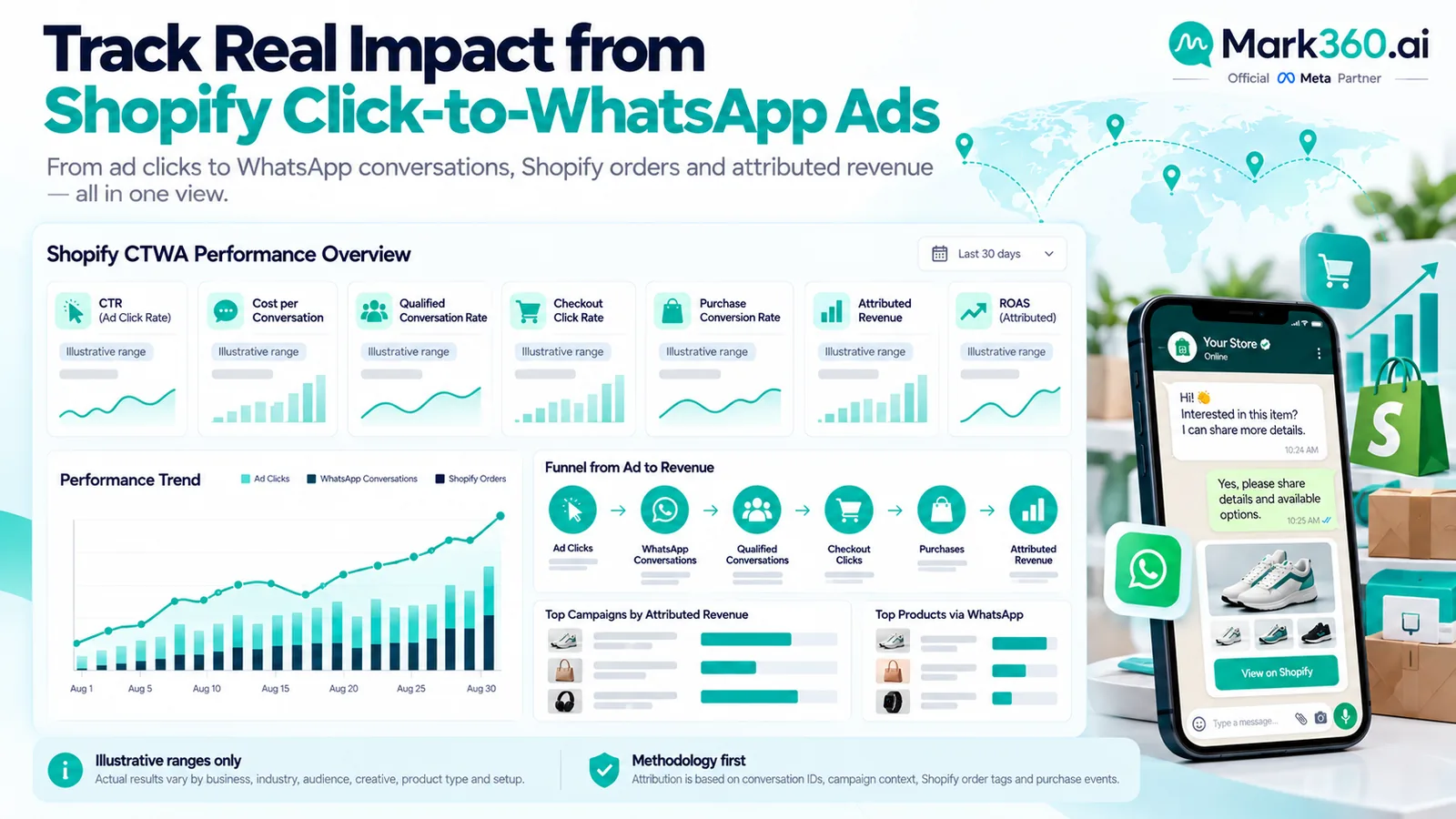
- Track the full path. Measure ad click → conversation → qualified intent → checkout click → Shopify purchase, not just Meta CTR.
- Separate the 24-hour customer-service window from later template messaging. Messaging permissions, template categories, and current platform rules affect what you can send and when.
- Judge performance against your own baseline. Global benchmarks vary too much by market and offer to justify a universal conversion promise.
| Stage | Shopify action | Primary KPI |
|---|---|---|
| Ad click | Open WhatsApp with contextual intent | CTR / cost per conversation |
| Conversation | Answer, qualify, recommend | Qualified conversation rate |
| Checkout | Send product or checkout URL | Checkout-click rate |
| Purchase | Match WhatsApp source to Shopify order | Purchase conversion / ROAS |
| Re-engagement | Use eligible approved templates | Incremental revenue per recipient |
How this guide differs from Mark360's India CTWA and Meta funnel posts
This article is deliberately Shopify-specific and global. It does not repeat an India-only Ads Manager walkthrough, INR cost table, COD-heavy opener strategy, or a generic Instagram funnel. The commercial question here is what happens after a shopper clicks: can your WhatsApp experience move intent into a Shopify checkout and can you prove that the resulting order came from the conversation?
If you're operating primarily in India and need account prerequisites, objective selection, WhatsApp destination setup, and India-specific cost considerations, use the IndiaCTWA guide. If your campaign spans Instagram placements and you want the Meta-to-WhatsApp funnel view, use the Click-to-WhatsAppads funnel article. If your immediate problem is connecting Shopify and WhatsApp, use the ShopifyWhatsApp integration guide rather than treating this article as an implementation manual.
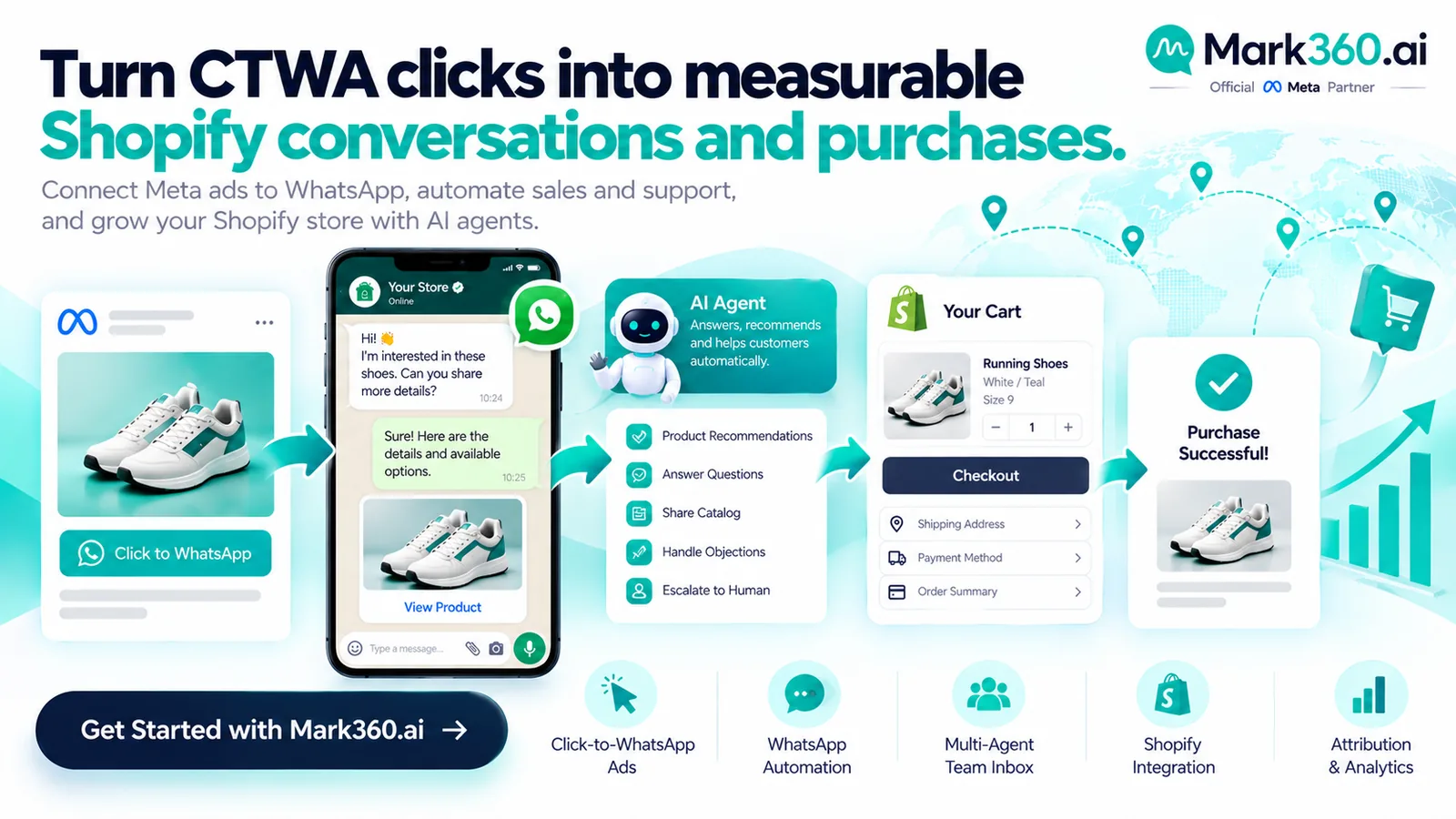
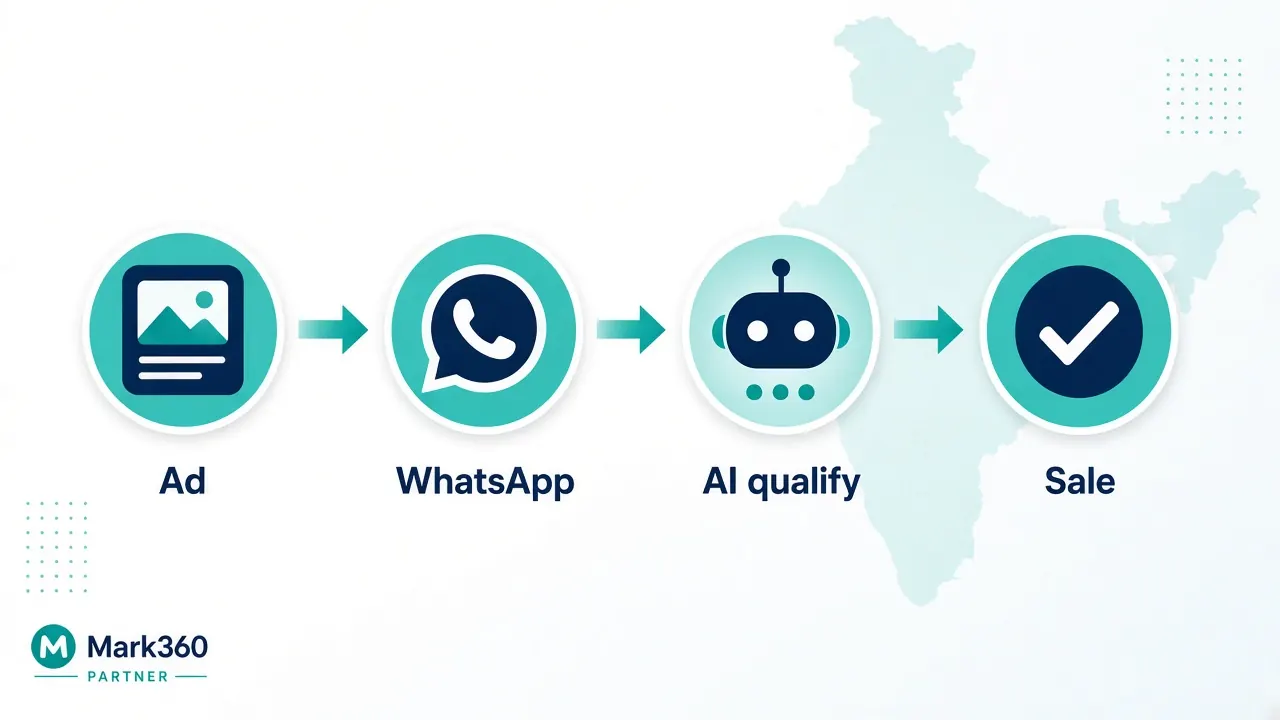
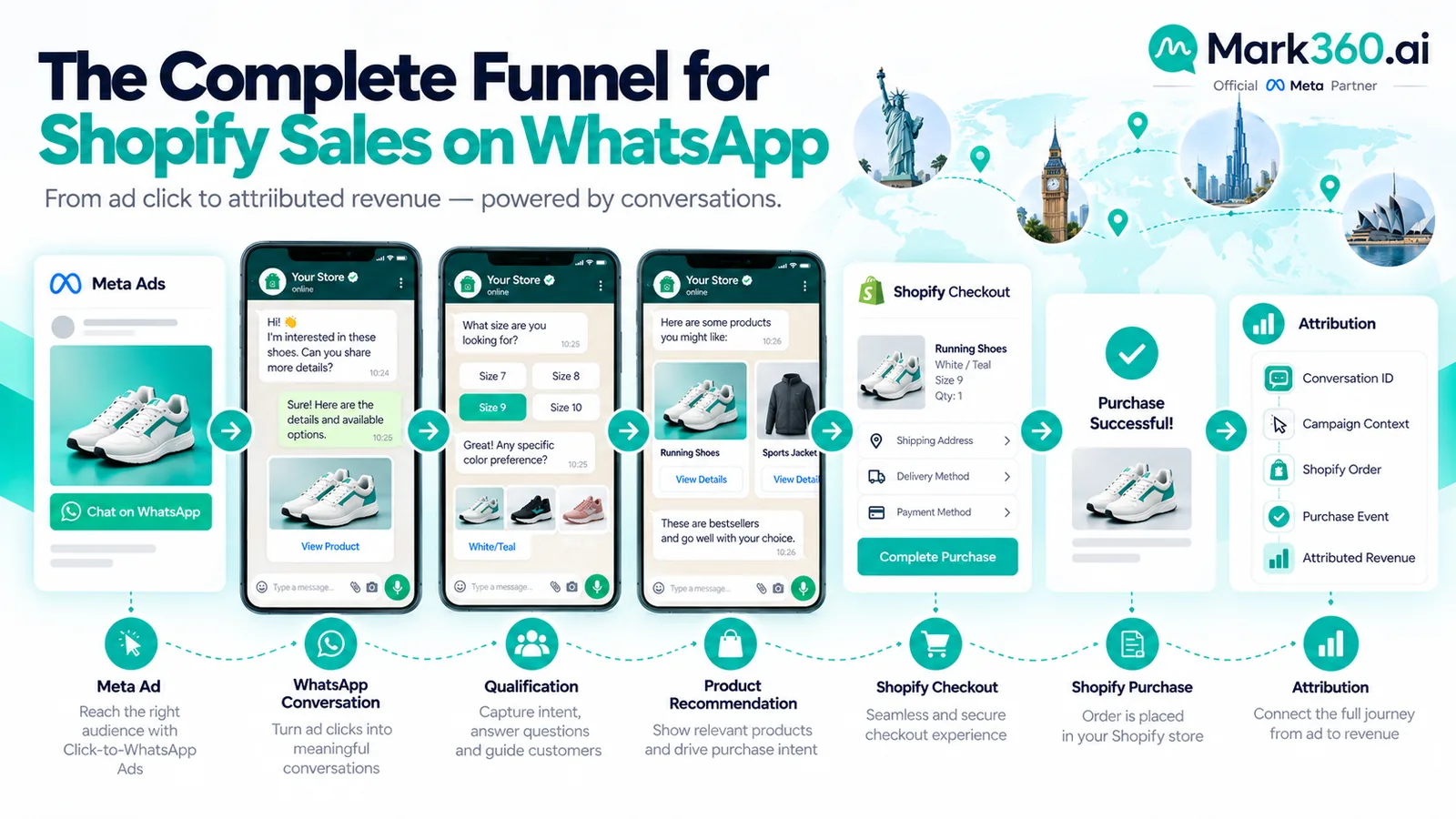
Funnel map: Ad → chat → qualify → catalog or checkout → purchase
A strong Shopify CTWA funnel has five operational stages. The ad creates a specific reason to message. WhatsApp captures that intent. Your automation or team qualifies the shopper and removes the purchase blocker. Shopify receives the shopper through a product or checkout path. Finally, the order is matched back to the source so you can evaluate revenue rather than conversation volume.
- Ad: Make the promise concrete: ask about a product, get a recommendation, check availability, or receive a personalized offer.
- Chat: Open WhatsApp with a prefilled message that carries context from the ad.
- Qualification: Ask only what changes the recommendation, such as product type, use case, size, budget, or delivery region.
- Checkout: Send a relevant product page, cart, or checkout URL rather than forcing the shopper back through a generic storefront search.
- Purchase: Persist campaign and conversation identifiers so Shopify orders can be tied to the WhatsApp journey.
Meta setup essentials for Shopify brands
The campaign setup should reflect the business outcome you actually want. If the goal is WhatsApp conversations, use a Meta setup that optimizes toward messaging rather than treating WhatsApp as a decorative destination attached to a traffic campaign. Keep the Shopify offer, product feed, ad creative, WhatsApp number, and measurement plan aligned before you scale spend.
Use one clear conversion promise
"Message us" is weaker than a useful reason to message. Examples include "Find your best size on WhatsApp," "Ask about today's bundle," or "Get product recommendations in WhatsApp." The promise should match what the team or automation can actually deliver.
Build the WhatsApp entry point around the ad
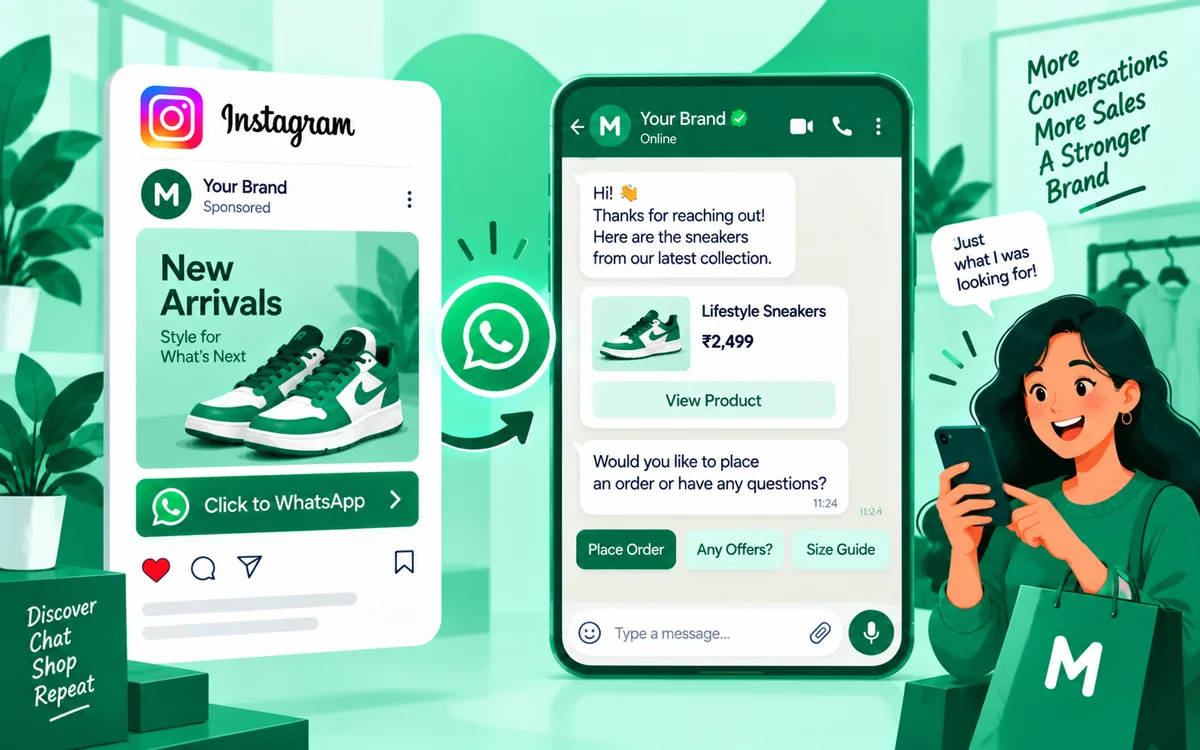
A shopper who clicked an ad for running shoes shouldn't enter a conversation that asks them to explain what they want from scratch. Carry campaign or product context into the opener and use quick replies when available. The first response should acknowledge that context rather than restart discovery.
Keep Shopify ready for the handoff
Before launch, verify that product URLs, variants, inventory signals, discount logic, and checkout links behave correctly on mobile. A WhatsApp funnel can create purchase intent quickly; a broken variant link or confusing checkout page can erase that gain.
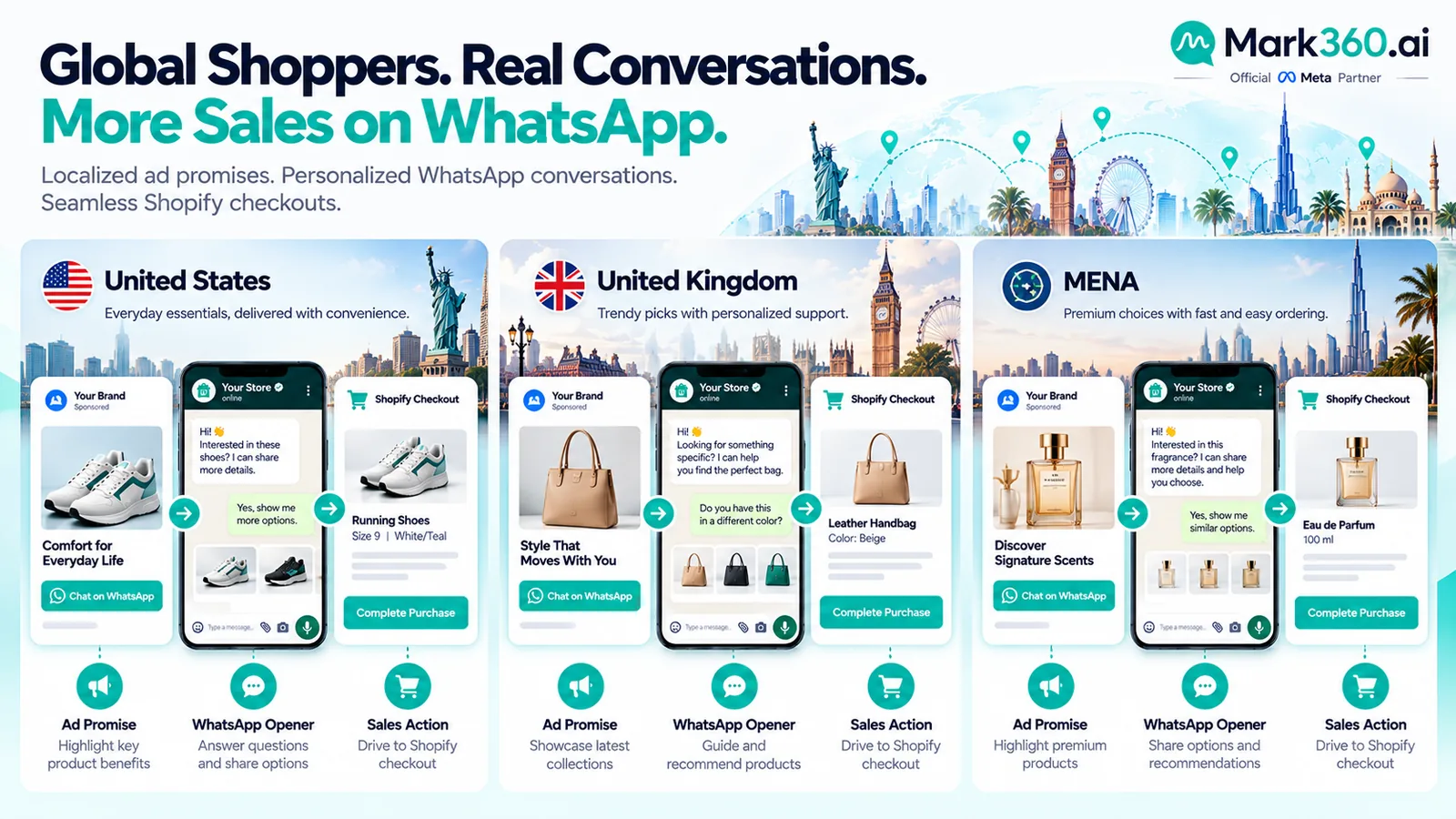
Creative and opener patterns for US, UK, and MENA shoppers
The underlying pattern is global, but the offer and tone should match the market. US shoppers may respond to convenience and product guidance. UK shoppers may need concise product or delivery information. MENA campaigns can put more emphasis on product availability, service access, or localized assistance. These are examples, not universal cultural rules; test your own audience.
| Market context | Ad promise | Conversation opener |
|---|---|---|
| US | Get help choosing the right product | "Hi, I saw the product guide ad. Can you help me choose the right option?" |
| UK | Check fit, availability, or delivery | "Hi, I saw your ad and want to check which size is right for me." |
| MENA | Get product or availability assistance | "Hi, I saw the offer. Can you help me choose the right product and confirm availability?" |
Don't treat these examples as copy templates that work everywhere. Test the promise, the first question, the offer, and the amount of friction before declaring a winning pattern.
Shopify handoff patterns that reduce friction
The best WhatsApp conversation is not necessarily the longest one. If the shopper already knows the product, your job is to remove friction and get them to the right Shopify destination quickly. If they are uncertain, the conversation should answer the uncertainty and then present a clear next step.
Product recommendation → product page
When the shopper needs help choosing between variants, use the conversation to narrow the choice and send the exact product or variant URL. Avoid sending a generic collection page if you already know what the shopper wants.
Product question → checkout
For high-intent shoppers, a direct checkout path can be appropriate. Confirm that the link is valid, mobile-friendly, and consistent with the offer stated in the conversation.
Silent user → eligible follow-up
If someone starts a conversation but does not purchase, don't automatically send repeated messages. Define a consent-aware follow-up policy, respect applicable messaging rules, and use approved templates when a message falls outside the active customer-service window.
Offer → tracked destination
If a promotion is part of the campaign, make the discount or offer logic measurable. Use consistent identifiers so the Shopify order can be reconciled against the campaign and conversation source.
For abandoned-checkout-specific implementation and timing, link to WhatsAppabandoned-cart recovery for Shopify instead of duplicating that setup here.
Attribution and events: connect the conversation to the Shopify order
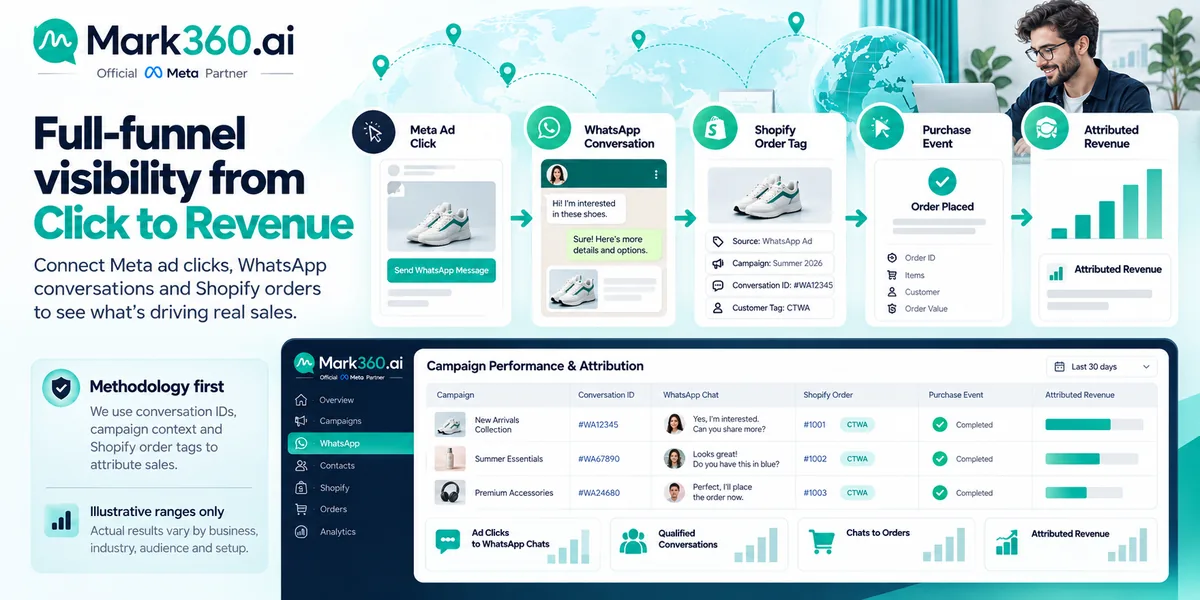
CTWA measurement becomes useful when your identifiers survive the handoff. Capture campaign information at the ad or conversation layer, retain it in your customer or conversation record, and write a stable source identifier into the workflow or Shopify order metadata where your stack supports it.
- UTMs: Keep campaign, source, medium, content, and relevant ad identifiers consistent across paid traffic and downstream destinations.
- Conversation ID: Store the WhatsApp conversation or lead identifier alongside the qualification record.
- Shopify order metadata: Preserve the campaign or conversation source where your integration supports order tags or metadata.
- Purchase event: Send eligible purchase information back into the relevant advertising measurement stack according to platform capabilities and policy.
- Conversation-to-order matching: Define the attribution window and matching rule before reporting performance. Otherwise the same order can be counted differently by Meta, Shopify, and your CRM.
A practical revenue calculation is simple: CTWA revenue = attributed Shopify orders × attributed order value. If you need contribution margin, subtract product, fulfilment, discount, messaging, platform, and relevant operational costs rather than treating gross sales as profit.
The 24-hour messaging window and post-window templates
Don't design a CTWA funnel as if every shopper can be messaged indefinitely after clicking an ad. WhatsApp messaging rules distinguish active customer-service conversations from later outbound messaging, and approved template categories matter once the applicable customer-service window has closed.
Inside an active customer-service conversation, the experience can be conversational and responsive to the shopper's request. Outside that window, your team needs an eligible approved template and an appropriate category, with consent and policy requirements handled by the messaging stack.
For example, a shopper might ask about a product, receive a recommendation, and purchase in the same conversation. A later promotional message is a separate messaging decision. Don't assume that a prior ad click automatically authorizes every future marketing message.
Current category rules and pricing can change. Verify the live WhatsAppBusiness Platform pricing documentation and applicable messaging policies before building a financial model or campaign workflow.

KPIs and honest illustrative ranges
There is no single global CTWA conversion rate that a Shopify merchant should plan around. US, UK, EU, MENA, and APAC accounts differ in audience intent, creative quality, product category, AOV, consent quality, traffic source, and sales process. Use benchmarks as questions to investigate, not promises to budget against.
The KPI dictionary
| KPI | Formula | What it tells you |
|---|---|---|
| CTR | Ad clicks ÷ impressions | Whether the creative generates initial interest |
| Cost per conversation | Ad spend ÷ conversations started | Cost to generate a WhatsApp conversation |
| Qualified conversation rate | Qualified conversations ÷ conversations started | How much inbound intent is commercially useful |
| Checkout-click rate | Checkout clicks ÷ qualified conversations | How effectively chat moves intent toward purchase |
| Purchase conversion | Attributed purchases ÷ eligible conversations | Conversation-to-order performance |
| ROAS | Attributed revenue ÷ advertising spend | Paid-media efficiency; define attribution clearly |
| Cost per recovered order | Messaging + attributable labor + campaign cost ÷ recovered orders | Economics of recovery workflows |
Illustrative ranges and methodology
Abandoned-checkout recovery: industry and vendor discussions often cite roughly 5–15% of eligible opted-in abandoners converting after reminder(s) as an illustrative range. This is not a Mark360 or Meta guarantee. The range depends heavily on timing, offer strength, AOV, product category, consent quality, checkout friction, and how "recovered" is defined.
Conversation engagement: avoid using one magic WhatsApp reply or click rate as a global benchmark. Measure reply rate, qualified-reply rate, product-link click rate, checkout click rate, and purchase rate against your own baseline. A high response rate with weak purchase intent is not automatically good performance.
Post-purchase upsell or review attach: a low-single-digit to mid-teens attach range can be used only as an illustrative planning range for some offers. It is highly dependent on timing, product fit, customer lifecycle, and incentive. Validate against your Shopify cohort data.
Methodology note: these are illustrative ranges drawn from commonly cited industry reporting and vendor case-study patterns, not controlled global benchmarks. Validate them against your Shopify reports, Ads Manager data, consented recipient counts, and a defined attribution window. Do not present them as Mark360 case-study percentages or Meta guarantees.
Budget and cost awareness
Model CTWA costs in separate layers. First is Meta media spend. Second is WhatsApp messaging costs that depend on current category and platform rules. Third is your software and operational cost: inboxes, automation, AI, seats, CRM work, and human handling.
Do not insert a made-up global Meta rate card into your forecast. WhatsApp Business Platform pricing and category rules can change by market and period. Check the current MetaWhatsApp Business Platform pricing documentation and the provider's current pricing page before approving a campaign budget.
For Mark360 software pricing, use the current Mark360pricing page or talk to sales. Do not assume a subscription figure from an old article or third-party comparison.
A useful operating formula is cost per recovered order = messaging cost + attributable labor + campaign cost allocated to recovery ÷ recovered orders. This makes it harder to confuse message volume with revenue contribution.
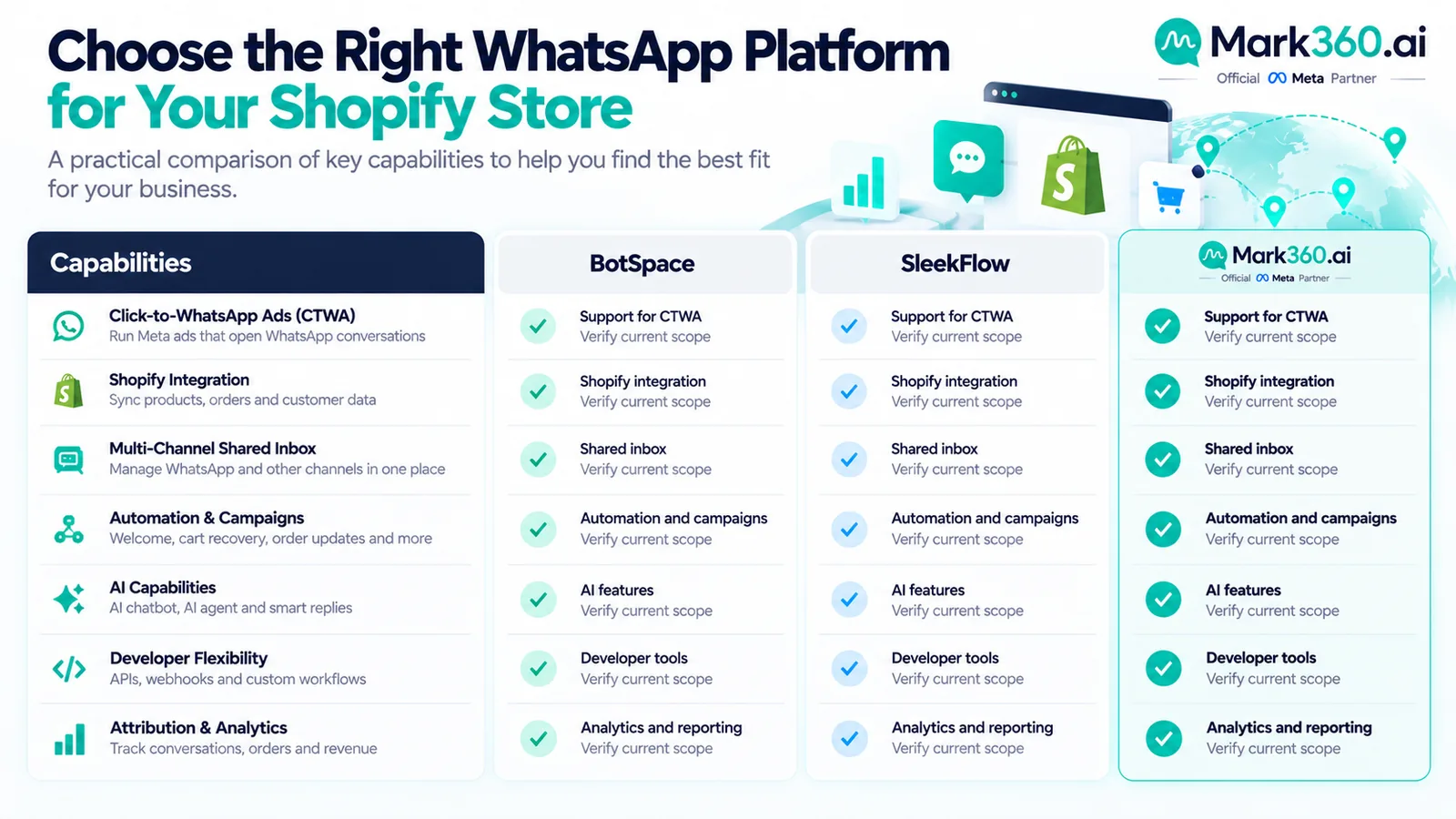
Stack checklist: BotSpace vs SleekFlow CTWA vs Mark360
Platform selection should start with the workflow you need, not the brand name. Public product pages change, so verify current capabilities before procurement. The comparison below is a fair capability checklist rather than a ranking.
| Capability | BotSpace | SleekFlow | Mark360 |
|---|---|---|---|
| CTWA campaign support | Verify current product scope | Verify current product scope | WhatsApp-focused workflow support |
| Shopify integration | Verify current integration depth | Verify current integration depth | Shopify-friendly WhatsApp journeys |
| Shared inbox | Verify current plan | Verify current plan | Available through platform workflows |
| Automation | Verify triggers and plan limits | Verify triggers and plan limits | WhatsApp automation and workflows |
| AI agents | Verify current AI capabilities | Verify current AI capabilities | WhatsApp AI agents |
| Developer flexibility | Review API and webhook documentation | Review API and integration documentation | Review API and integration options |
| Best evaluation question | Does it fit your CTWA workflow? | Does it fit your CTWA workflow? | Does the WhatsApp depth match your sales process? |
The right comparison is operational: Can the platform preserve campaign context, respond quickly, send Shopify destinations, route complex conversations, capture order attribution, and give your team enough visibility to optimize the funnel?
Compliance notes for global Shopify campaigns
CTWA does not remove consent and messaging obligations. The exact legal requirements vary by jurisdiction, customer relationship, message type, and applicable law. US, UK, EU, MENA, and APAC campaigns should be reviewed against the rules that apply to the merchant and recipient.
At a practical level, maintain records of consent where required, make the purpose of marketing communication clear, provide appropriate opt-out handling, use approved WhatsApp templates where required, and avoid treating an ad click as blanket permission for unrelated future marketing.
For EU campaigns, consider applicable GDPR and ePrivacy requirements. For US campaigns, review applicable messaging and marketing-consent requirements. For UK and other markets, apply the relevant local rules. This article is operational guidance, not legal advice.
14-day launch checklist
- Define the Shopify product or offer the CTWA campaign is meant to sell.
- Choose one primary conversation promise.
- Confirm the WhatsApp business setup and messaging eligibility.
- Map the ad click to a contextual opener.
- Write the first response and qualification path.
- Prepare product, variant, cart, and checkout URLs.
- Test mobile checkout from the WhatsApp conversation.
- Define UTM and campaign naming conventions.
- Persist conversation or campaign identifiers into the customer workflow where supported.
- Define the Shopify order attribution rule.
- Set KPI reporting for clicks, conversations, qualified intent, checkout clicks, purchases, and revenue.
- Document post-window template rules and consent requirements.
- Launch with controlled spend and avoid changing multiple variables at once.
- Review the first cohort by creative, audience, product, and purchase outcome before scaling.
FAQ
How do Click-to-WhatsApp Ads work for Shopify stores?
They open a WhatsApp conversation from a Meta ad. The shopper can ask questions, receive product guidance or a checkout link, and then complete the purchase on Shopify. The key measurement task is matching the conversation to the resulting order.
Are CTWA good for Shopify stores outside India?
They can be useful in US, UK, EU, MENA, and APAC markets when WhatsApp is an appropriate customer channel. Performance depends on audience behavior, offer, consent, creative, product category, and operational response quality.
How do I attribute Shopify purchases to WhatsApp conversations?
Use consistent campaign identifiers, conversation IDs, UTMs where applicable, and Shopify order metadata or tags supported by your integration. Define the attribution window before reporting results so Meta, Shopify, and your CRM are not using incompatible rules.
What happens after the 24-hour customer-service window?
Later outbound messaging may require an approved template and must follow current WhatsApp category and consent rules. Check current Meta documentation before designing post-window campaigns.
CTWA vs landing-page ads for Shopify — when should I use which?
Use CTWA when conversation can remove a purchase blocker, qualify intent, recommend products, or provide assistance. Landing pages can be more efficient when the shopper already knows what to buy and needs little interaction. Test both against purchase and revenue metrics rather than CTR alone.
Can I send a Shopify checkout link inside WhatsApp?
Yes, when your Shopify workflow and messaging setup support the relevant link and the message is appropriate for the active conversation or approved template context. Test the link on mobile and ensure the product, variant, pricing, and offer match the conversation.
What KPIs should I track for Shopify CTWA?
Track CTR, cost per conversation, qualified conversation rate, checkout-click rate, purchase conversion, attributed revenue, and ROAS. For recovery workflows, also track recovered orders and cost per recovered order.
How does Mark360 differ from BotSpace or SleekFlow for CTWA and Shopify?
Compare current capabilities rather than relying on static rankings. Mark360 focuses on WhatsApp Business API workflows and WhatsApp AI agents, with Shopify-friendly journeys and automation. BotSpace and SleekFlow have their own product scopes and should be evaluated against your required inbox, automation, AI, integration, and developer needs.
Do I need the WhatsApp Business API for CTWA at scale?
At scale, API-based infrastructure is generally the practical path when you need automation, team workflows, integrations, templates, or AI agents. The exact setup depends on your business and provider architecture.
How does this differ from Mark360's India CTWA guide?
This article is a global Shopify sales playbook focused on the ad-to-conversation-to-checkout-to-purchase journey. The India guide covers India-specific setup, account prerequisites, costs, and local considerations. Use the India guide for that depth rather than duplicating it here.
Next steps: build the sales loop, not just the ad
The strongest CTWA programs treat WhatsApp as part of the Shopify sales funnel rather than as an alternative destination for ad clicks. Start with one product or offer, one conversation promise, one attribution rule, and a small set of revenue KPIs. Then expand only after the data shows where the funnel is actually breaking.
If your Shopify integration is not connected yet, start with the ShopifyWhatsApp integration guide. If abandoned checkout is the priority, use the WhatsApprecovery guide. If you need AI to handle product questions and route higher-intent conversations, see the WhatsApp AI agentAI agent guide.
For a broader product view, explore Mark360Click-to-WhatsApp workflows and WhatsAppBusiness API. Check Mark360pricing for current commercial details.