
Shopify Order Notifications on WhatsApp: Cut WISMO Tickets (Meta Official App vs BSP)
“Where is my order?” is an expensive question when your support team has to answer it one order at a time. Email can sit unread, SMS can be easy to miss, and a tracking page only helps when the customer knows where to find it.
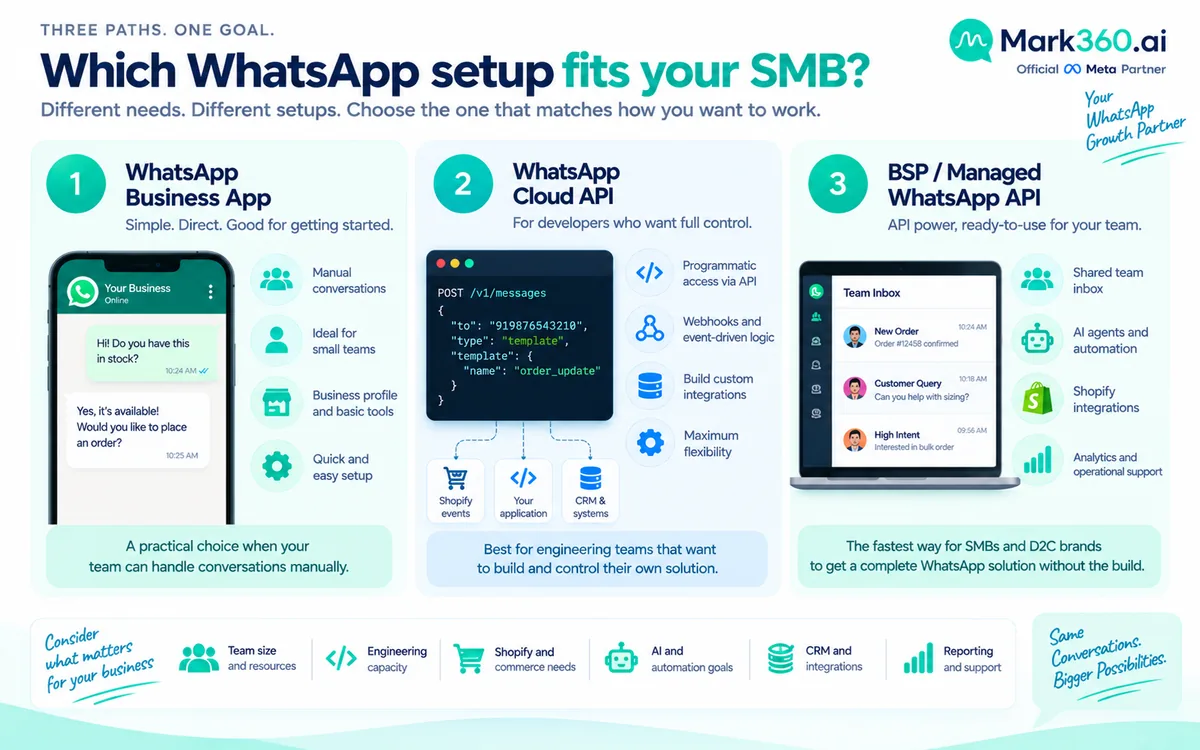
For Shopify merchants selling across the US, UK, EU, MENA and APAC, WhatsApp can put the order status directly into the conversation customers already use. The practical question is not simply whether to send WhatsApp notifications. It is how much automation you need, and whether Meta’s official Shopify WhatsApp app is enough or a BSP-managed WhatsApp Business Platform setup makes more sense.
Quick answer: How do WhatsApp order notifications cut Shopify WISMO?
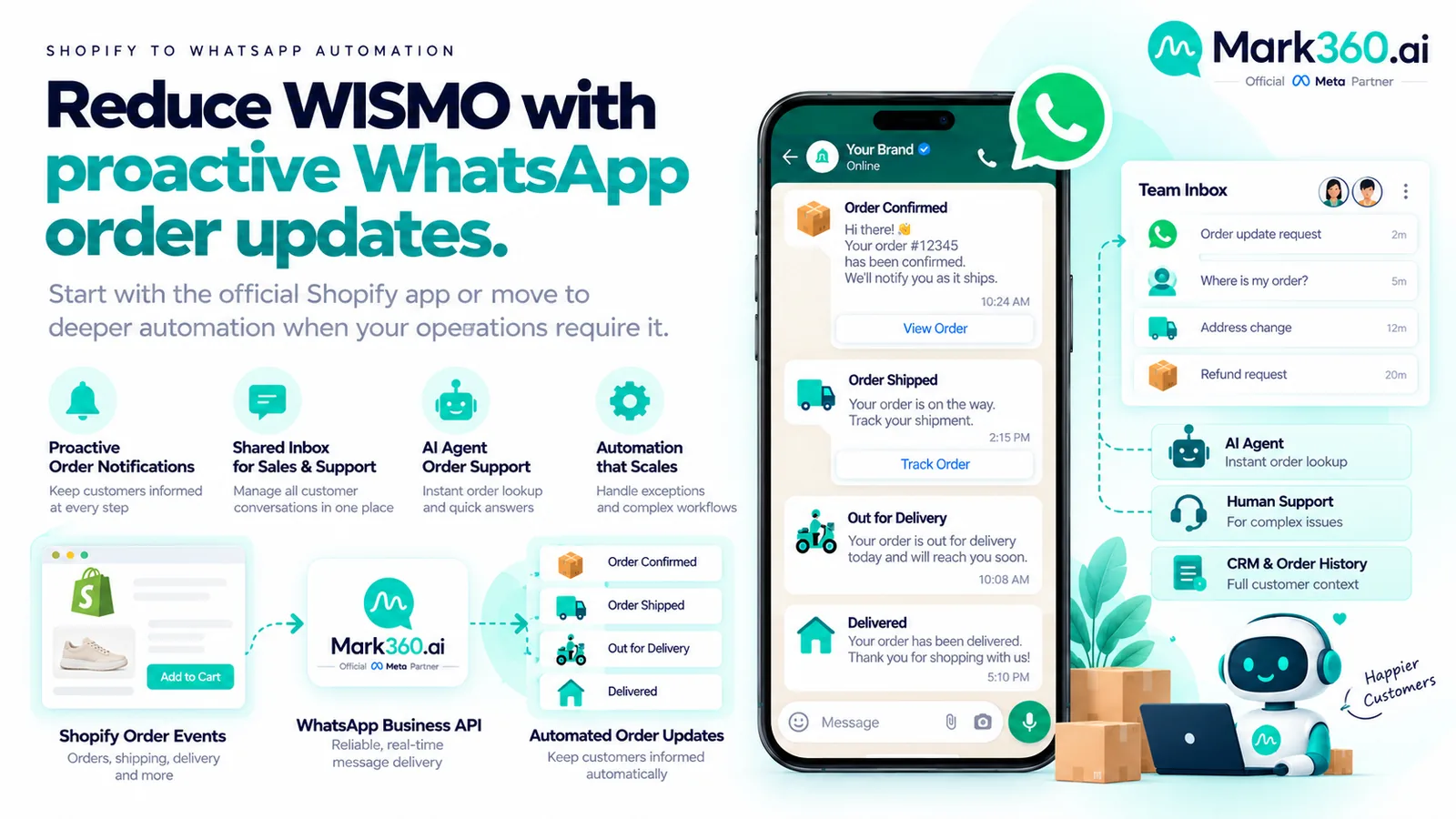
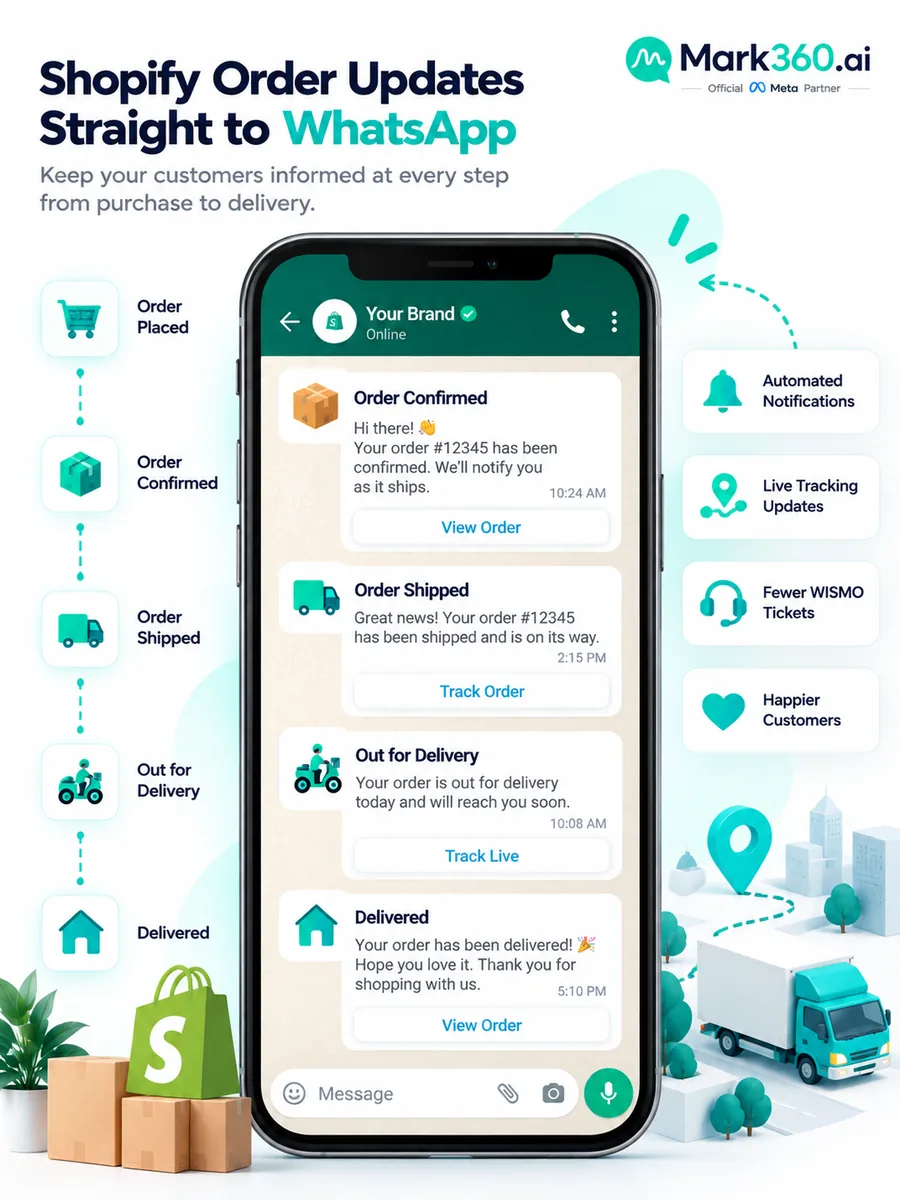
Proactive WhatsApp order and shipping updates—confirmed, shipped, out for delivery, delivered and delay exceptions—reduce “Where is my order?” contacts by answering status before shoppers open a ticket. Meta’s official Shopify WhatsApp app covers basic order updates and checkout opt-in; a BSP adds custom triggers, shared inbox, AI order lookup and broader automation when ops needs more than stock notifications.
Five key takeaways
- Send status before customers ask. Order confirmation, shipment and delivery events should arrive close to the underlying Shopify or carrier event.
- Measure WISMO as a rate, not a feeling. Track WISMO contacts divided by orders shipped, then compare a consistent pre- and post-automation period.
- The official Shopify WhatsApp app is a valid starting point. It can make sense when your primary requirement is straightforward order updates and you do not need complex routing or custom logic.
- A BSP becomes useful when exceptions and operations matter. Shared inboxes, custom triggers, CRM integrations, AI order lookup and human handoff are the difference between notifications and an operational messaging system.
- Do not judge the channel on delivery or read rates alone. The business outcome is fewer support contacts, faster resolution, better customer experience and measurable operational savings.
| Status event | Message goal | Ticket impact |
|---|---|---|
| Order confirmed | Set expectations and provide order reference | Reduces “Did my order go through?” contacts |
| Shipped | Provide tracking URL and carrier information | Reduces early “Has it shipped?” questions |
| Out for delivery | Set same-day delivery expectation | Reduces status checks during the delivery window |
| Delivered | Confirm completion and offer help | Reduces “Was this delivered?” contacts |
| Delay or exception | Explain the issue and next action | Moves customers from uncertainty to resolution |

What WISMO is and why email and SMS alone can fall short
WISMO means “Where Is My Order?” and covers customer contacts about order status, shipment progress, delivery timing and tracking. Your exact taxonomy can vary, but the useful operational definition is simple: a customer contact that exists primarily because the customer cannot easily determine what is happening with an order.
Email remains essential for ecommerce notifications, and SMS can be valuable for urgent delivery events. WhatsApp does not need to replace either channel. Its advantage is that a status update can become a two-way conversation when the customer has a question or when an exception needs intervention.
The weak setup is to send the same generic message at every stage. The stronger setup maps each event to a customer question: What happened? What happens next? Can I track it? What should I do if there is a problem? A useful tracking URL and carrier variable often matter more than decorative copy.
Order-notification journey map
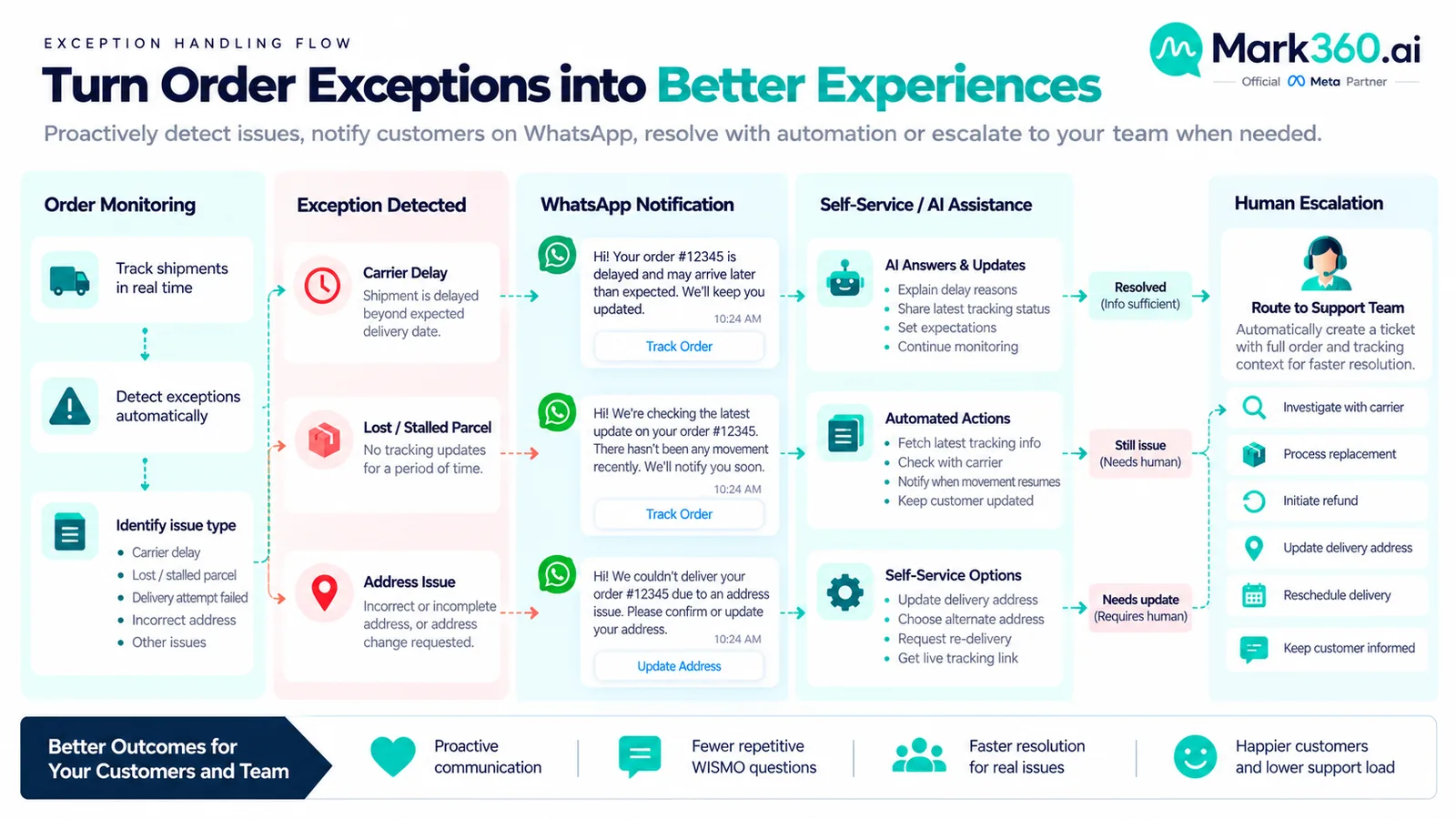
A practical Shopify-to-WhatsApp journey starts with the order event, adds the relevant customer and carrier data, sends the appropriate notification, and creates an escalation path for exceptions. Keep the journey courier-agnostic: the message should use a tracking URL and carrier variables rather than hard-code one logistics provider.
- Order created: confirm the purchase and identify the order.
- Fulfilment or shipment created: tell the customer the order has shipped and expose tracking.
- In transit: update only when the event provides useful information.
- Out for delivery: set expectations for the delivery window.
- Delivered: confirm completion and provide a support path.
- Exception: branch into delay, failed delivery, address correction or human escalation.
If you need the underlying Shopify connection first, use the existing Shopify WhatsApp integration guide rather than rebuilding the integration explanation here.
Meta’s official WhatsApp app for Shopify — capabilities and limits
Meta’s official Shopify WhatsApp app is designed to reduce the friction of getting WhatsApp connected to a Shopify store. For merchants whose requirement is primarily basic order updates and customer opt-in at checkout, an official app path can be a sensible place to start.
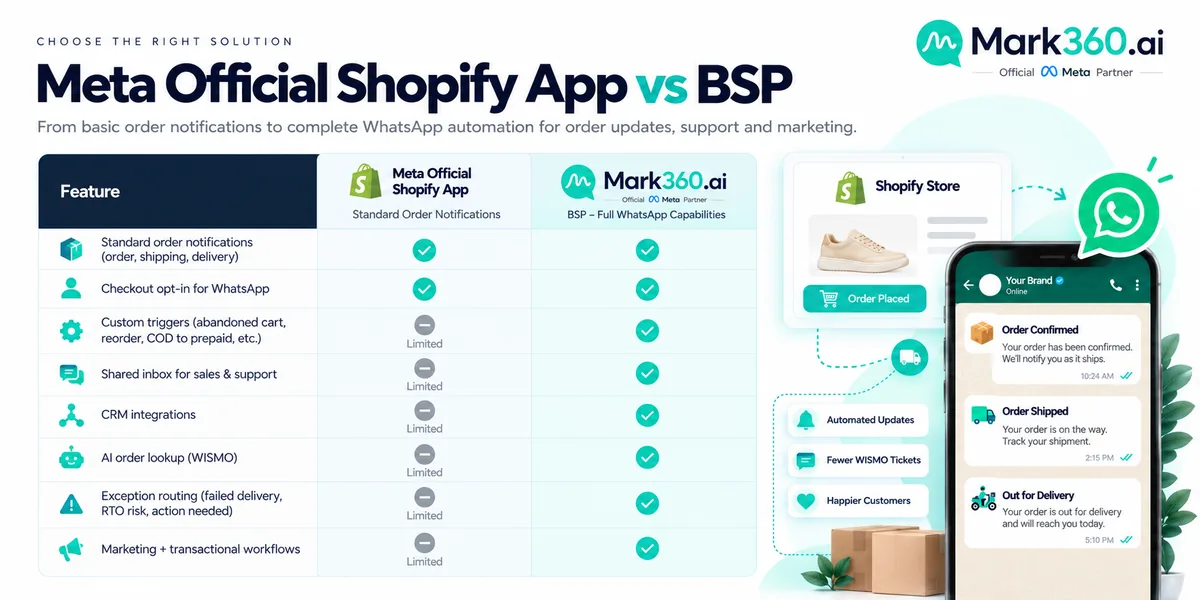
The trade-off is control. A merchant with straightforward notification needs may not need a separate operational messaging layer. But once you need custom event logic, multiple agents, CRM routing, AI order lookup, exception workflows or coordinated marketing and transactional messaging, the requirements move beyond a simple notification connection.
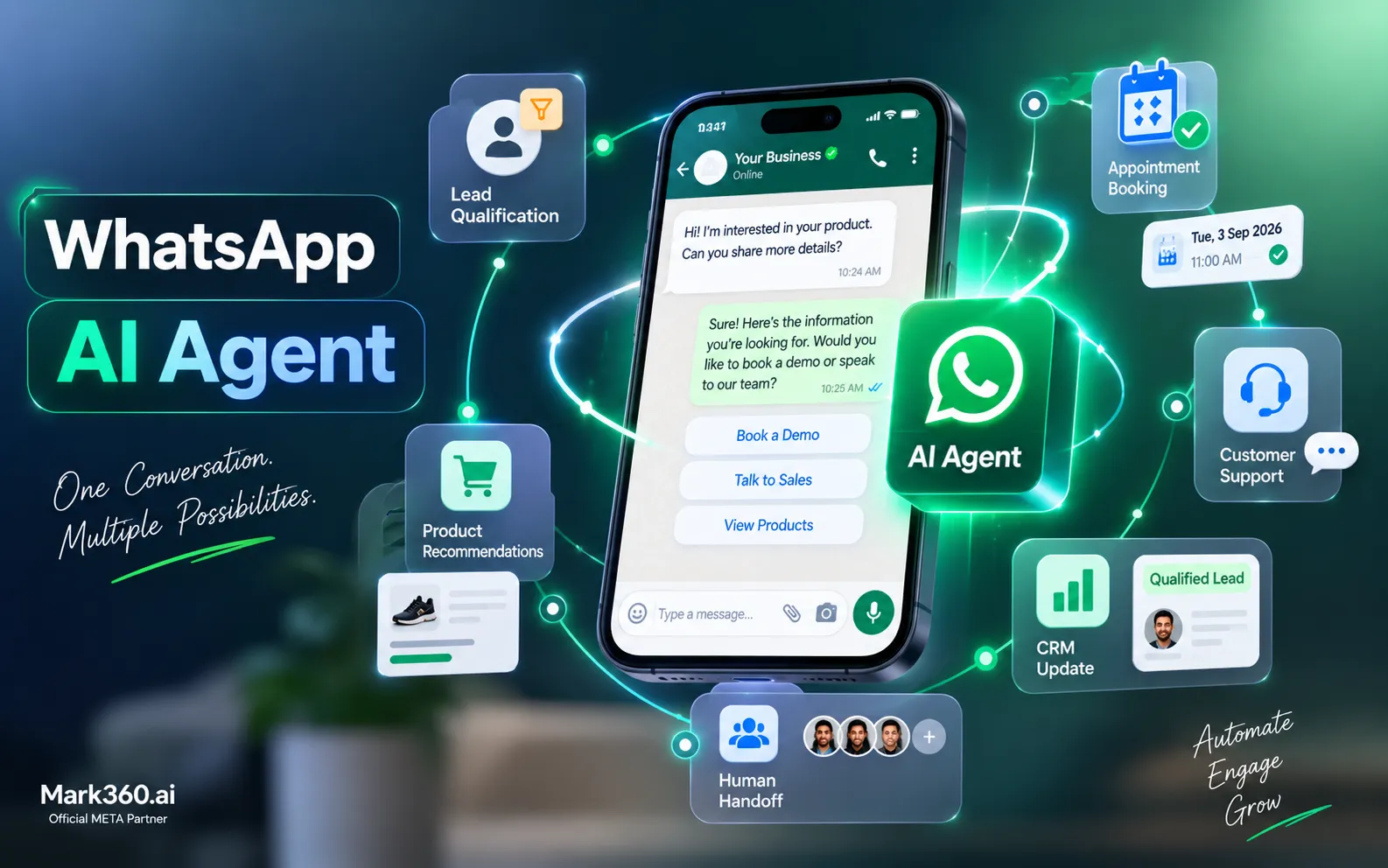
Think about the decision as an operating-model question. If your team can describe the workflow as “when Shopify sends this standard event, send this approved message,” the official app may cover the job. If the workflow sounds like “when this event occurs, check another system, decide which message applies, route it to a team, let an AI agent answer the order question and escalate exceptions,” you are evaluating BSP capabilities.
Meta's official app should also be distinguished from a BSP. A BSP is a platform or provider layer built around WhatsApp Business Platform capabilities, often adding inbox, workflow, integrations, analytics, routing and automation. The right choice depends on how much operational control you need, not on the label alone.
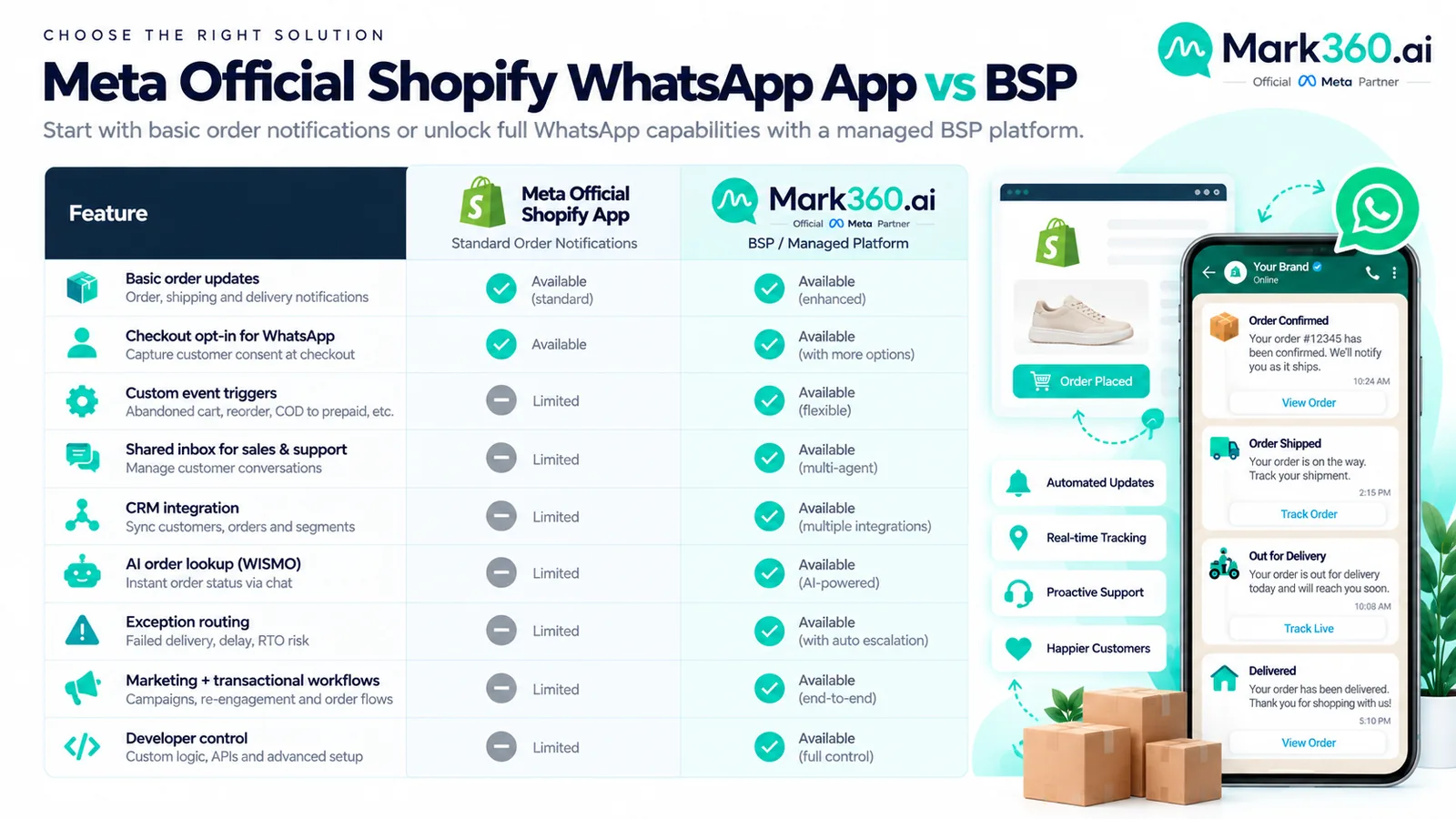
Feature matrix: Meta official app vs BSP
| Capability | Meta official Shopify app | BSP / managed platform |
|---|---|---|
| Basic Shopify order notifications | Core use case | Supported |
| Checkout WhatsApp opt-in | Supported where available | Supported through configured flows |
| Custom event triggers | More limited | Core strength |
| Shared team inbox | Limited compared with dedicated platforms | Common capability |
| CRM and operational integrations | More constrained | Broad integration options |
| AI order lookup and customer support | Limited | Available with suitable platform and integrations |
| Exception routing | Basic workflows | Custom routing and escalation |
| Marketing plus transactional workflows | More constrained | Can be managed in one operational stack |
| Developer control | Lower | Varies by provider and API access |
Templates and categories for order updates
Order notifications need to follow the current WhatsApp Business Platform messaging rules and applicable template categories. For transactional journeys, keep the message utility-first: state what happened, give the customer the information they need, and provide a relevant action such as tracking the parcel or contacting support.
A typical shipment update can contain the order number, shipment state, carrier name and tracking URL. A delay message should not pretend that the parcel is progressing normally. If the carrier reports an exception, tell the customer what is known and what action is available.
Template category rules and pricing can change. Do not hard-code a public article around a rate card that may become outdated. Check Meta's WhatsApp Business Platform pricing documentation and current messaging policies, and verify current utility and marketing rates before modelling costs.
Metrics that prove WISMO reduction
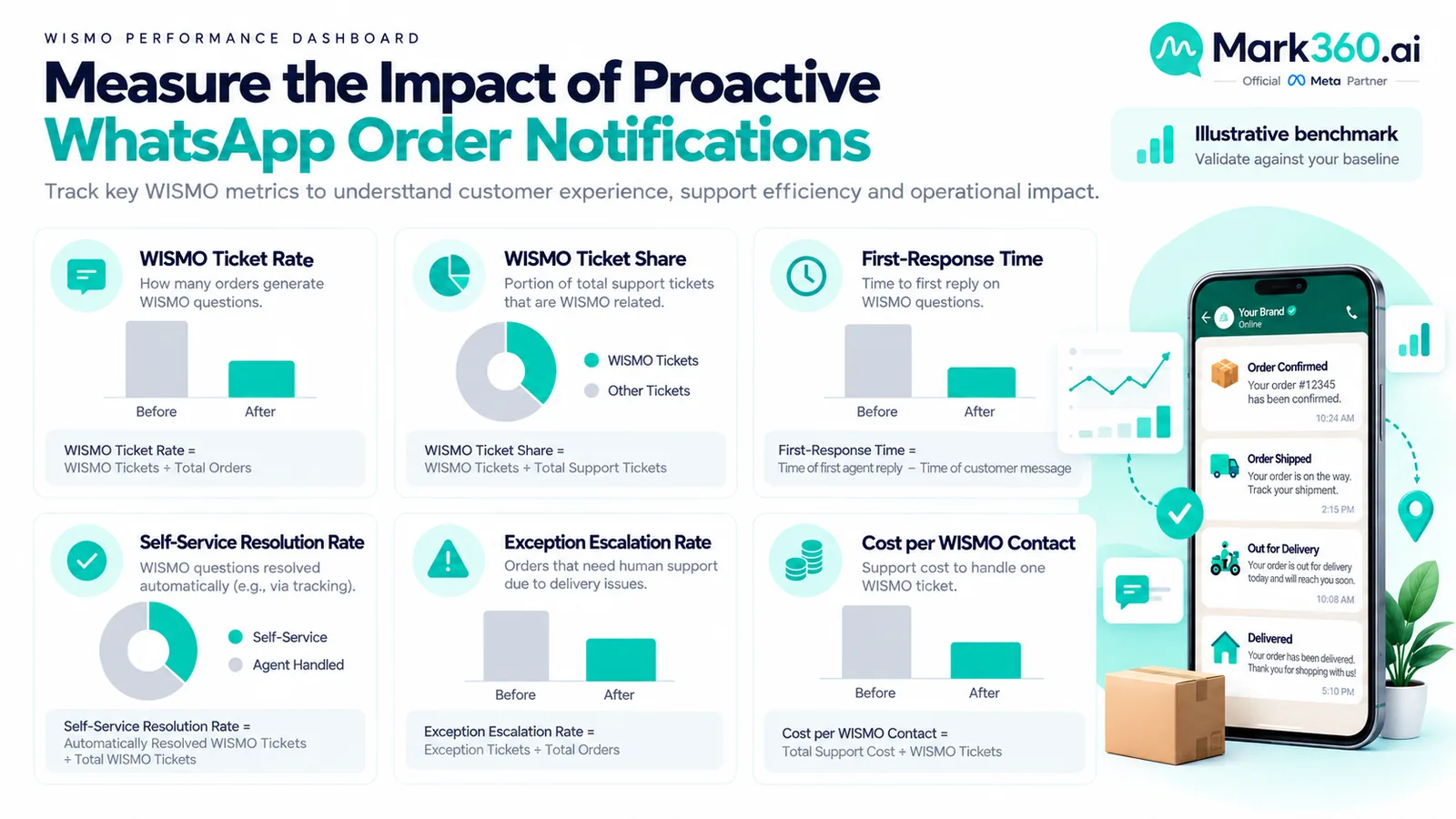
The core KPI is WISMO ticket rate: WISMO ticket rate = WISMO contacts ÷ orders shipped. This normalises support demand for order volume and is more useful than counting raw tickets.
Track the rate before launch and after the notification journey has enough volume to compare like-for-like periods. Segment by country, carrier, product category and delivery method where the data is available. Otherwise, a carrier outage or seasonal sales spike can make an automation look better or worse than it actually is.
| KPI | Formula | Why it matters |
|---|---|---|
| WISMO ticket rate | WISMO contacts / orders shipped | Primary measure of support demand |
| WISMO ticket share | WISMO contacts / all support contacts | Shows how much CX workload comes from delivery questions |
| First-response time | Total response minutes / answered contacts | Shows whether exceptions are being handled promptly |
| Self-service resolution rate | Resolved without human intervention / eligible conversations | Measures automation depth |
| Exception escalation rate | Escalated exceptions / total exceptions | Shows where automation still needs people |
| Cost per WISMO contact | WISMO support cost / WISMO contacts | Converts ticket volume into an operational cost |
Also measure message delivery and read behaviour, but do not treat a single global delivery or read percentage as a business benchmark. Market, consent, template quality, number reputation and customer behaviour all affect those metrics.
Honest benchmark ranges (illustrative) and methodology
Public ecommerce commentary and vendor case studies often describe material WISMO reductions after proactive shipping updates. An illustrative industry range is approximately 20–40% fewer “where is my order?” contacts when updates are timely and tracking links work. This is not a Mark360 or Meta guarantee.
The range should be treated as a hypothesis for planning, not a promise. Methodology matters: define what counts as WISMO, measure orders shipped, compare equivalent periods, account for carrier mix and seasonality, and exclude unrelated support categories. A store with already excellent proactive email and SMS notifications may have less incremental WhatsApp impact than a store where customers currently receive little shipment information.
Do not use “98% open rate” or a similar universal number as proof that WhatsApp will reduce tickets. Delivery and read rates vary. Measure your own delivered messages, read behaviour, clicks on tracking links, replies, WISMO contacts and resolution outcomes.
A useful experiment is to compare eligible customers receiving the new notification journey against a defensible baseline. Where operationally and legally appropriate, use a holdout or staggered rollout so you can estimate incremental impact rather than attributing every change to WhatsApp.
Exception playbooks: delay, lost parcel and address fix
Standard order updates handle the easy majority. Exceptions are where a messaging platform earns its keep.
Delay
Send a clear exception message when the carrier reports a meaningful delay. Include the latest known status, tracking link and the next available action. Avoid sending repeated “still delayed” messages with no new information.
Lost or stalled parcel
Route the conversation to support when tracking has stopped progressing beyond your operational threshold. An AI agent can retrieve order and tracking information if the integration supports it, but it should hand off when the customer needs a replacement, refund or carrier investigation.
Address correction
Do not force the customer through a generic FAQ if the address can no longer be changed automatically. Explain the constraint, collect the necessary information and route the case to the team that can act.
For high-COD markets, an order-confirmation step can be added as an optional workflow. It should not be the foundation of a global WISMO strategy. The broader goal is to make order status and exception handling proactive for every market.
Implementation checklist
- Define WISMO in your support taxonomy before changing the notification journey.
- Record a baseline WISMO ticket rate using orders shipped as the denominator.
- Map Shopify order, fulfilment and shipment events to customer-facing messages.
- Confirm WhatsApp opt-in and applicable messaging rules for each target market.
- Use courier-agnostic tracking variables and reliable tracking URLs.
- Write utility-first templates for confirmation, shipping, delivery and exceptions.
- Decide whether the official Shopify WhatsApp app covers the required events.
- If not, document the custom triggers, inbox, CRM, AI and escalation requirements for a BSP.
- Test every event with real order states before enabling the full journey.
- Launch in stages and compare WISMO rate, support contacts and exception resolution against baseline.
Keep the integration itself out of this playbook. If you need technical connection steps, use the Shopify WhatsApp integration article.
When the official app is enough vs when you need a BSP
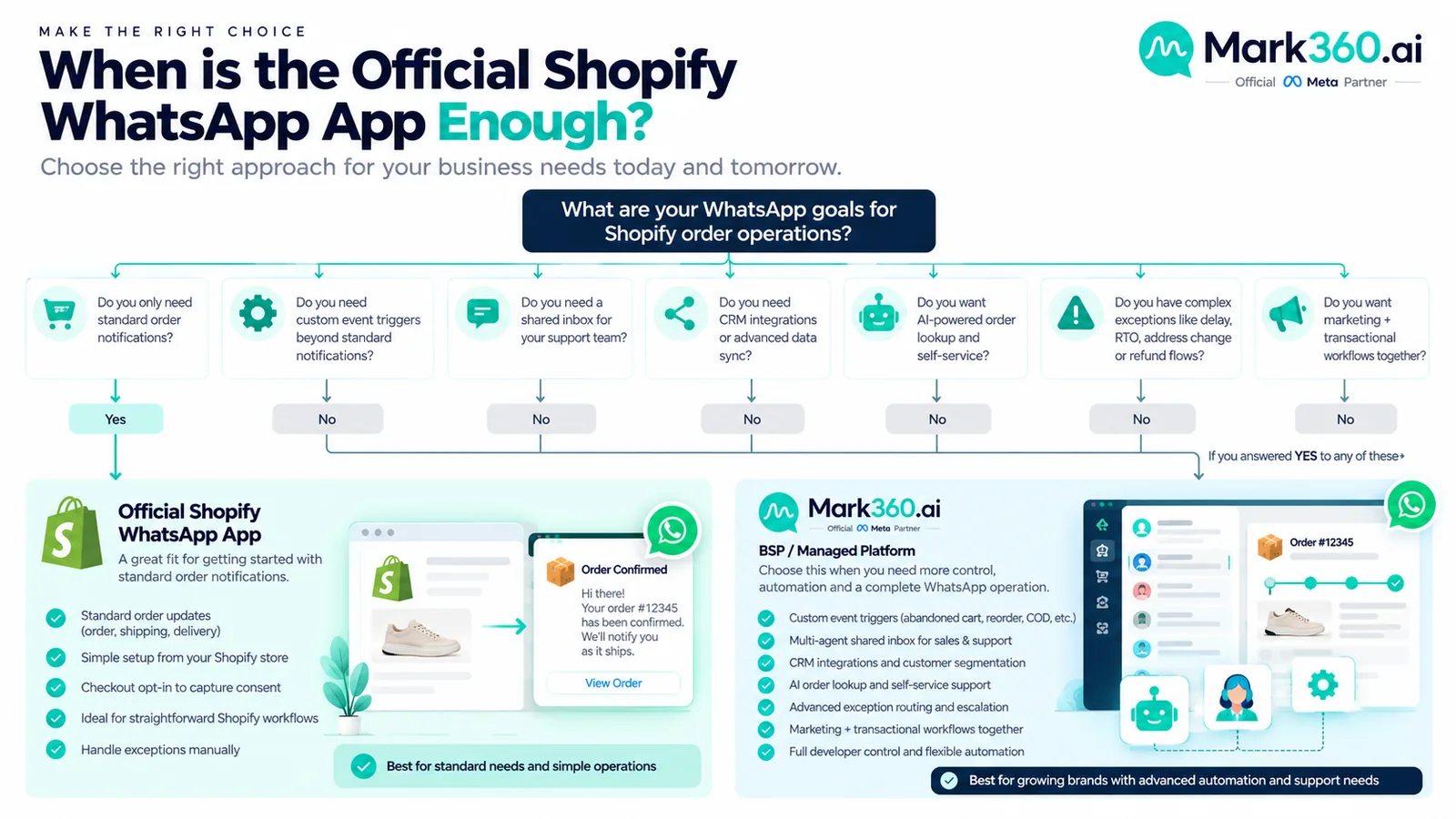
The official app is often enough when you have a straightforward Shopify store, a modest support operation and a clear requirement for basic WhatsApp order notifications. You do not need a large messaging stack simply because WhatsApp is involved.
A BSP becomes more compelling when the workflow crosses systems or teams. If you need custom triggers, a shared inbox, CRM updates, AI order lookup, marketing and transactional journeys in the same operating environment, or detailed exception routing, a managed platform can reduce the amount of custom infrastructure your team has to maintain.
| Choose the official app when... | Consider a BSP when... |
|---|---|
| Basic Shopify order updates are the main requirement | You need custom triggers and business logic |
| A small team can handle exceptions manually | Multiple agents need a shared operational inbox |
| You do not need AI order lookup | Customers should be able to ask order questions conversationally |
| Standard notification paths are sufficient | Carrier, CRM, Shopify and internal events must be orchestrated |
| Simple setup is the priority | Automation depth and ongoing operations are the priority |
Landscape note: Flowcart, Whapi, WhatFlow and Mark360
There is no universal winner among WhatsApp tooling providers. Flowcart, Whapi, WhatFlow and Mark360 can be evaluated as alternatives depending on the merchant's desired architecture, automation depth, integrations and support model. Product capabilities and pricing can change, so compare current documentation rather than relying on a static feature list.
The useful comparison is operational. Ask whether the platform supports the exact Shopify events you need, whether your team gets a shared inbox, how custom triggers are created, whether order data can be retrieved during a conversation, how human handoff works, what CRM integrations are available, and how marketing and transactional messaging are governed.
For merchants that want a managed WhatsApp Business API layer with automation, shared workflows and AI agents, Mark360's WhatsApp API offering is designed around that broader operational model. The decision should still be based on your requirements and current product documentation.
FAQ
How do WhatsApp order notifications reduce Shopify WISMO?
They proactively answer common status questions by sending order confirmation, shipping, delivery and relevant exception updates. The goal is to reduce the need for customers to contact support simply to discover their order status.
What does Meta’s official WhatsApp app for Shopify include?
It provides an official path for connecting WhatsApp with Shopify use cases such as customer opt-in and basic order notifications. The exact capabilities available to your store should be checked in the current Shopify and Meta documentation.
Meta official WhatsApp app vs BSP — what’s the difference?
The official app is aimed at straightforward Shopify-connected WhatsApp use cases. A BSP or managed platform can add shared inboxes, custom triggers, integrations, routing, automation and AI capabilities for more complex operations.
Which templates are appropriate for order and shipping updates?
Use utility-oriented templates for transactional order and shipping updates where the current WhatsApp rules classify them as such. Always verify the current category requirements and template rules before publishing a workflow.
What KPIs prove WISMO reduction?
Start with WISMO ticket rate, WISMO ticket share, support response time, self-service resolution and exception escalation. Compare those against a consistent baseline instead of using message delivery or read rates as a proxy for business impact.
Can the official app send abandoned-cart messages?
Capabilities and eligibility can change, so check the current official Shopify and Meta documentation. If abandoned-cart automation is your main requirement, use the dedicated Shopify WhatsApp abandoned-cart guide rather than assuming order-notification capabilities automatically cover marketing journeys.
Do I need a BSP if I only want shipping updates?
Not necessarily. If your requirement is limited to straightforward shipping notifications and the official Shopify app meets the required workflow, a BSP may add unnecessary complexity. Consider a BSP when you need custom triggers, team operations, integrations or AI support.
How should delay and failed-delivery exceptions be handled?
Use the carrier or fulfilment event to trigger a specific exception path, explain what is known, provide tracking and route cases requiring a refund, replacement, address change or investigation to a human team.
WhatsApp vs email and SMS for order notifications?
Use them as complementary channels rather than assuming one should replace the others. Email is useful for durable order records, SMS can work well for urgent alerts, and WhatsApp adds a conversational path when customers need to ask or resolve something.
How does Mark360 compare to Whapi, WhatFlow or Flowcart for order ops?
Compare current capabilities around Shopify events, API access, shared inbox, custom workflows, AI order lookup, integrations, support and pricing. Mark360's positioning is broader WhatsApp Business API automation with AI agents and operational workflows; the appropriate choice depends on your required depth and team model.
Next steps: measure the ticket problem before buying more software
Start with your own support data. Calculate WISMO contacts divided by orders shipped, identify the order events that generate the most questions, and map which updates customers currently receive. Then test proactive WhatsApp notifications against that baseline.
If the official Shopify WhatsApp app covers the workflow, keep the stack simple. If your team needs custom triggers, shared inbox operations, AI order lookup or coordinated marketing and transactional automation, evaluate a BSP against those requirements.
For technical integration context, see the Shopify WhatsApp integration guide. For broader automation, explore Mark360 WhatsApp API and review current Mark360 pricing. Verify current WhatsApp category rules and rates in Meta's documentation before building a cost model.