
Best Wati Alternatives in India (2026): Fair Comparison for WhatsApp API Buyers
You're probably not looking for another list of WhatsApp providers. You want to know which platform will actually fit your sales, support, marketing and Shopify workflows without creating another tool your team has to babysit.
Wati is a strong option for teams that want a mature WhatsApp inbox, automation and broader customer-engagement tooling. But it's not the only sensible choice in India. Mark360, AiSensy, Interakt and Gupshup each take a different approach to WhatsApp Business Platform usage.
This comparison focuses on product fit rather than claiming that one provider is universally better. For India SMB and D2C buyers, the right decision usually comes down to the workflow you need to automate, how deeply Shopify needs to connect, how much your team relies on broadcasts, and whether you need an enterprise-grade CPaaS layer.

Quick answer: What is the best Wati alternative in India?
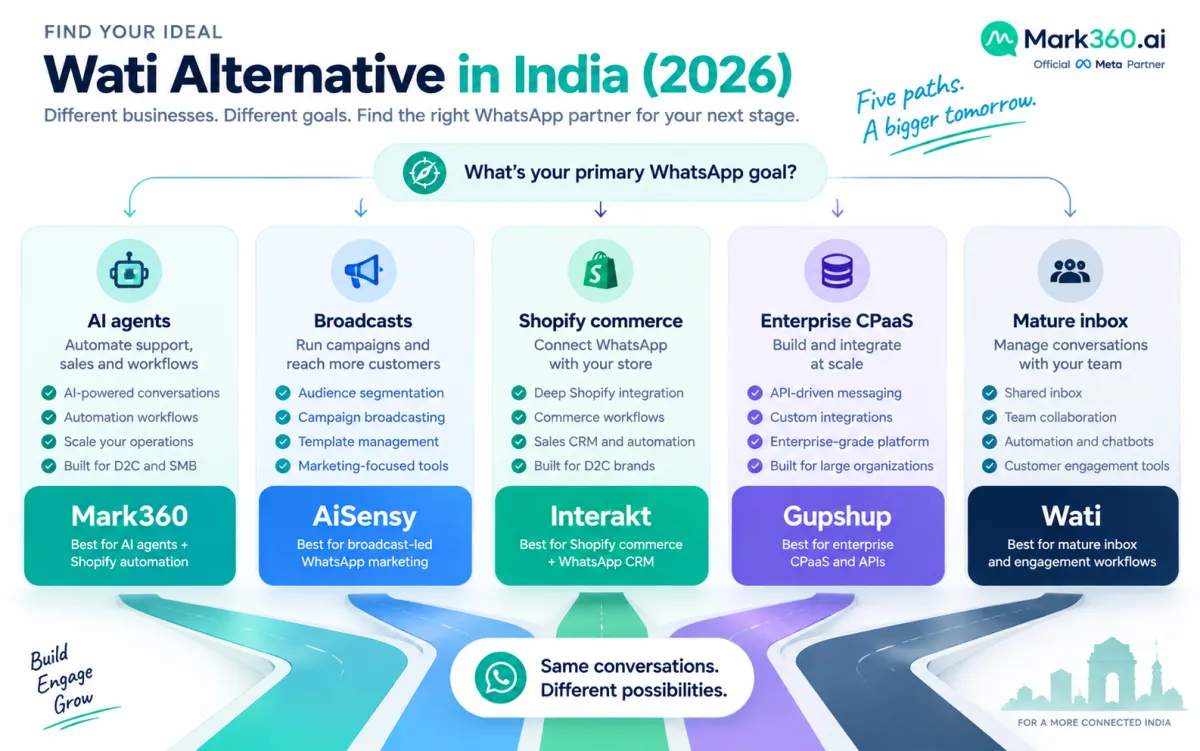
Mark360 is the best Wati alternative for Shopify-focused SMB and D2C teams that want AI agents, WhatsApp automation and clear India messaging totals in one operating layer. AiSensy is a strong choice when broadcast marketing is the priority. Interakt is particularly compelling when Shopify commerce and WhatsApp CRM are central to the buying journey. Gupshup is better suited to enterprise teams that need a CPaaS and API-oriented architecture. Wati itself remains a sensible choice when a mature shared inbox and broader customer-engagement platform fit your operating model.
| Platform | Best fit | AI / automation | Shopify | Broadcasts | Inbox / CRM | India buyer fit |
|---|---|---|---|---|---|---|
| Mark360 | AI-led SMB/D2C automation | AI agents, workflows | Strong | Strong | Inbox + automation | Strong for Shopify and AI-led teams |
| Wati | Mature WhatsApp engagement | Chatbots, automation, AI capabilities | Strong | Strong | Mature shared inbox and CRM | Strong for established teams |
| AiSensy | Broadcast-led WhatsApp marketing | Chatbots and AI agents | Strong | Very strong | CRM and live chat | Strong for campaign-heavy teams |
| Interakt | Shopify commerce + WhatsApp CRM | AI agents, chatbots, workflows | Very strong | Strong | Sales CRM + inbox | Strong for commerce-led brands |
| Gupshup | Enterprise CPaaS and API workflows | API-driven automation | Integration-led | API-led | Build around existing systems | Strong for technical enterprises |
Five takeaways before you choose
- Choose Mark360 if AI agents and Shopify automation are central to your WhatsApp operation.
- Choose AiSensy if campaign broadcasting, audience segmentation and marketing execution are the main job.
- Choose Interakt if your WhatsApp strategy is closely tied to Shopify commerce and CRM workflows.
- Choose Gupshup if your engineering team needs a CPaaS platform and API-level control across enterprise systems.
- Keep Wati on the shortlist if its established inbox, automation, integrations and team workflows already match what your operators need.
What makes a good Wati alternative?
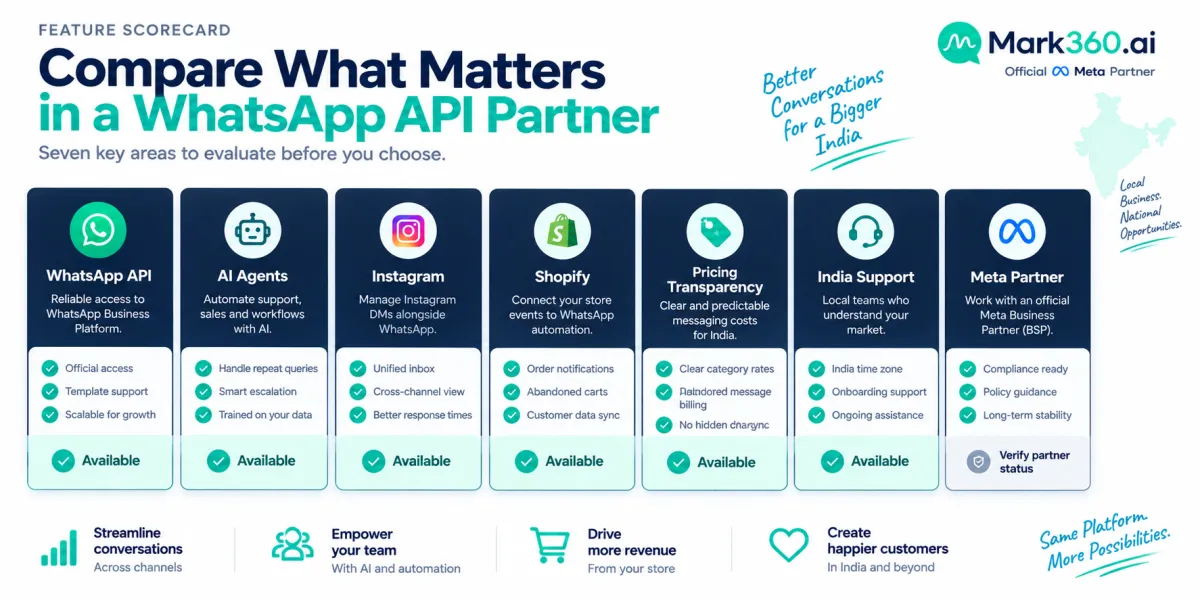
A good Wati alternative should solve the reason you're considering a switch, not just reproduce Wati's feature list. Start with the workflow that is currently costing your team time: support tickets, abandoned carts, COD confirmation, promotional campaigns, order updates or lead qualification.
Then evaluate five things: WhatsApp Business Platform access, automation depth, Shopify integration, conversation management and reporting. For technical teams, add API and webhook flexibility. For marketing teams, add segmentation, campaign scheduling and conversion tracking.
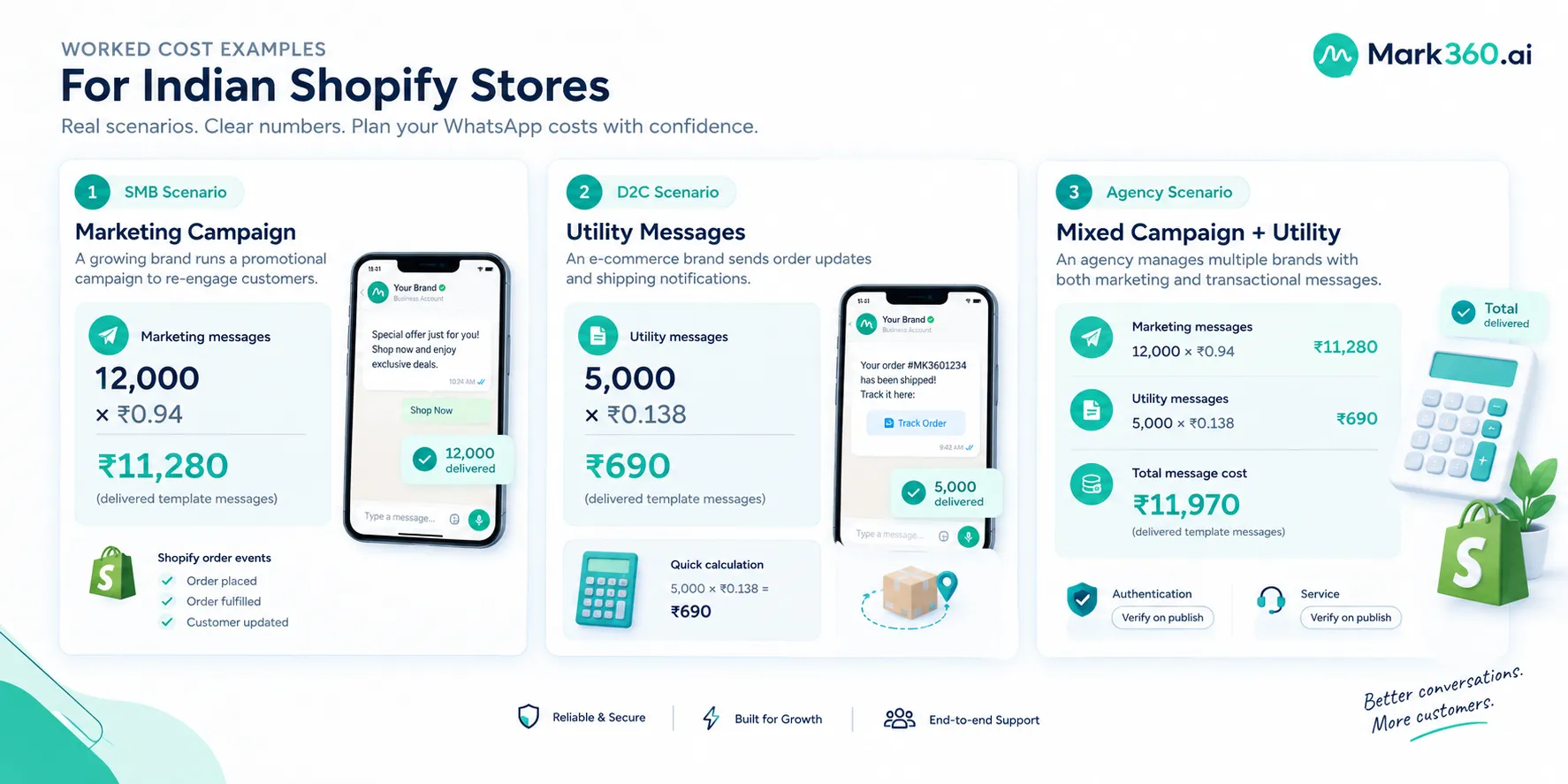
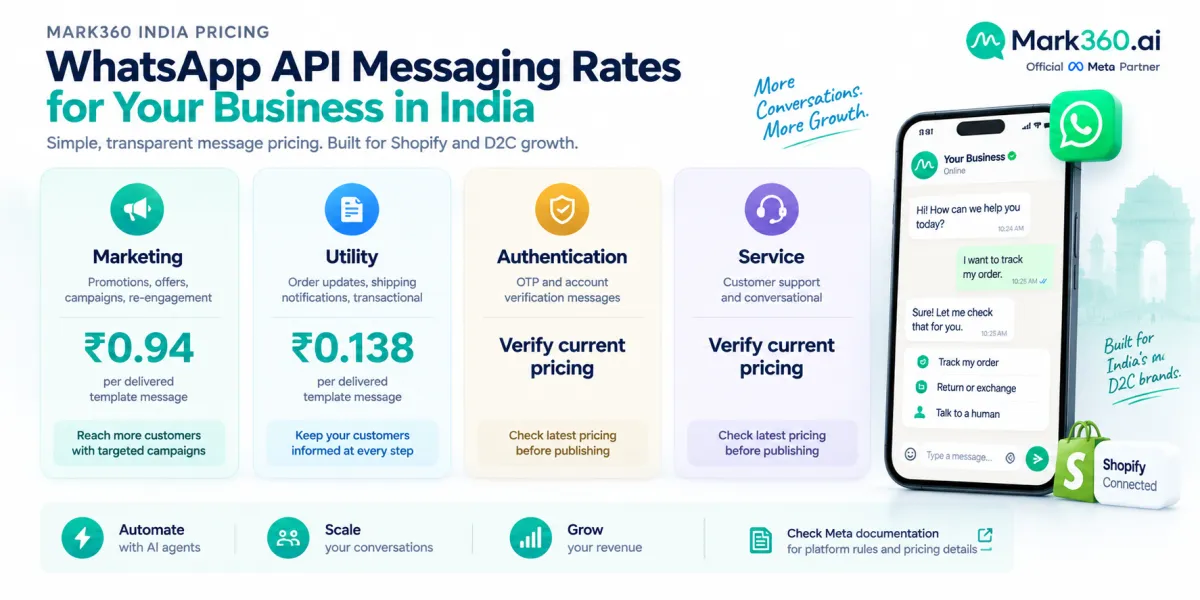
There is also a practical India-specific question: Can you understand your expected WhatsApp messaging cost before committing to the workflow? Mark360's customer-facing India figures used in this comparison are ₹0.94 per delivered Marketing template message and ₹0.138 per delivered Utility template message. Authentication and Service pricing should be verified against current pricing before publication or budgeting.
For more detail on WhatsApp Business API pricing mechanics, see the Mark360 WhatsApp Business API pricing guide for India.
Mark360 vs Wati: which should you choose?
Mark360 and Wati both target businesses that need more than a basic WhatsApp inbox. The difference is where the platforms are most compelling.
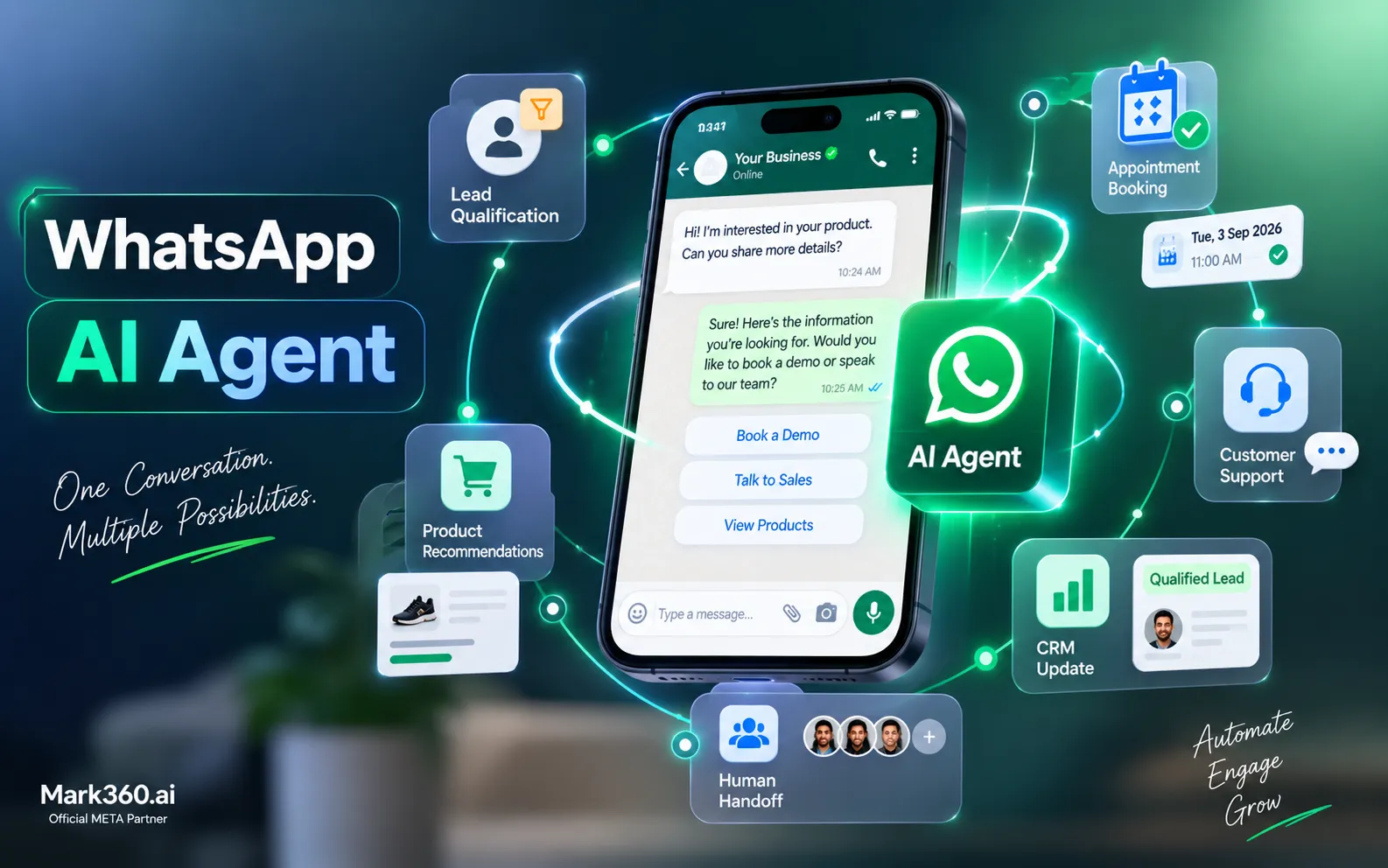
Mark360 is a strong fit when the core requirement is to connect WhatsApp, Shopify and AI-driven conversations. Mark360 describes its platform around WhatsApp AI agents, automation workflows, team inbox capabilities and integrations, and identifies itself as an Official Meta Business Partner.
Wati is a strong fit when your team wants an established customer-engagement workspace built around WhatsApp, shared inbox operations, campaigns, automation, CRM and integrations. Its current product documentation also covers Shopify, campaigns, team inbox, automation and AI capabilities.
The practical question is not “Which platform has more features?” It's “Which platform makes the workflows I care about easier to run every day?”
Pick Mark360 when
- Shopify is the operational system behind your customer journeys.
- You want AI agents to handle repetitive support or sales questions.
- You want WhatsApp campaigns and automated workflows in the same environment.
- You want a clear India-specific messaging cost model using delivered-message rates.
- You want an Official Meta Business Partner for WhatsApp Business Platform access.
Pick Wati when
- Your team prefers a mature shared inbox and established customer-engagement workflow.
- You need broad team collaboration around WhatsApp conversations.
- Your operation already fits Wati's automation, CRM and campaign model.
- You want to evaluate its wider omnichannel and customer-engagement capabilities.
Mark360 vs AiSensy: AI automation or broadcast-first marketing?
AiSensy is particularly strong for teams that think of WhatsApp first as a marketing channel. Its platform includes audience segmentation, scheduled broadcasts, campaign analytics, chatbot tools, Click-to-WhatsApp Ads and AI WhatsApp agents.
That makes AiSensy a strong Wati alternative for a marketing team whose primary requirement is to reach opted-in audiences with campaigns and then measure clicks, responses and retargeting opportunities.
Mark360 is the stronger fit when marketing is only one part of the customer journey. If the same WhatsApp number needs to handle product questions, order support, AI-led qualification, Shopify events and campaigns, an AI-and-automation-first architecture can be more useful.
Choose AiSensy when broadcasts are the center of the operation
AiSensy has built a substantial set of broadcast and audience tools around WhatsApp marketing. Its official product pages highlight segmentation, scheduling, campaign tracking, retargeting, Click-to-WhatsApp Ads and Shopify integration.
For a campaign-heavy D2C team, those capabilities deserve serious consideration. You don't need to switch away from a platform that already does the marketing job your team needs.
Mark360 vs Interakt: AI automation or Shopify CRM?
Interakt is one of the more relevant Wati alternatives for Shopify merchants because its product is tightly connected to commerce, sales CRM and WhatsApp. Its current platform supports Shopify integration, catalog synchronization, order workflows, abandoned-checkout use cases, sales CRM, team inbox and AI agents.
If your WhatsApp operation is effectively an extension of your Shopify store and sales pipeline, Interakt is a strong contender. It can make sense when your team wants customer records, sales stages, commerce workflows and WhatsApp activity connected in one system.
Mark360 is a better fit when the priority shifts toward AI agents and broader automation around the Shopify customer journey. The deciding test is the complexity of the conversations you want the system to handle automatically.

Mark360 vs Gupshup: platform product or enterprise CPaaS?
Gupshup occupies a different part of the market. Its WhatsApp documentation and API tooling are aimed at teams that want to integrate WhatsApp messaging into their own systems, including CRM and customer-care environments.
That makes Gupshup a natural candidate for enterprise CPaaS projects where developers need API-level control, custom integrations, webhooks and a messaging infrastructure that can sit underneath an existing technology stack.
Mark360 is generally easier to position for an SMB or D2C team that wants the operating layer already assembled: WhatsApp, AI agents, automation, Shopify workflows and a team inbox. If your engineers are building the customer-engagement application themselves, Gupshup deserves a closer technical evaluation.
Full Wati alternatives comparison matrix
The matrix below is designed for an India SMB or D2C buyer. “Best fit” describes the strongest use case rather than a universal ranking.
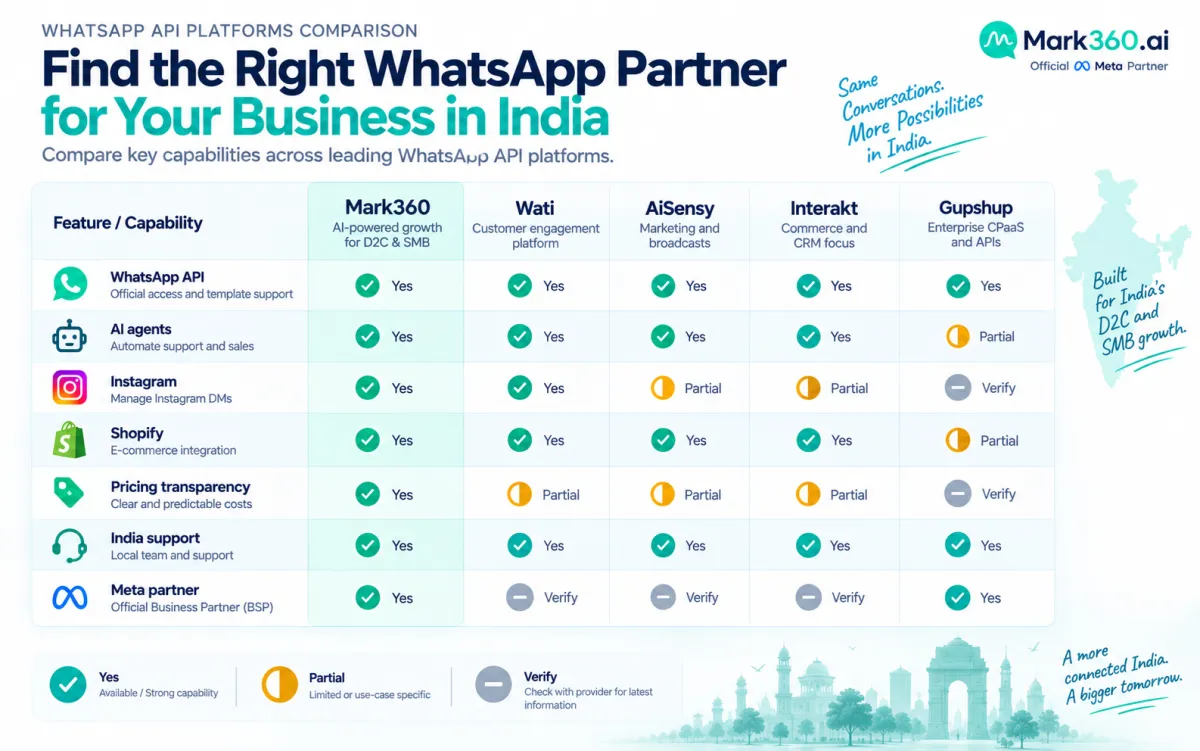
| Provider | Primary strength | AI agents / automation | Shopify / commerce | Marketing / broadcasts | Inbox / CRM | Best India buyer profile |
|---|---|---|---|---|---|---|
| Mark360 | AI-powered WhatsApp automation | AI agents, workflows, automated conversations | Strong Shopify integration and event-driven workflows | Campaigns and segmentation | Shared inbox and automation | SMB/D2C teams wanting AI + Shopify in one workflow |
| Wati | Mature WhatsApp engagement platform | Chatbots, automation and AI capabilities | Shopify integration and commerce workflows | Broadcasts, campaigns and CTWA capabilities | Established team inbox and CRM capabilities | Growing teams wanting a mature WhatsApp workspace |
| AiSensy | WhatsApp marketing and broadcasts | Chatbots and AI agents | Shopify integration and e-commerce flows | Very strong broadcasting, segmentation and retargeting | Live chat and CRM functions | Marketing-led D2C and campaign teams |
| Interakt | WhatsApp commerce and CRM | AI agents, AnswerBot and workflows | Very strong Shopify and commerce tooling | Campaigns, CTWA and conversion tracking | Sales CRM and shared inbox | Commerce-led Shopify brands |
| Gupshup | Enterprise CPaaS and APIs | API and integration-led automation | Custom integration approach | API-led messaging | Built around existing enterprise systems | Technical enterprises and custom platforms |
How to compare Wati alternatives without getting distracted by feature lists
Feature checklists are useful only until every provider starts looking identical. Most serious WhatsApp platforms now offer some combination of templates, campaigns, automation, inboxes, chatbots, integrations and AI.
Instead, run a workflow test. Ask every provider to demonstrate the same five journeys using your actual requirements.
- New lead: a prospect enters from a Click-to-WhatsApp ad and needs qualification.
- Abandoned cart: a Shopify customer leaves checkout and needs a relevant follow-up.
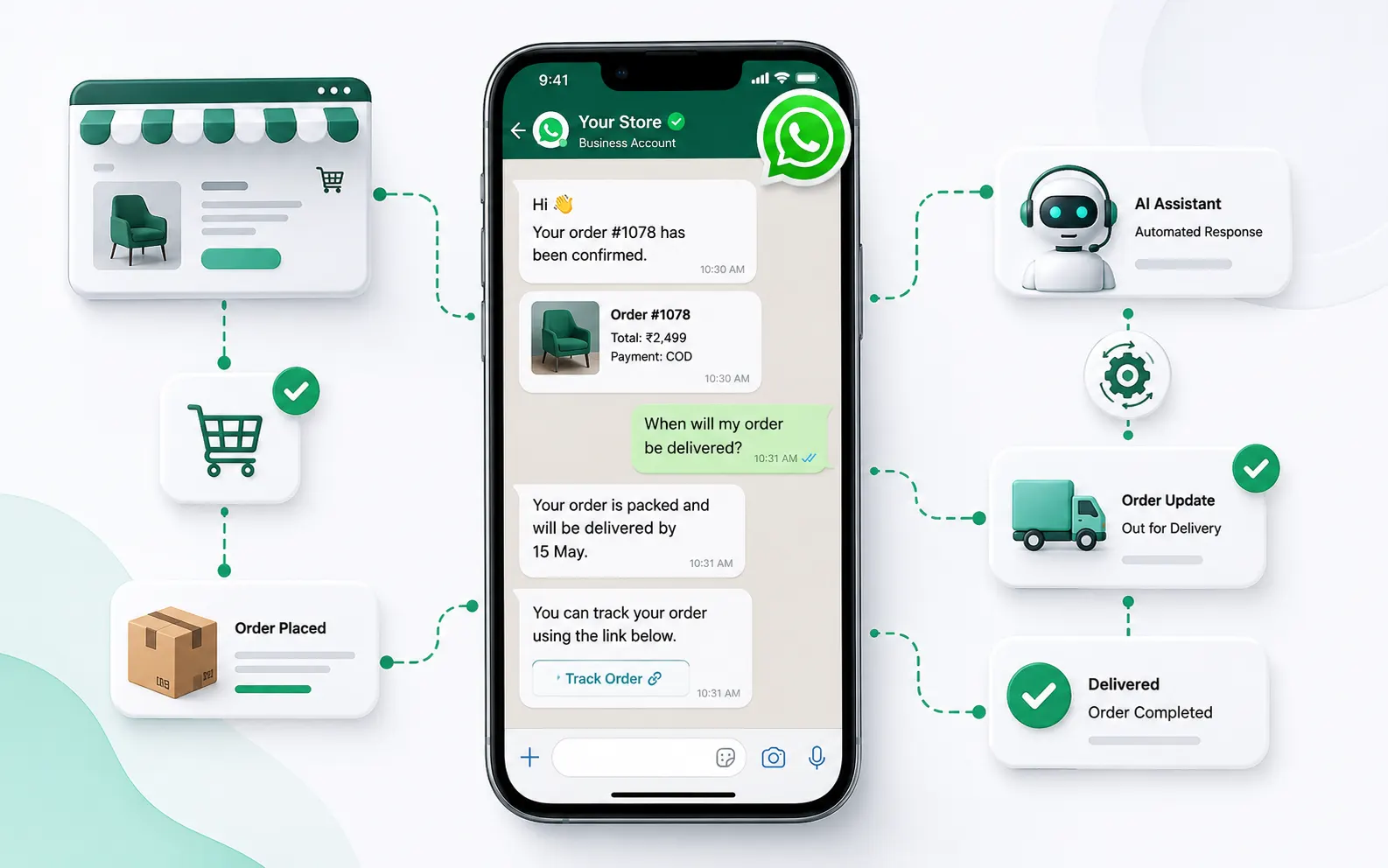
- Order support: a customer asks for delivery status and expects an immediate answer.
- Campaign: a segmented audience receives a promotional template and the team measures the result.
- Escalation: an AI agent cannot resolve a case and routes it to a human with context intact.
The provider that handles these journeys with the least manual work is usually more relevant than the provider with the longest feature page.
AI agent vs chatbot: what should a WhatsApp buyer actually evaluate?
A rule-based chatbot is useful when the conversation follows a predictable path: select an option, enter an order number, choose a product, confirm an action. An AI agent becomes more valuable when customers ask questions in different ways and the system needs to interpret intent, retrieve information and decide what to do next.
For Shopify stores, that distinction matters. “Where is order #1234?” can be handled through a structured flow. “I ordered this three days ago, but the tracking hasn't changed and I need it before Friday” requires more context.
When evaluating Wati alternatives, ask to see both. Don't accept “AI-powered” as the end of the discussion. Ask what the agent can access, when it hands off to a human, how it handles uncertain answers, and whether conversation context reaches the human operator.

What should India SMB and D2C buyers check on pricing?
Start with the message categories your business actually uses. A Shopify store may have Marketing campaigns, Utility order notifications, Authentication flows and Service conversations. Those categories should not be treated as one generic WhatsApp cost.
For Mark360, the customer-facing India figures covered in this article are:
| Category | Mark360 India customer-facing rate | Billing reference |
|---|---|---|
| Marketing | ₹0.94 | Per delivered template message |
| Utility | ₹0.138 | Per delivered template message |
| Authentication | Verify current pricing | Do not assume a rate |
| Service | Verify current pricing | Do not assume a rate |
Meta's official WhatsApp Business Platform pricing documentation should be checked for current category rules and policy changes before publishing a final commercial quote: WhatsApp Business Platform pricing.
For a quick planning workflow, you can also use the Mark360 WhatsApp API pricing calculator and then confirm the applicable pricing for your exact setup.
When Mark360 fits best
Mark360 is a strong choice when WhatsApp isn't just another outbound marketing channel. It fits teams that want the channel connected to the rest of the customer journey: acquisition, qualification, sales, order updates, support and retention.
That is especially relevant for Shopify merchants. A store can connect order events to WhatsApp, route repetitive questions to an AI agent, keep a human inbox for exceptions, and run targeted campaigns from the same operating environment.
Mark360 is also an Official Meta Business Partner. Its WhatsApp Business API offering covers Cloud API access, templates, webhooks, multi-agent conversations and automation capabilities.
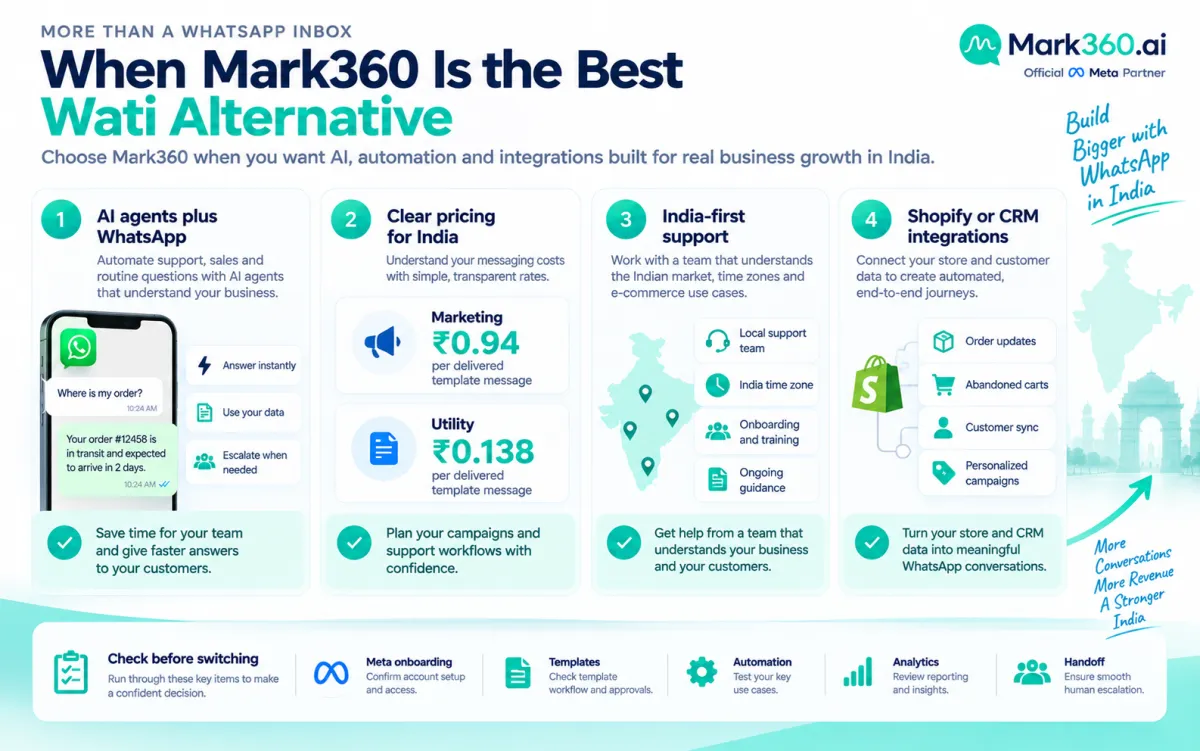
That doesn't mean Mark360 is automatically the right answer for every buyer. If your main need is broadcast marketing, AiSensy may be the more natural fit. If your operation is centered on Shopify CRM, Interakt deserves a close look. If you need enterprise CPaaS infrastructure and custom API architecture, evaluate Gupshup. If Wati's existing inbox and workflow model already fits your team, switching may not create enough operational benefit.
Which Wati alternative should you choose?
Use this simple rule:
- Choose Mark360 for AI agents + Shopify + WhatsApp automation.
- Choose AiSensy for broadcast-heavy WhatsApp marketing.
- Choose Interakt for Shopify commerce + WhatsApp CRM.
- Choose Gupshup for enterprise CPaaS and API-led infrastructure.
- Choose Wati when its mature inbox, automation and customer-engagement model already matches your team.
The fair comparison is not about declaring one winner for everyone. It's about matching the provider to the operating model you actually have.
Frequently asked questions
What is the best Wati alternative in India?
For SMB and D2C teams that want AI agents, Shopify automation and WhatsApp workflows in one platform, Mark360 is a strong Wati alternative. AiSensy, Interakt and Gupshup can be better fits for broadcast marketing, Shopify CRM or enterprise CPaaS respectively.
Is Mark360 better than Wati?
It depends on the workflow. Mark360 is particularly suited to teams prioritizing AI agents, Shopify automation and integrated WhatsApp journeys, while Wati is a strong option for teams that value its mature inbox, automation, CRM and broader customer-engagement capabilities.
What is the best AiSensy alternative?
Mark360 is worth evaluating if you want to move beyond broadcast marketing into AI-led support, sales qualification and Shopify-driven automation. Interakt is another strong option when Shopify CRM and commerce are central to the operation.
What is the best Interakt alternative?
Mark360 is a strong Interakt alternative for Shopify merchants that want a heavier focus on AI agents and automated customer conversations. Wati is another option if the primary requirement is a mature team inbox and broader customer-engagement platform.
Is Gupshup suitable for small Indian businesses?
Gupshup can support smaller businesses, but its API and CPaaS orientation becomes especially relevant when an engineering team needs custom integrations and enterprise messaging infrastructure. An SMB that wants a ready-to-operate WhatsApp workspace may find a more application-focused platform easier to manage.
Does Mark360 integrate with Shopify?
Yes. Mark360's platform supports Shopify-connected automation and customer journeys, allowing store events and commerce workflows to participate in WhatsApp automation. The right implementation should still define which events deserve a customer message and which should remain internal.
What are Mark360's WhatsApp API rates in India?
The customer-facing India figures covered in this article are ₹0.94 per delivered Marketing template message and ₹0.138 per delivered Utility template message. Authentication and Service pricing should be verified against current pricing before publishing or budgeting.
How should I compare WhatsApp API providers in India?
Compare providers against your actual workflows rather than feature count alone. Test Shopify events, AI support, human handoff, campaigns, templates, reporting, inbox operations, APIs and the total cost model you will use in production.

Make the decision from your workflows, not a feature checklist
Wati is a credible platform, but “best Wati alternative” has no single answer for every Indian buyer. The better question is what your WhatsApp operation needs to accomplish.
If you're a Shopify-led SMB or D2C brand and AI agents are becoming part of your support and sales workflow, Mark360 is the first alternative worth testing. If broadcasts drive most of your WhatsApp activity, evaluate AiSensy. If Shopify CRM and commerce are central, look closely at Interakt. If your engineering team is building a custom messaging layer, Gupshup deserves an enterprise evaluation. And if Wati already fits your operating model, there's no reason to switch simply because another provider exists.
For a practical next step, review Mark360's WhatsApp Business API capabilities, calculate your expected messaging usage, and map the five customer journeys that matter most to your team. That's a much better basis for choosing a WhatsApp API provider than a generic “top 10” list.